
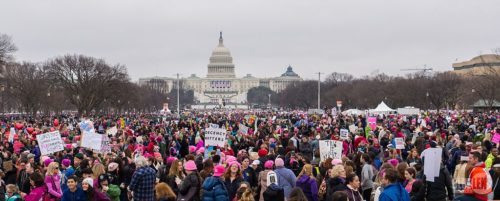
Throughout history, when women have gotten fed up and gotten organized, they have been a powerful force for change.
“They said it couldn’t be done, but they did it.”
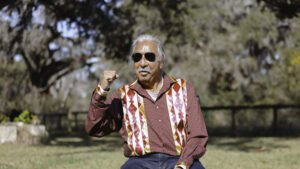
That’s how Charlie Brotman, the longtime announcer dumped from the Inauguration and then embraced by the official Women’s March on Washington, kicked off the historic rally at the nation’s capital on Saturday morning. It was a fittingly inclusive start to the event, which began as a Facebook invitation and evolved into a movement encompassing a multitude of liberal issues and ideals, from ensuring Black Lives Matter to stopping climate change. For better or worse, the grassroots idea became the Uber-Protest following the November 8th U.S. presidential election.
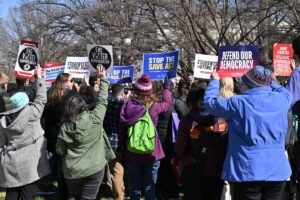
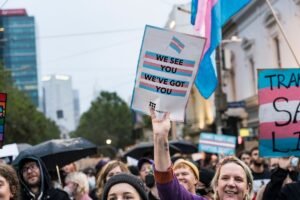
Despite early controversies and later objections that the Women’s March platform was not inclusive enough, the movement put the patriarchy on notice on Saturday, with millions of women and their families gathering in Washington and at solidarity marches across the country and the world. (The New York Times has a great compilation of photos and a map, too; many news outlets, including BuzzFeed, had fun round-ups of the best signs.) From the subzero temperatures of the northernmost march in Barrow, Alaska, to several hundred thousand people in Denver and Chicago, the crowds gathering around the country far surpassed expectations. In many locations, including Washington, D.C., the numbers were too large for actual marching to take place, and additional rallies swept all seven continents.
It was arguably the largest national protest in U.S. history—and remarkably peaceful.
Even as the U.S. press dithered about the counts for the numbers of people in the National Mall on Friday and Saturday, crowd scientists in the UK were making relatively definitive estimates. According to Marcel Altenburg and Keith Still of Manchester Metropolitan University in Britain, there were around 160,000 people on the Mall on Friday right before Trump took the podium at his inauguration, whereas at the march on Saturday at 2 pm, there were at least 470,000 people in the same area. In other words, there were three times as many people just in Washington alone. The university’s estimates are on the conservative side when it comes to the march, as the attendees were more spread out than the inauguration crowd.
Police put the number rallying in L.A. at around a half million, and NYC’s Mayor Bill de Blasio has declared there were 400,000 marchers in New York City. In Chicago, organizers estimated 250,000, and in Boston, officials estimated 175,000. Around a hundred thousand people gathered in Seattle, Denver, and Portland, Oregon. The Guardian reports that “In the UK, between 80,000 and 100,000 people joined the Women’s March on London, and another 14 marches took place in towns and cities including Manchester, Cardiff, Edinburgh, Liverpool, Leeds and Belfast.” Add to that all the smaller marches across the United States and the gatherings around the world, and the participation numbers rise to an estimated 5 million, organizers say.
“It’s been a heart-rending time to be both a woman and an immigrant in this country,” said actress America Ferrara in Washington, one of many celebrities and high-profile activists who spoke, including Gloria Steinem, Angela Davis, and Michael Moore. “A platform of hate and division assumed power yesterday. But the president is not America. His cabinet is not America. Congress is not America. We are America…and we are here to stay. We march today for our families and our neighbors, our future, for the causes we claim and the causes that claim us.”
Prominent nonprofit partners included Planned Parenthood and the Natural Resources Defense Council—which had logos on stage in Washington—and many others. As NPQ reported earlier in January, Cecile Richards, the president of Planned Parenthood hopes the Women’s March has helped create a new, informal coalition of cause.
“Right now, we are facing a government that is putting polluters first and the rest of us at risk,” said Rhea Suh, president of the Natural Resources Defense Council. “It may not seem like we as individuals can do much…but we are not helpless. We are still a democracy! And we should never forget that our country was created by individuals who stood up for what they believed in.”
Sign up for our free newsletters
Subscribe to NPQ's newsletters to have our top stories delivered directly to your inbox.
By signing up, you agree to our privacy policy and terms of use, and to receive messages from NPQ and our partners.
But, in a country with dueling narratives about who has been left behind and what constitutes a “minority,” the stakes are high. As a recent survey showed, while more than 80 percent of women think sexism is a problem, Republican men say it’s a better time to be a woman than a man.
As Jia Tolentino eloquently wrote for the New Yorker, activism is internally contentious by nature, and even more so in today’s social media-drive society.
The march has produced fracture as well as inspiration, evincing the same crises of confidence and solidarity that the march aims to resist, if not resolve. What’s more, the Women’s March has provided a case study in the unlimited potential for critical exhaustion provided by the Internet. It is unfortunate that Facebook is both the best place to reach people and the worst place to conduct political discussion. Imagine any major protest in the twentieth century promoted via Facebook; there would have been no shortage of “infighting” enshrined on social media for everyone to see.
But this is precisely why the Women’s March feels vital. Of course it’s difficult to pull together an enormous group of women who may have nothing in common other than the conviction that a country led by Trump endangers their own freedoms and the freedoms of those they love. That conviction is nonetheless the beginning of the resistance that those planning to attend the march hope to constitute.
For now, organizers have planned for a campaign of 10 large-scale actions during President Trump’s first 100 days in office, including a mass postcard mailing to the White House where women are asked to explain their reasons for marching under the hashtag #WhyIMarch. New actions will be announced every 10 days thereafter. But in the end, there is no need to depend on this single hub. In the same way this massive action came together organically, the dynamic can and should allow for many hubs of activity with strong connecting tissue.
Cecile Richards of Planned Parenthood said in a recent Rolling Stone interview that the “work we have to do together is not about any one election, but about the long haul.”
I will say, I’ve been doing this work a long time, not always at Planned Parenthood but in various progressive organizations. If there is one thing that his election did for the progressive community, it served as an enormous bonding experience. Over the last month, we’ve had meetings of some of the major progressive organizations. Folks recognize that our issues, our organizations and frankly our activists are all connected. Planned Parenthood patients are immigrants, they’re Muslims, they’re LGBT folks, they’re single parents, they’re students. And all of the attacks that folks are anticipating going forward are ones that are already engaging our activists as well. We feel a particular responsibility to stand with those who’ve stood with us as we’ve been under attack these many years.
So, what does it all mean? The press is already taking runs at that question—is this a new Occupy or a kind of Democratic Tea Party—and this is where we part company to suggest that this is just what it seemed: a coming-out for those who are ready to mobilize against some of the directions in which the Trump administration is headed. How that mobilization will occur, how it will grow, in what forms, and with what momentum are hard to say, but if the sheer numbers are any indication, the next five years will not be passive for civil society organizers.
Meanwhile, the new president tweeted out a “Well, why didn’t they vote?” But, of course, many of those on the streets on Saturday did vote and furthermore, they are not silly enough to imagine that that is the only way in which to get things done in a democracy.