logo logo
Fund the truth. #Wethecivic giving banner
Donate
    • Membership
    • Donate
  • Social Justice
    • Racial Justice
    • Climate Justice
    • Disability Justice
    • Economic Justice
    • Food Justice
    • Health Justice
    • Immigration
    • LGBTQ+
  • Civic News
  • Nonprofit Leadership
    • Board Governance
    • Equity-Centered Management
    • Finances
    • Fundraising
    • Human Resources
    • Organizational Culture
    • Philanthropy
    • Power Dynamics
    • Strategic Planning
    • Technology
  • Columns
    • Ask Rhea!
    • Ask a Nonprofit Expert
    • Gathering in Support of Democracy
    • Hope in the Dark
    • Humans of Nonprofits
    • Inside the States
    • In Defense of Civil Society
    • The Myth of Heroic Leadership
    • The New Harvest Project
    • Notes from the Frontlines
    • Notes from the Long Arc
    • Reimagining Philanthropy
    • The Unexpected Value of Volunteers
    • We Stood Up
  • Newsletters
  • NPQ Online Events
    • Premium Webinars
    • Learn Out Loud
    • Partner Events
    • On Demand
  • Leading Edge Membership

UN Investigators Warn of Threats to Right to Protest in the United States

Ruth McCambridge
April 3, 2017
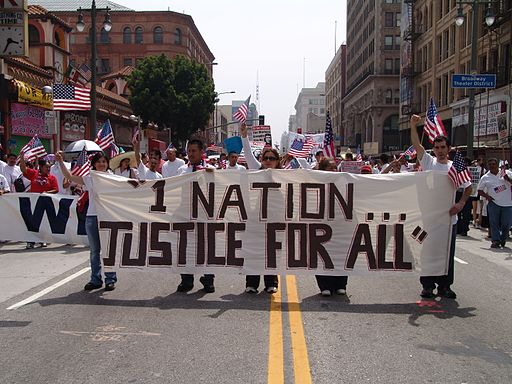
By Jonathan McIntosh (Own work) [CC BY-SA 2.5], via Wikimedia Commons

April 2, 2017; Washington Post

Maina Kiai and David Kaye, independent human rights investigators at the United Nations are warning that, under President Trump, our foundational right to democratic protest is under attack. They point to numerous bills introduced by GOP legislators in 19 states that, taken together, present an “alarming and undemocratic trend.”

What do these measures look like? Here are some examples from the past few months:

  • In a number of states, Republican lawmakers have proposed penalties for demonstrators who block traffic—up to and including one bill in North Dakota that would prevent motorists who run over and kill protestors from being held liable should the crash be deemed accidental.
  • A bill in Indiana would permit the police to use “any means necessary” to remove protestors from the roadway.
  • The Arizona State Senate voted in February to expand racketeering laws to allow police to arrest anyone involved in a protest and seize their assets, treating demonstrators like organized criminals, though the House Speaker has said he “won’t hear the bill,” rendering it essentially dead.
  • Colorado lawmakers have proposed increased penalties for environmental protestors.
  • One bill in Virginia would have increased penalties for anyone who “unlawfully” assembles after “having been lawfully warned to disperse.” (That one was killed in January.)
  • In North Carolina, one lawmaker wants to criminalize heckling political officials.

Kiai and Kaye objected to the language in some of the proposed bills that characterized protests as “unlawful” or “violent.”

There can be no such thing in law as a violent protest. There are violent protesters, who should be dealt with individually and appropriately by law enforcement. One person’s decision to resort to violence does not strip other protesters of their right to freedom of peaceful assembly. This right is not a collective right; it is held by each of us individually.

Sign up for our free newsletters

Subscribe to NPQ's newsletters to have our top stories delivered directly to your inbox.

By signing up, you agree to our privacy policy and terms of use, and to receive messages from NPQ and our partners.

Peaceful assembly is a fundamental right, not a privilege, and the government has no business imposing a general requirement that people get permission before exercising that right.

Meanwhile, federal Judge David J. Hale in Kentucky has refused to throw out a lawsuit against Donald Trump accusing him of inciting violence against protesters at a March 2016 campaign rally in Louisville.

At the rally, Trump repeatedly said “get ’em out of here” before, according to the protesters, they were shoved and punched by his supporters. Trump’s attorneys sought to have the case dismissed on free speech grounds, arguing that he didn’t intend for his supporters to use force. But Hale noted that speech inciting violence is not protected by the First Amendment and ruled that there is plenty of evidence that the protesters’ injuries were a “direct and proximate result” of Trump’s words.

“It is plausible that Trump’s direction to ‘get ’em out of here’ advocated the use of force,” Hale wrote. “It was an order, an instruction, a command.”

—Ruth McCambridge

Our Voices Are Our Power.

Journalism, nonprofits, and multiracial democracy are under attack. At NPQ, we fight back by sharing stories and essential insights from nonprofit leaders and workers—and we pay every contributor.

Can you help us protect nonprofit voices?

Your support keeps truth alive when it matters most.
Every single dollar makes a difference.

Donate now
logo logo logo logo logo
About the author
Ruth McCambridge

Ruth is Editor Emerita of the Nonprofit Quarterly. Her background includes forty-five years of experience in nonprofits, primarily in organizations that mix grassroots community work with policy change. Beginning in the mid-1980s, Ruth spent a decade at the Boston Foundation, developing and implementing capacity building programs and advocating for grantmaking attention to constituent involvement.

More about: Federal GovernmentNonprofit NewsPolicy
See comments

Sidebar-WTC
You might also like
Thousands of Species Wait for Protection as Delays Grow Under Endangered Species Act
Rajeev Tyagi
Community Benefit Agreements: A Tool for Building Stronger Democracies
Sameera Fazili, Pronita Gupta and Doug Bloch
Custodians
Yahia Lababidi
The New Counterterrorism State
Darakshan Raja
When Knowledge Is Not Enough: On Exercising Your Rights
Kim Tran
As Surveillance of Immigrant Communities Expands, How Can Nonprofits Respond?
María Constanza Costa

Upcoming Webinars

Group Created with Sketch.
June 25, 2:00 pm ET

Reframing Organizational Risk

Register
Group Created with Sketch.
July 16, 2:00 pm ET

Readying for the 2026 Midterms

How 501(c)(3)s Can Educate and Advocate During this Election Season

Register

    
You might also like
Close-up of a red wolf lying still on wood chips, head down, gaze turned away from the camera.
Thousands of Species Wait for Protection as Delays Grow...
Rajeev Tyagi
Community members seated at a public meeting, one attendee holding an open notebook and pen on their lap, ready to take notes.
Community Benefit Agreements: A Tool for Building Stronger...
Sameera Fazili, Pronita Gupta and Doug Bloch
A view of The Tomb of David in 1903, taken on film.
Custodians
Yahia Lababidi

Like what you see?

Subscribe to the NPQ newsletter to have our top stories delivered directly to your inbox.

See our newsletters

By signing up, you agree to our privacy policy and terms of use, and to receive messages from NPQ and our partners.

  • About
  • Advertise
  • Careers
  • Contact
  • Copyright
  • Donate
  • Funders
  • Editorial Policy
  • Media Relations
  • Privacy Policy
  • Submissions

We are using cookies to give you the best experience on our website.


Nonprofit Quarterly | Civic News. Empowering Nonprofits. Advancing Justice.
Powered by  GDPR Cookie Compliance
Privacy Overview

This website uses cookies so that we can provide you with the best user experience possible. Cookie information is stored in your browser and performs functions such as recognising you when you return to our website and helping our team to understand which sections of the website you find most interesting and useful.

Strictly Necessary Cookies

Strictly Necessary Cookie should be enabled at all times so that we can save your preferences for cookie settings.