logo logo
giving banner
Donate
    • Membership
    • Donate
  • Social Justice
    • Racial Justice
    • Climate Justice
    • Disability Justice
    • Economic Justice
    • Food Justice
    • Health Justice
    • Immigration
    • LGBTQ+
  • Civic News
  • Nonprofit Leadership
    • Board Governance
    • Equity-Centered Management
    • Finances
    • Fundraising
    • Human Resources
    • Organizational Culture
    • Philanthropy
    • Power Dynamics
    • Strategic Planning
    • Technology
  • Columns
    • Ask Rhea!
    • Ask a Nonprofit Expert
    • Economy Remix
    • Gathering in Support of Democracy
    • Humans of Nonprofits
    • The Impact Algorithm
    • Living the Question
    • Nonprofit Hiring Trends & Tactics
    • Notes from the Frontlines
    • Parables of Earth
    • Re-imagining Philanthropy
    • State of the Movements
    • We Stood Up
    • The Unexpected Value of Volunteers
  • CONTENT TYPES
  • Leading Edge Membership
  • Newsletters
  • Webinars

Crisis in Puerto Rico Reveals Deeper US Political Fissures

Cyndi Suarez
October 17, 2017
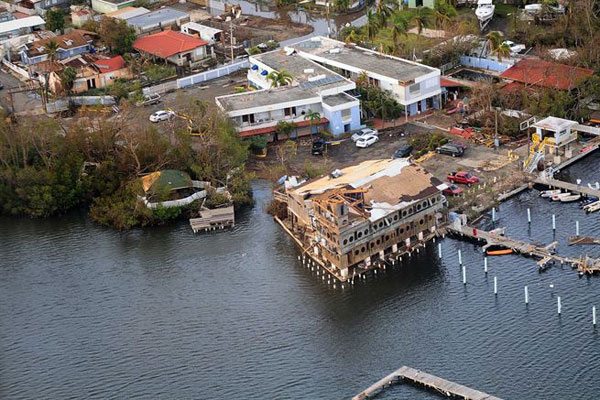
Puerto Rico National guard photo by Sgt. Jose Ahiram Diaz-Ramos.

October 16, 2017; CNN, NPR, and The Hill

It’s less than a month since Hurricane Maria hit Puerto Rico, but Puerto Ricans are already adapting and doing all they can to take care of each other. Adaptation has been hard, and has included making do with substandard or nonexistent basics like food, water, and power; moving stateside; or sending children away to attend school.

One of the many disturbing realities: CNN reported yesterday that people are drinking water from the Dorado Groundwater Contamination Site, a Superfund site that the EPA designated as contaminated with industrial chemicals that can cause damage to the liver and increase the risk of cancer. According to the Associated Press, “Even the island’s own water authority has distributed water from some wells at the Dorado Superfund site.” Puerto Rico, an island 100 miles across and 40 miles north to south, contains 18 Superfund sites, likely the result of the US pharmaceuticals companies that took advantage of tax-free policies and US Navy bombings.

The EPA is asking residents to avoid using the wells in the western portion of the site. Erik Olson, the Health Program Director for the Natural Resources Defense Council in an email to CNN wrote, “It is irresponsible to not make every effort humanly possible to find and provide safe drinking water as soon as possible.” Academi, the private security firm headed by Betsy DeVos’s brother—you may remember it as Blackwater, from when four guards were found guilty in 2007 of the shooting of over 30 Iraqis—has received requests to send employees to the island to protect fuel and water distribution. The New York Post writes that armed mercenaries now roam the streets and local leaders seek to regulate their presence and behavior.

Sign up for our free newsletters

Subscribe to NPQ's newsletters to have our top stories delivered directly to your inbox.

By signing up, you agree to our privacy policy and terms of use, and to receive messages from NPQ and our partners.

According to The Hill, unemployment is close to 100 percent. Since October 4th, less than two weeks ago, 30,000 have left the island. Of 1,113 schools in Puerto Rico, NPR reports that only 200 have reopened. Students have already lost 35 to 40 days of school, according to Julia Keleher, the island’s secretary of education. In many cases, students are traveling stateside, often on their own, and staying with relatives to attend school. In the case of the children covered in this report, it wasn’t the federal government that helped, but the company of the husband of the family taking them in.

US politicians, particularly Democrats, are trying to mobilize those coming to the mainland as potential voters. Meanwhile, Trump begrudgingly provides as little rebuilding support as possible while complaining that he should not have to and blaming Puerto Ricans for being the cause of their own problems, debt, and failing infrastructure. It’s as if the fact that US companies have benefitted from the tax haven and market that is Puerto Rico—if the island were an independent country, it would be the United States’ fifth-largest market—does not figure into the account.

But this is how domination works: a removal from history and a reversal of facts. In spite of high poverty, Puerto Rico has a literacy rate of 94 percent; an island of just over three million awards 50,000 college degrees a year. With 97 percent of these graduates currently unable to find employment on the island, The Hill concludes that what Puerto Rico needs is a business plan that starts at zero—that is, with no debt, from scratch (right now, Puerto Rico’s debt totals $74 billion). By now, we can conclude that this isn’t something that the US federal government or its agencies will support.

In this political leadership vacuum, nonprofits, private companies and individuals are taking the lead. We saw this script play out before with Katrina. At the time, we thought this was an exception to the rule. Now it is beginning to look like the new normal, only this time, unlike with Katrina, the scenario of an absent federal response is playing out without 24-hour coverage. In short, it seems it’s not just Puerto Rico’s infrastructure that is collapsing, but the legitimacy of the US government. We may want to pay attention and learn; one day, this may hit even closer to home.—Cyndi Suarez


Our Voices Are Our Power.

Journalism, nonprofits, and multiracial democracy are under attack. At NPQ, we fight back by sharing stories and essential insights from nonprofit leaders and workers—and we pay every contributor.

Can you help us protect nonprofit voices?

Your support keeps truth alive when it matters most.
Every single dollar makes a difference.

Donate now
logo logo logo logo logo
About the author
Cyndi Suarez

Cyndi Suarez is the former president and editor-in-chief of NPQ (Nonprofit Quarterly). She is author of "The Power Manual: How to Master Complex Power Dynamics", in which she outlines a new theory and practice of liberatory power. Suarez has worked as a strategy and innovation consultant with a focus on networks and platforms for social movements. She has 20 years of experience in the nonprofit sector—in community-based, advocacy, organizing, consulting, infrastructure, and philanthropic organizations. She is passionate about elegant design and designing for power. Her studies were in feminist theory and organizational development for social change.

More about: Climate PolicyNonprofit NewsPolicyPuerto Rico
See comments

You might also like
Can the Fight Against AI Revitalize the US Labor Movement?
Ted Siefer
Social Enterprise: Lessons from Down Under
Vicki Pozzebon
If Farm School NYC Closes, What Will the City Lose?
Farm School NYC and Iris M. Crawford
How to Develop a Community Housing Vision for Puerto Rico
Alison Chopel, Orlando Velázquez Pérez, Belinés Ramos Negrón and Eduardo J. Rodríguez León
The New COVID Vaccine Rules Leave Parents with More Questions Than Answers
Barbara Rodriquez
The Protective Visas That May Never Come
Mel Leonor Barclay

Upcoming Webinars

Group Created with Sketch.
January 29th, 2:00 pm ET

Participatory Decision-making

When & How to Apply Inclusive Decision-making Methods

Register
Group Created with Sketch.
February 26th, 2:00 pm ET

Understanding Reduction in Force (RIF) Law

Clear Guidance for Values-centered Nonprofits

Register

    
You might also like
Senator Elizabeth Warren speaks into a microphone in front of a sign reading "We are the Supermajority" while an audience listens.
Supermajority, Group Organizing Women Around Politics, Is...
Jennifer Gerson
A black and white x-ray image of human lungs.
Can the Fight Against AI Revitalize the US Labor Movement?
Ted Siefer
A red circle overlayed on a yellow background with three multi-colored dots on each side. In the center it reads, " Isaiah Thompson: Staff Picks for 2025"
Staff Picks for 2025: Isaiah Thompson
Isaiah Thompson

Like what you see?

Subscribe to the NPQ newsletter to have our top stories delivered directly to your inbox.

See our newsletters

By signing up, you agree to our privacy policy and terms of use, and to receive messages from NPQ and our partners.

  • About
  • Advertise
  • Careers
  • Contact
  • Copyright
  • Donate
  • Editorial Policy
  • Funders
  • Submissions

We are using cookies to give you the best experience on our website.


Nonprofit Quarterly | Civic News. Empowering Nonprofits. Advancing Justice.
Powered by  GDPR Cookie Compliance
Privacy Overview

This website uses cookies so that we can provide you with the best user experience possible. Cookie information is stored in your browser and performs functions such as recognising you when you return to our website and helping our team to understand which sections of the website you find most interesting and useful.

Strictly Necessary Cookies

Strictly Necessary Cookie should be enabled at all times so that we can save your preferences for cookie settings.