logo logo
giving banner
Donate
    • Membership
    • Donate
  • Social Justice
    • Racial Justice
    • Climate Justice
    • Disability Justice
    • Economic Justice
    • Food Justice
    • Health Justice
    • Immigration
    • LGBTQ+
  • Civic News
  • Nonprofit Leadership
    • Board Governance
    • Equity-Centered Management
    • Finances
    • Fundraising
    • Human Resources
    • Organizational Culture
    • Philanthropy
    • Power Dynamics
    • Strategic Planning
    • Technology
  • Columns
    • Ask Rhea!
    • Ask a Nonprofit Expert
    • Economy Remix
    • Gathering in Support of Democracy
    • Humans of Nonprofits
    • The Impact Algorithm
    • Living the Question
    • Nonprofit Hiring Trends & Tactics
    • Notes from the Frontlines
    • Parables of Earth
    • Re-imagining Philanthropy
    • State of the Movements
    • We Stood Up
    • The Unexpected Value of Volunteers
  • CONTENT TYPES
  • Leading Edge Membership
  • Newsletters
  • Webinars

Well-Known Economic Justice Advocate Outs Himself as THE “Mr. Boston” in Release of Pentagon Papers

Ruth McCambridge
January 30, 2018

January 30, 2018; New Yorker

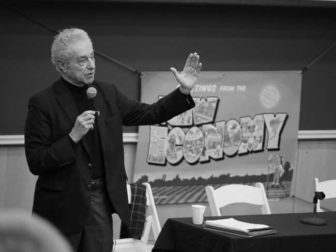
The New Yorker published a story yesterday revealing that Gar Alperovitz was a key member of the Lavender Hill Mob, the loose group of anti-war activists that helped to hide Daniel Ellsberg for three weeks as they released the Pentagon Papers to various news organizations.

The article describes the first meeting between Alperovitz and Ellsberg at a dinner party and the subsequent weeks when the group contacted reporters and delivered documents. While Ellsberg now credits him with “all the cloak and dagger stuff,” Alperovitz, now 81, says the whole endeavor was entirely uncharacteristic of him, but he felt responsible for trying to help stop the war.

I was someone who was trying with many other people to stop this killing. It was a moral issue of the first order.

“I’m a very cautious person,” he comments, “but I didn’t blink—which I don’t understand. I’m surprised I didn’t just say, ‘whoops, I’m busy tomorrow.’ It was out of character.”

Meanwhile, the article describes a made-for-screen series of elaborate handoffs of an estimated 7,000 pages of material, orchestrated by Alperovitz and his colleagues.

The story has been told before, but with the names undisclosed. For example, the initial stages of the handoff of the Pentagon Papers to the Washington Post—now the focus of a motion picture starring Meryl Streep and Tom Hanks—is described here:

The next morning, in the newsroom of the Washington Post, assistant managing editor Ben Bagdikian stepped out of a meeting and was handed a slip of paper. He read the short note:

Sign up for our free newsletters

Subscribe to NPQ's newsletters to have our top stories delivered directly to your inbox.

By signing up, you agree to our privacy policy and terms of use, and to receive messages from NPQ and our partners.

“Call Mr. Boston from a secure phone.”

The name sounded fake. There was a phone number with a 617 area code. Boston. Bagdikian thought he knew what this might be about. He ran out of the building and across the street to a row of pay phones. He dropped in a coin and dialed the number on the note. Someone picked up.

“An old friend has an important message for you,” a man’s voice said. “Give the number of a pay phone where the friend can call in a few minutes.”

The Boston Globe, the less-famous third paper to print the Pentagon Papers, also recently told a similar story:

Then-editor Tom Winship was contacted by someone who identified himself as “Mr. Boston” and offered to provide the documents, wrote Storin, who had just left the paper’s Washington bureau to take up duties as metropolitan editor in Boston. Because Storin had reported from South Vietnam earlier that year, Winship tapped him to join other editors and reporters in an out-of-the-way conference room on another floor of the paper’s Dorchester headquarters.

[Storin added] “Two editors were instructed to stand by phone booths in Cambridge and Newton. The Newton ‘drop’ was the fruitful one, and Tom Ryan, national news editor, walked triumphantly into the Globe with a red plaid zipper suitcase full of Pentagon Papers excerpts.”

Alperovitz has written extensively on the atomic bomb and atomic diplomacy, and he remains a leader among leaders in conceptualizing and helping to spark models of a more pluralistically owned and controlled economy.

As for why he’s coming forward now? He sees the political climate under Trump as very dangerous, as rhetoric with North Korea grows both outrageous and destabilizing, and this moment as one in which it is important to act decisively and with moral certitude because it is the right and necessary thing to do.—Ruth McCambridge


Our Voices Are Our Power.

Journalism, nonprofits, and multiracial democracy are under attack. At NPQ, we fight back by sharing stories and essential insights from nonprofit leaders and workers—and we pay every contributor.

Can you help us protect nonprofit voices?

Your support keeps truth alive when it matters most.
Every single dollar makes a difference.

Donate now
logo logo logo logo logo
About the author
Ruth McCambridge

Ruth is Editor Emerita of the Nonprofit Quarterly. Her background includes forty-five years of experience in nonprofits, primarily in organizations that mix grassroots community work with policy change. Beginning in the mid-1980s, Ruth spent a decade at the Boston Foundation, developing and implementing capacity building programs and advocating for grantmaking attention to constituent involvement.

More about: Nonprofit NewsPolicy
See comments

You might also like
Social Enterprise: Lessons from Down Under
Vicki Pozzebon
If Farm School NYC Closes, What Will the City Lose?
Farm School NYC and Iris M. Crawford
The New COVID Vaccine Rules Leave Parents with More Questions Than Answers
Barbara Rodriquez
The Protective Visas That May Never Come
Mel Leonor Barclay
Moving Beyond a Buzzword: Making “Resilience” Real
Laurie Mazur
Voter Registration Faces Threats Nonprofits Can’t Ignore
Lauren Girardin

Upcoming Webinars

Group Created with Sketch.
January 29th, 2:00 pm ET

Participatory Decision-making

When & How to Apply Inclusive Decision-making Methods

Register
Group Created with Sketch.
February 26th, 2:00 pm ET

Understanding Reduction in Force (RIF) Law

Clear Guidance for Values-centered Nonprofits

Register

    
You might also like
A protest sign reading, “No Business on a dead planet”, emphasizing how the wellbeing of our planet is more important than profit.
Social Enterprise: Lessons from Down Under
Vicki Pozzebon
Participants growing garlic at the Farm School NYC. 2025.
If Farm School NYC Closes, What Will the City Lose?
Farm School NYC and Iris M. Crawford
A gloved hand injecting a child’s arm with a needle vaccine.
The New COVID Vaccine Rules Leave Parents with More...
Barbara Rodriquez

Like what you see?

Subscribe to the NPQ newsletter to have our top stories delivered directly to your inbox.

See our newsletters

By signing up, you agree to our privacy policy and terms of use, and to receive messages from NPQ and our partners.

  • About
  • Advertise
  • Careers
  • Contact
  • Copyright
  • Donate
  • Editorial Policy
  • Funders
  • Submissions

We are using cookies to give you the best experience on our website.


Nonprofit Quarterly | Civic News. Empowering Nonprofits. Advancing Justice.
Powered by  GDPR Cookie Compliance
Privacy Overview

This website uses cookies so that we can provide you with the best user experience possible. Cookie information is stored in your browser and performs functions such as recognising you when you return to our website and helping our team to understand which sections of the website you find most interesting and useful.

Strictly Necessary Cookies

Strictly Necessary Cookie should be enabled at all times so that we can save your preferences for cookie settings.