
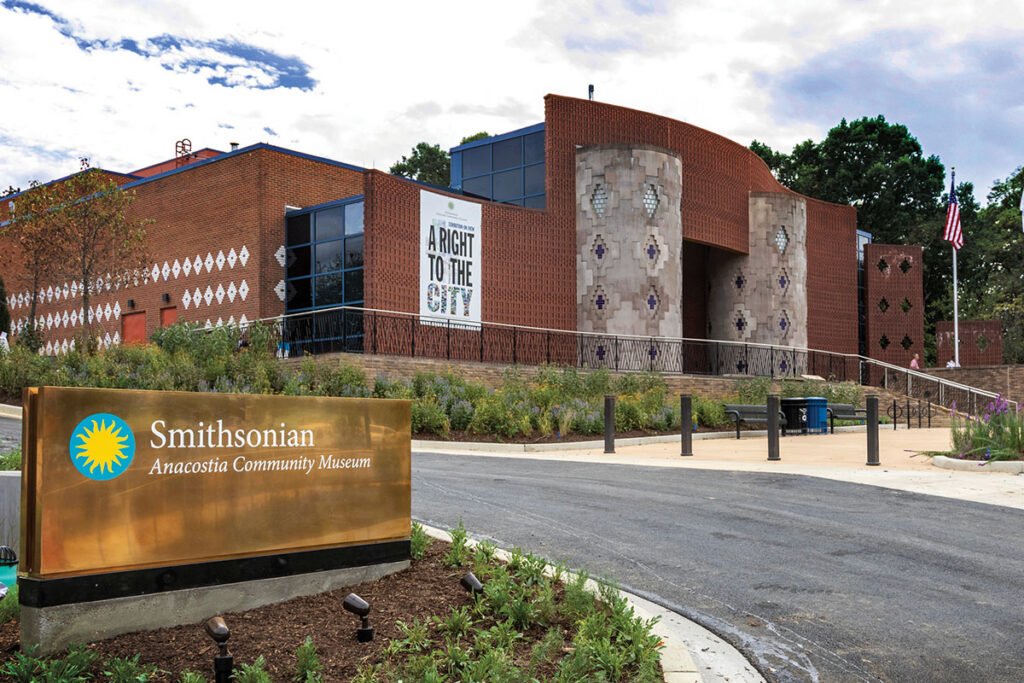
When Katelynd Anderson reflects on the impact of the Anacostia Community Museum, she thinks of the story of Vivian Williams. As a resident of the Arthur Capper public housing project in Capitol Hill, Williams dedicated much of her life to public advocacy and drawing attention to the food access disparities affecting African American neighborhoods in Washington, DC.
Museums offer a transformative opportunity: to document, shape and reshape our knowledge of our own history. But who writes that history?
When the Anacostia Community Museum unveiled its “Food for the People: Eat & Activism in Greater Washington” exhibit in 2022, Williams—then 95—brought three generations of her family to witness it.
“I still enjoy talking about that,” said Anderson, interim director of Smithsonian Institution’s Anacostia Community Museum, in an interview with NPQ. “It’s why we come to work every day. We have these powerful stories of everyday people making change.”
Museums offer a transformative opportunity: to document, shape, and reshape our knowledge of our own history. But who writes that history?
To Homogenize or to Affirm?
In March 2025, the Trump administration issued an executive order—“Restoring Truth and Sanity to American History”—aimed at reviewing national museums in order to “restore truth.” As a result, in 2026, a slavery display at Independence Hall was removed.
While the current administration’s attempts to revise museum history displays are novel in character, attempts to revise museum history are by no means new. In an interview with NPQ, Andrea Burns, a professor of history at Appalachian State University, noted that during the Clinton administration attempts were made to revise the exhibit dedicated to the Enola Gay—the Boeing B-29 Superfortress bomber that dropped the first atomic bomb. The exhibit was scaled back but eventually displayed at the National Air & Space Museum due to criticism from Smithsonian leadership.
When museums foster inclusion, they expand who is represented to reflect the full complexity of our history and the diverse experiences it contains.
“There’s always been difficulty in telling these stories,” Burns said. “The Enola Gay is probably the closest counterpart or example to what’s happening now.” Yet, Burns points out a key distinction that “the Clinton administration did not directly intervene or demand to see exhibit scripts, plans or other Smithsonian records. By contrast, Executive Order 14253, ‘Restoring Truth and Sanity to American History,’ directly interferes with the operations of the Smithsonian in regard to its current and future exhibits.”
Burns added that such White House interventions send a problematic message about the work of museums. If museums are forced to tell a homogenized story, they jeopardize the trust of their local stakeholders—like Vivian Williams—who make the museum vital.
“It’s a slap in the face to historians, to community leaders and organizations, to the very history, to the ancestors of these people. It’s a denial of their history to be replaced with something that is homogenized,” Burns told NPQ. “It sends a signal that these stories are not valuable, that they’re shameful, that they shouldn’t be understood or interpreted by Americans.”
Museums archive the past and affirm our present. When museums foster inclusion, they expand who is represented to reflect the full complexity of our history and the diverse experiences it contains. In doing so, they create a culture of belonging—individual citizens see their own story as core threads in America’s historical tapestry.
Capturing America’s Story
Diminishing the US history of slavery and racial oppression is deeply problematic in that it does a disservice to America’s national achievements. It’s “just not the same story without the backdrop,” Bryan Stevenson, the executive director of the nonprofit Equal Justice Initiative, said in an interview with CNN. “You won’t appreciate the success of the Tuskegee Airmen, the Navajo Code Breakers or other people of color who’ve done great things if you don’t understand the burdens and the barriers and the obstacles they had to overcome.”
On March 31, 2026, Stevenson spoke at the dedication of Montgomery Square, a legacy site in Montgomery, AL, dedicated to memorializing the city as the birth of the US civil rights movement.
“Montgomery has become the city in this country that is doing the most to educate people about the legacy of slavery,” Stevenson said in a press release by the Equal Justice Initiative. “We’ve also come here today…to say to America that we’ve come too far to turn around now.”
Such exhibits are key to offering an accessible entry to history. Hillary Van Dyke, an assistant professor of education at the University of Tampa, is conducting research on Black history in the Tampa Bay region as a part of developing a museum space for Tampa’s Black History Museum. She has been a part of interpreting Black history in the Tampa Bay community since 2016 and has been working with museums since 2021, particularly with the Pinellas County African American History Museum.
“It’s important that museums like this exist and are just easy for people, not just tourists, but even folks that live here to access,” Van Dyke told NPQ in an interview. She added that it is important to allow for “a more accessible way for people to learn Black history in Tampa.”
This is why museums are important: They offer the opportunity to make the unknown known and help us grapple with sensitive parts of our history. And as Burns noted, “this history is under threat right now.”
“We can continue to support museums when they have exhibits,” said Burns. “Even if they may seem to feature sensitive topics, we go out there and support them just by showing up to demonstrate that we care about these subjects, that we will continue to care about these subjects.”
How Communities Can Shape Museum Exhibits
Museums engage in often long, nuanced processes to introduce a new exhibit. According to Jessica Bicknell, director for exhibitions at Penn Museum at the University of Pennsylvania, the process includes an initial proposal, a review by the museum exhibition committee, followed by a “green lighting” process in which the directors and staff determine the feasibility of the project as they move it forward. Following this process, dependent on the exhibit, museums often also reach out to stakeholder communities for feedback.
Soliciting community feedback was an approach taken in developing the Native North American Gallery at Penn Museum. Bicknell noted that their team worked with community consultation as they were developing the exhibition—eight Indigenous consulting curators lead the gallery project in partnership with exhibition staff and in-house curators.
“Co-creation is an important component to the Penn Museum’s ongoing commitment to ethical stewardship and collections practices, letting [the] communities tell their own stories,” Bicknell told NPQ.
In this way, designing museum spaces is as much for history as it is for the community to find themselves. Neville Lee has been designing museum exhibits for more than 30 years, with impressive credits that range from the National Air and Space Museum, to currently, Tampa’s Black History Museum.
Sign up for our free newsletters
Subscribe to NPQ's newsletters to have our top stories delivered directly to your inbox.
By signing up, you agree to our privacy policy and terms of use, and to receive messages from NPQ and our partners.
“You have to engage the community enough to understand what matters to them,” Lee told NPQ. “I can’t interview someone from south St. Pete to tell us about what was their Black experience in Tampa, right? So, we want to make sure that we have conversations with the folks that live within blocks of where this museum is going to be.”
Bicknell, in this same way, noted that the Penn Museum has a community advisory council that provides outside perspectives on museum exhibits. Tia Jackson-Truitt was tasked with creating a community advisory council for Penn Museum when she was hired in 2022. The group includes about 20 community activists, faith leaders, and representatives from city and local government.
“This group advises us on our programming, community engagement initiatives, and provide guidance as we seek to repair our relationships with our neighbors and the broader community,” Jackson-Truitt, director of staff and community engagement, told NPQ. “They’re invited to all of our events. They’re invited to weigh in and provide feedback. Sometimes a subset of that community advisory group is brought in to talk about a specific permanent gallery exhibit or even pop-up exhibits.”
This process, Jackson-Truitt and Bicknell note, is what allows the Penn Museum to engage productively to represent their community and engage with their community. But what happens when the museums’ ability to host exhibits, shaped by the communities they serve, risks being disrupted?
“We’re certainly not a community center, but we want to make sure we are at the center of our community.”
Inclusion Matters in Exhibits and Beyond
In response to the administration’s request for review, Lonnie Bunch, the Smithsonian’s secretary, released an internal memo to staff indicating that they would provide request materials to the White House, even as they held the line at their own independence.
“I take my responsibility to steward the institution on behalf of the American people very seriously,” the letter to staff said, as reported in The New York Times. He added, “Our independence is paramount.”
And that independence matched with a commitment to engage and partner with diverse communities is essential for reflecting the American experience.
Inclusion through a museum doesn’t just occur through exhibits but also through the various programming offered. For Dan Samuels, the director of public programs at the Weitzman National Museum of American Jewish History, this is key in that “keeping a pulse on what you think your community wants is absolutely the name of the game.”
“Public programming at museums is supposed to be a key way museums can respond to things in real time,” Samuels told NPQ. “An exhibition can take months and years to put together.”
Samuels estimates that he manages more than 70 events per year, geared toward representing the history for the American Jewish community and their contemporary living culture.
“We rely on our regulars to make it feel like home, just as much as we rely on ourselves as staff to make it feel like home,” Samuels said. “Feeling like you belong, making someone feel like you’re in a place where you’re included is not just the program content. Obviously, seeing your own family story on the stage and in the exhibitions is part of it. And the quest to represent the diversity of Jewish experiences and opinions is never ending.”
Accessibility is a key aspect of inclusion, and at the Weitzman, Samuels aims to achieve this not just by limiting financial costs but also by offering live streaming. Similarly, Anderson said the Anacostia Community Museum provides buses to Washington, DC, public schools to bring students to the museum at no charge. But even as Anderson works to offer options for students, she also prioritizes the community in trying to serve the needs around the museum.
“We’re certainly not a community center, but we want to make sure we are at the center of our community,” Anderson said.
Nonprofit partnerships help museums to deepen community ties. At Anacostia Community Museum, Anderson works to support community through educational programming—a program called Lifelong Learners, for example, offers a range of learning opportunities—and serving basic community needs, such as acknowledging the Anacostia Community Museum is in a food desert. In response, they’ve turned their awareness into impact by offering a farmers’ market in partnership with Fresh Farm, a nonprofit based in Washington, DC. The market runs from Earth Day to the week before Thanksgiving.
In this way, museum spaces have benefited from partnerships with nonprofits that allow them to serve as a community hub that addresses educational needs in addition to material ones.
The Efforts to Preserve History
On a 2013 visit to the Nagasaki Atomic Bomb Museum in Nagasaki, Japan, I had a good idea of what to expect: sobering narratives of the impact of the atomic bomb, both immediate and longstanding. But it was the details of US military handwringing that I didn’t anticipate. One statement, which has stuck with me for years, details a US military leader making a passionate argument against a second atomic bomb. He argued, “Japan was already defeated and…dropping the bomb was completely unnecessary…our country should avoid shocking world opinion by the use of a weapon whose employment was, I thought, no longer mandatory as a measure to save American lives.” It was signed by Dwight D. Eisenhower.
Regardless of the legislative outcome, the museum’s civic duty remains the same: to serve as a mirror, reflecting not a polished myth but a beautiful, complex, and complete story of who we are.
I’ll admit, I didn’t know that there had been any debate in the military. When I revisited my high school history book, I realized why: it was also never mentioned there. Recognizing the gaps in what we’ve been taught makes clear why preservation must be inclusive, capturing the full spectrum of voices and experiences that shape our shared past.
In just this way, the National Trust for Historic Preservation awarded $3 million in grants to support the preservation of sites that tell the story of Black American activism and resilience. Similarly in Maryland, Governor Wes Moore awarded $5 million to Maryland nonprofit groups to acquire, improve, or build sites that commemorate African American heritage.
Further, the Smithsonian’s National Museum of African Art continues to serve as a beacon for inclusion through its groundbreaking exhibition Here: Pride and Belonging in African Art. Despite nearly a year of delays, this institution has launched the largest exhibition of LGBTQ+ African art in January 2026.
The concern over preservation is also taking a legislative turn. In February 2026, US Rep. Kweisi Mfume (D-Maryland) proposed the creation of a National Council on African American History and Culture within the National Endowment for the Humanities. At time of writing, the bill has been introduced and referred to the House Committee on Education and Workforce.
Regardless of the legislative outcome, the museum’s civic duty remains the same: to serve as a mirror, reflecting not a polished myth but a beautiful, complex, and complete story of who we are.