

This month, meeting in Silicon Valley, the Global Philanthropy Forum hosted its annual convening. Titled “No Bystanders,” the conference amplified the call of former Secretary-General of the United Nations Kofi Annan for all of us to do everything possible to prevent genocide. While various data sets point to the dramatic reduction in the rate of genocides since 1948, when the United Nations Assembly unanimously approved the Genocide Convention, declaring genocide an international crime, the forum’s presenters, most of whom are in the field, emphasized that human rights are in crisis.
The forum launched with an interview of Annan, in which he outlined key events in moving from the “No Bystanders” stance to a more practical application—the acceptance of a new norm—namely a “responsibility to protect”—which asserts that states have an obligation to protect their citizens from mass atrocities. The doctrine further declares that should a state fail to protect its citizens, the international community has the right and responsibility to intervene. What this seeks to do is assert the value of the lives of individual beings over that of any state, known as sovereignty. This is particularly important in a time when, Annan says, “The social contract between governments and the people in many cases has broken down.”
For Annan, this is associated with a fast-changing world where people are not adapting fast enough, and people are losing their jobs and despairing. In other words, the rise in human rights atrocities is related to extreme economic deprivation.
Michael Hardt and Antonio Negri’s new book, Assembly, traces these developments and describes the current reality as one in which there is simultaneously an increase in economic precarity and a decrease in government safety-net protections. Annan notes that this causes lots of anger and fear and tends to foster autocracy and the “squeezing of civil society,” by which he means the trend of governments preventing organizations from receiving donations from outside the country, effectively running them out of business, since it is difficult in many countries to raise money locally.
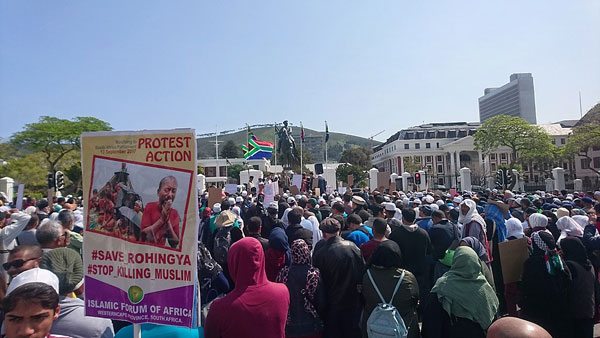
The Rohingya people, an ethnic minority group, are now facing the world’s largest refugee crisis, a combination of extreme economic deprivation and a total breakdown in the group’s relationship with the government of Myanmar, formerly called Burma. The antagonism towards the Rohingya has a long history (NPQ has written about this), but the current crisis began in 2016 with the killing of nine Myanmar border police in Rakhine state, one of the poorest in the Buddhist nation. The area has also, for centuries, been known as Arakan or Rohang to the mostly Muslim Rohingya. Myanmar denies the Rohingya any level of citizenship. It has labeled them external, effectively stateless. They are unable to access basic government services, the economy, or society. As a result, they have lived in dire conditions.
The 2016 attack was blamed on the Rohingya, though they have no known armed faction. In response, a military operation killed at least eight people. The government of Aung San Suu Kyi, which had just taken office, asked Annan to head a commission to heal long-term divisions in Rakhine. At the forum, Annan recalls that Suu Kyi’s mandate was for three recommendations to improve the situation. Annan also recalls that a day after submitting the report in August 2016, the attacks we now know of took place.
It’s interesting, however, that Annan, who has made a career of getting the world to respond to genocides, told the BBC in December 2016, in response to rumors of escalating violence and outright ethnic cleansing and questions of whether we should call what’s happening in Myanmar genocide, “I think there are tensions, there has been fighting, but I wouldn’t put it the way some have done.” The BBC notes that Annan cautioned “observers should be ‘very, very careful’ in using the word genocide.” But why? Are these just the machinations of politics? How does this align with the stance of “No Bystanders”?
Sign up for our free newsletters
Subscribe to NPQ's newsletters to have our top stories delivered directly to your inbox.
By signing up, you agree to our privacy policy and terms of use, and to receive messages from NPQ and our partners.
Granted, that was two years ago, when the crisis was beginning. But he was also a bit measured at the forum this month, saying, “The question is, how do you get them back, and I don’t think they will go back unless they are given a sense of security and here the international community will have to put a sustained pressure on the government of Myanmar, particularly the military. All the humanitarian agencies and NGOs should be allowed to go back and serve as the eyes and ears of the international community. The international community should provide resources to help look after the Rohingya in Bangladesh. I’m worried about the monsoons coming next month, as they have precarious accommodations.” Annan concluded his comments with a call for corporations and NGOs to work with government to address our biggest challenges. But this is strangely apolitical. It fails to acknowledge that sometimes corporate behavior causes the economic precarity that is often the backdrop to governments’ genocidal behavior.
The “Restoring Dignity: The Case of the Rohingya” panel provided a more human perspective on the Rohingya crisis. The title itself speaks to the deep trauma the Rohingya have experienced. On the panel were Muhammad Musa of the Bangladesh-based BRAC, Aerlyn Pfeil of Médecins sans Frontières, and Nirmala Rao of the Asian University for Women. They began by announcing that there is an attack on human rights norms and institutions, and the Rohingya crisis is the worst they had ever seen.
Musa, who was a refugee himself as a child, heads one of the largest development agencies in the world in Bangladesh, where the Rohingya have settled in Cox’s Bazar. Musa said he saw something different in these refugees: There was no hope in their eyes. The horrors visited upon them in Myanmar have destroyed their humanity. Pfeil’s voice was full of emotion as she recalled her experience there as a midwife. When she said, “For the Rohingya women, rape is not the worst thing that has happened to them,” the audience took a collective deep breath. She described a refugee camp unlike any other—in the mountainside, without roads, barely housing about 700,000 people, 900,000 counting prior refugees, in a 3.5-square-mile area. She recounted that before one could offer the Rohingya aid, one had to sit with them for a while and help them connect to being human again in this world. She heard many of them say, “We don’t belong here.” The panel agreed that in designing interventions for the Rohingya, it is imperative that they show care, give hope, and help them regain dignity, which they feel they have lost.
There are now an estimated 40,000 pregnancies resulting from the rapes, as well as diseases with which to contend. It is illegal to terminate pregnancies in Bangladesh, and the women must get special permission from the state, which takes time and can lead to late-stage complications. According to a recent TIME article, nine months after the events of last summer, 60 babies are born every day in the camps. Feliz Solomon writes, “The UN children’s agency, UNICEF, said Wednesday that more than 16,000 Rohingya babies have been born in Bangladesh since the violence broke out in Myanmar’s Rakhine state in August last year.” According to UNICEF, only one out of every five babies in the camp is delivered in a medical facility.
Solomon also notes that the US and the UN Security Council have described the crisis as “ethnic cleansing.” Human Rights organizations are urging the Council to push for an investigation for crimes against humanity, including genocide, at the International Criminal Court. The panel reported that Bangladesh has limited NGO access to Cox’s Bazar to Médecins sans Frontières.
Another panel, titled “Standing Up for Human Rights,” urged us to move from addressing catastrophes to preventing them. Panelist Oren Yakobovich, co-founder and CEO of Videre est Credere, a human rights organization that “wields the latest covert recording technology to expose and subvert violent oppression,” noted that “to prevent catastrophe, we have to be able to recognize it while it is happening.” And it starts with dehumanizing narratives. The next phase is initial violence that receives no response, which gives the perpetrator the green light to continue. All of these happened to the Rohingya in Myanmar.
This is not new. We know that these narratives lead to violence. We just haven’t skilled up and organized ourselves yet to respond at this level and moment. In what are essentially narrative battles, both civil society and nonprofits must step up to the task—and fast! Timing is everything. We see these dehumanizing narratives reemerging in the US, and as Donella Meadows told us and Yakobovich reminds us, paradigms, or the stories we tell ourselves about the world, or that we allow to be told without protest, are the highest leverage point in a system.