
logo logo
giving banner
Donate
    • Membership
    • Donate
  • Social Justice
    • Racial Justice
    • Climate Justice
    • Disability Justice
    • Economic Justice
    • Food Justice
    • Health Justice
    • Immigration
    • LGBTQ+
  • Civic News
  • Nonprofit Leadership
    • Board Governance
    • Equity-Centered Management
    • Finances
    • Fundraising
    • Human Resources
    • Organizational Culture
    • Philanthropy
    • Power Dynamics
    • Strategic Planning
    • Technology
  • Columns
    • Ask Rhea!
    • Ask a Nonprofit Expert
    • Gathering in Support of Democracy
    • Humans of Nonprofits
    • The Impact Algorithm
    • Living the Question
    • Nonprofit Hiring Trends & Tactics
    • Notes from the Frontlines
    • Parables of Earth
    • Reimagining Philanthropy
    • State of the Movements
    • We Stood Up
    • The Unexpected Value of Volunteers
  • CONTENT TYPES
  • Leading Edge Membership
  • Newsletters
  • Webinars

How Nonprofits Use Social Media to Engage with Communities

Aine Creedon
March 13, 2014


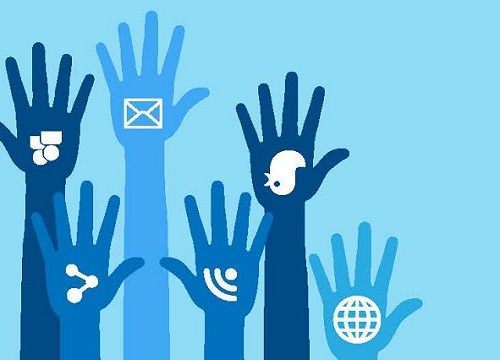
sketch of the hands raised with logos of different social media platforms on the palm. used in an article about social media for nonprofits

A new study from the Case Foundation and social media for nonprofits, based on a survey of almost 500 nonprofits, helps advance the conversation around how nonprofits use social media to engage their communities. What is working and why?


To better understand how nonprofit practitioners integrate social media and online communications into their strategies, the Case Foundation in collaboration with social media for nonprofits, created an informal survey to help advance the conversation around how nonprofits use social media to engage their communities. Close to 500 nonprofit professionals, who are involved with running their organization’s social media and online communications efforts, responded to the survey detailing their own methodologies and practices.

The answers proved to be insightful and revealing. From these responses, we’ve aggregated key takeaways, tips and tools that have proven most effective for them and shared them below. (See full results here, n=480.)

Email & Websites Still Rule: Nonprofits overwhelmingly (88%) said their most important communication tools were email and their websites, even though fully 97% of them are on Facebook. This may have to do with the fact that in their mind, the pinnacle of engagement is a donation (47%). Clearly, simply getting folks to retweet or comment (18% each) is helpful only to the extent it culminates in financial support, which still typically happens through a donate page.

Graphic

More Focus on Social: Just about half our respondents had one or less staffers overseeing their social media efforts, and the remaining half was split between teams using a social media policy to guide their efforts, and those winging it. This is actually more upscale than Social Media Benchmark Study’s finding that most nonprofits only allocate ¼ of one full-timer, so it seems nonprofits are starting to allocate more personnel to their efforts. Yet lack of manpower is still the biggest challenge facing nonprofits, followed by moving beyond the “like” and transcending cute kitty photos.

Sign up for our free newsletters

Subscribe to NPQ's newsletters to have our top stories delivered directly to your inbox.

By signing up, you agree to our privacy policy and terms of use, and to receive messages from NPQ and our partners.


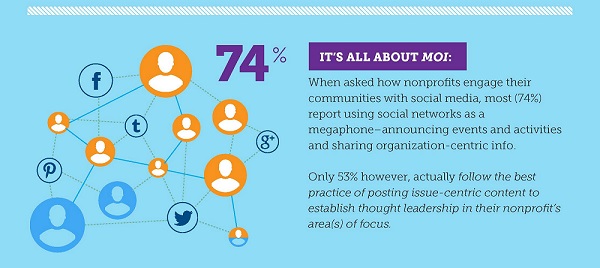
It’s All About Moi: When asked how nonprofits engage their communities with social media, most (74%) use social networks as a megaphone, announcing events and activities and sharing organization-centric info. Only 53% actually follow the best practice of posting issue-centric content to establish thought leadership in their nonprofit’s area(s) of focus. Clearly, the sector still has a long way to go on this front.
Networked

Managing What You Measure: Although Facebook Insights topped our list of the most popular social measurement tools/metric (70%), followed by number of Twitter followers (43%), fully 60% of our audience still believe that there is no benchmark for what an average engagement rate is on Facebook. 22% said 2-4%, but from our personal experience, only the most engaging posts from nonprofits with highly active communities can hope to attract those numbers.

So what does that mean for you and what can you do learn from your peers in the nonprofit space? Check out these four tips aggregated from survey responses:
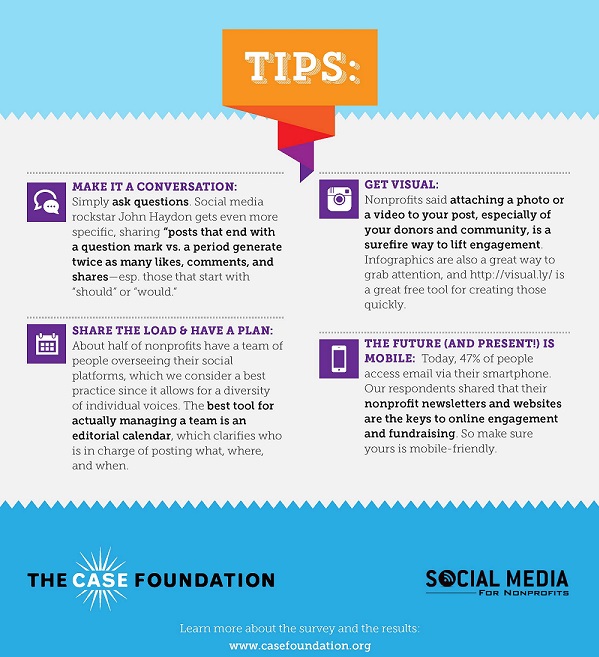
Tips

That does it for some of the big takeaways from our first-ever social media engagement survey. Be sure to check out the companion piece on CaseFoundation.org looking at survey results on engagement through social media and online channels.


Our Voices Are Our Power.

Journalism, nonprofits, and multiracial democracy are under attack. At NPQ, we fight back by sharing stories and essential insights from nonprofit leaders and workers—and we pay every contributor.

Can you help us protect nonprofit voices?

Your support keeps truth alive when it matters most.
Every single dollar makes a difference.

Donate now
logo logo logo logo logo
About the author
Aine Creedon

Aine Creedon is Nonprofit Quarterly's Director of Digital Operations and has worn many hats at NPQ since 2011. She has extensive experience with social media, communications and outreach in the nonprofit sector, and spent two years in Americorps programs serving with a handful of nonprofits across the nation as well as a community organization in Dorchester, Boston. Aine currently resides in Denver, Colorado where she enjoys volunteering, seeing live music, and hiking with her pups Frida and Tucker.

More about: Case StudiesEquity-Centered ManagementSocial MediaTechnology
See comments

You might also like
Using AI for Fundraising Still Requires Human Strategy
Rochelle Jerry
AI in the Nonprofit Sector Is a Question of Governance, Not Just Technology
James A. Lomastro
How the NAACP Is Stopping Dirty Data
Abre’ Conner
Wellbeing Is Infrastructure
Nineequa Blanding
Investing Your Values in the New Age of AI Civil Rights
Whitney Shepard
Data as Destiny in the Steel City
Ana Carolina de Assis Nunes and Cella Sum

Upcoming Webinars

Group Created with Sketch.
April 23, 2:00 pm ET

Receiving & Giving Feedback

Essential Practices for Healthy Organizations and Communities

Register
Group Created with Sketch.
May 14, 2:00 pm ET

Equitable Compensation in Practice

A New Values-Aligned Toolkit & Discussion Guide

Register

    
You might also like
An illustration of a robot hand holding up and supporting a floating human brain.
Using AI for Fundraising Still Requires Human Strategy
Rochelle Jerry
A robot hand reaching slightly downward to touch a human hand, representing the human influence on AI and vise versa.
AI in the Nonprofit Sector Is a Question of Governance, Not...
James A. Lomastro
A composite of a Black man in a field of cut-out roses, but his eyes are covered so he cannot see the roses.
How the NAACP Is Stopping Dirty Data
Abre’ Conner

Like what you see?

Subscribe to the NPQ newsletter to have our top stories delivered directly to your inbox.

See our newsletters

By signing up, you agree to our privacy policy and terms of use, and to receive messages from NPQ and our partners.

  • About
  • Advertise
  • Careers
  • Contact
  • Copyright
  • Donate
  • Editorial Policy
  • Privacy Policy
  • Funders
  • Submissions

We are using cookies to give you the best experience on our website.


Nonprofit Quarterly | Civic News. Empowering Nonprofits. Advancing Justice.
Powered by  GDPR Cookie Compliance
Privacy Overview

This website uses cookies so that we can provide you with the best user experience possible. Cookie information is stored in your browser and performs functions such as recognising you when you return to our website and helping our team to understand which sections of the website you find most interesting and useful.

Strictly Necessary Cookies

Strictly Necessary Cookie should be enabled at all times so that we can save your preferences for cookie settings.