logo logo
Donate
    • Membership
    • Donate
  • Social Justice
    • Racial Justice
    • Climate Justice
    • Disability Justice
    • Economic Justice
    • Food Justice
    • Health Justice
    • Immigration
    • LGBTQ+
  • Civic News
  • Nonprofit Leadership
    • Board Governance
    • Equity-Centered Management
    • Finances
    • Fundraising
    • Human Resources
    • Organizational Culture
    • Philanthropy
    • Power Dynamics
    • Strategic Planning
    • Technology
  • Columns
    • Ask Rhea!
    • Ask a Nonprofit Expert
    • Gathering in Support of Democracy
    • Hope in the Dark
    • Humans of Nonprofits
    • Inside the States
    • In Defense of Civil Society
    • The Myth of Heroic Leadership
    • Notes from the Frontlines
    • Notes from the Long Arc
    • Reimagining Philanthropy
    • The Unexpected Value of Volunteers
    • We Stood Up
  • Newsletters
  • NPQ Online Events
    • Learn Out Loud
    • Leading Edge Webinars
    • Partner Events
    • On Demand
  • Leading Edge Membership

Will Houston after Hurricane Harvey Embrace an Equitable Recovery?

Steve Dubb
August 30, 2018
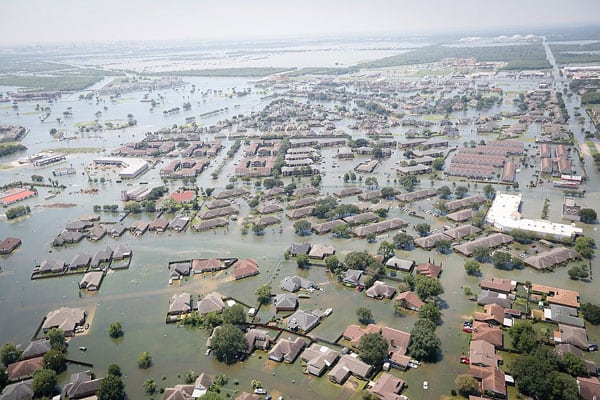
By SC National Guard (170831-Z-AH923-083) [Public domain], via Wikimedia Commons

August 22, 2018; Texas Monthly

On August 25, 2017, Hurricane Harvey made landfall. Harvey, a Category-4 hurricane that dumped over 40 inches of rain in the region, killed 68 people and caused $125 billion in property damage. CNBC adds that, “Thirty-six of the deaths were in the low-lying Houston area, where days of torrential rainfall and decades of unchecked development contributed to the flooding of more than 150,000 homes and 300,000 vehicles.”

Mimi Schwartz writes in Texas Monthly that, “When the rain began easing up a few days later, the only part of downtown that seemed functional was the George R. Brown Convention Center.” Schwartz adds that, “Houston today can sometimes seem like a city struggling with a massive case of PTSD (post-traumatic stress disorder). When heavy rains are forecast…people think twice about getting in their cars.”

Recovery has been slow. Brandon Formby of the Texas Tribune, citing a Kaiser Family Foundation and Episcopal Health Foundation joint report, notes that, “One year after Hurricane Harvey slammed the Texas coast, eight percent of the people impacted by the disaster have not been able to return to their homes [and] 15 percent of the hundreds of thousands of homes damaged by the storm are still unlivable.” Formby adds that report also shows that, “Among black Texans impacted by the storm, 60 percent say they are not getting the help they need. That compares to 40 percent of [Latinx] respondents and 33 percent of white respondents.”

According to Charity Navigator, nonprofits raised “$742.6 million in ‘Harvey restricted’ funds from August 2017 to December 2017.” Chris Matthews of the Houston Business Journal notes that the same report indicated that, “An additional $13.7 million was donated more broadly, for ‘disaster/hurricane’ restricted funding…and $17.7 million was donated to be unrestricted in its use.” While nonprofits have been key players—and a few, notably the local Red Cross, faced criticism when they fell short—the federal government remains the dominant player. According to Adriana Navarro of AccuWeather, federal Harvey relief funds distributed in Texas to date exceed $26 billion—more than 30 times the amount distributed by nonprofits.

The recovery has upended cultural norms, as the federal role is begrudgingly acknowledged. Houstonians have tended to prefer to raise private dollars. “That works great for [capital campaigns for] hospitals and museums, but it doesn’t work for this. You have to have government action. The dollars are too big, the infrastructure issues too boring. No naming rights,” a resident informed Schwartz.

Sign up for our free newsletters

Subscribe to NPQ's newsletters to have our top stories delivered directly to your inbox.

By signing up, you agree to our privacy policy and terms of use, and to receive messages from NPQ and our partners.

Some important steps have been taken. “I think Harvey is the moment that could be the turning point for Houston,” Dale Morris, director of strategic partnerships for Water Institute for the Gulf, a Louisiana-based nonprofit, told Schwartz. “Something has changed.”

Last week, 85 percent of Houston-area voters cast their ballots in favor of a $2.5-billion bond measure to “fund projects that may include buyouts of homes in flood-prone areas, the expansion of local bayous and the construction of additional stormwater detention basins.” For Harris County (population 4.65 million) taxpayers, the cost works out to a modest average of $5 a year per household.

Flood control is one matter; helping those who have been dislocated by the storm get back on their feet is another. Presently, the city is deciding how to allocate $1.15 billion in funds from the US Department of Housing and Urban Development (HUD). Tom McCasland, Houston’s director of housing and community development, “wants residents of poor and working-class neighborhoods…to have a voice in how that money is spent, “says Schwartz. Schwartz adds that McCasland “hopes to put in place land trust programs that will limit who can build in certain neighborhoods and what they can charge for homes there, along with a voucher program that helps poor families live in areas with better schools.”

Preserving affordable housing is critical. As NPQ reported this week, federal disaster aid, in part because it supports homeowners, can widen the gap between haves and have-nots. Indeed, in Harris County itself, when disaster aid was last distributed, the wealth gap between whites and Blacks grew by $87,000 per household. If low-income communities and communities of color are not protected, similar results could be expected this time.

Another challenge is maintaining attention. Disaster recovery, Schwartz notes, takes time, but public attention is often short. “Once the immediate crisis is past, it’s difficult to keep the public invested.” Katie Olse, executive director of the Texas Alliance of Child and Family Services, described this to Governing as the “aftermath of the aftermath.”

As NPQ’s Martin Levine noted last September, “After immediate needs have been met and the sense of crisis is past, the storms’ longer-term effects remain, demanding continued resources and attention.” How Houston will do remains to be seen. “One year later, many of those with the fewest resources are still struggling to bounce back from Harvey’s punch,” cautioned Elena Marks, Episcopal Health Foundation president and CEO.—Steve Dubb


The work isn’t done. Neither is our commitment.

The challenges facing nonprofits aren’t going away. Neither can the journalism that informs, connects, and amplifies the sector.

Help NPQ keep this work free and accessible.

Give Today
logo logo logo logo logo
About the author
Steve Dubb

Steve Dubb is senior editor of economic justice at NPQ, where he writes articles (including NPQ’s Economy Remix column), moderates Remaking the Economy webinars, and works to cultivate voices from the field and help them reach a broader audience. In particular, he is always looking for stories that illustrate ways to build a more just economy—whether from the labor movement or from cooperatives and other forms of solidarity economy organizing—as well as articles that offer thoughtful and incisive critiques of capitalism. Prior to coming to NPQ in 2017, Steve worked with cooperatives and nonprofits for over two decades, including twelve years at The Democracy Collaborative and three years as executive director of NASCO (North American Students of Cooperation). In his work, Steve has authored, co-authored, and edited numerous reports; participated in and facilitated learning cohorts; designed community building strategies; and helped build the field of community wealth building. Most recently, Steve coedited (with Raymond Foxworth) Invisible No More: Voices from Native America (Island Press, 2023). Steve is also the lead author of Building Wealth: The Asset-Based Approach to Solving Social and Economic Problems (Aspen 2005) and coauthor (with Rita Hodges) of The Road Half Traveled: University Engagement at a Crossroads, published by MSU Press in 2012. In 2016, Steve curated and authored Conversations on Community Wealth Building, a collection of interviews of community builders that Steve had conducted over the previous decade.

More about: Disasters and RecoveryHousing JusticeNonprofit NewsPolicy
See comments

Stuffing-1
You might also like
Proposition 40 and the question at the heart of America’s safety net: Who should pay?
María Constanza Costa
Designing durable systems: Lessons from the fight for transitional housing in Georgia
Sharaiyah Williams
American farmers’ politics are more complicated than headlines suggest
Lisa Held
Preserving the body politic against anti-immigration surges on Election Day
Katherine Graham
North Carolina is the canary in the coalmine for attacks on our democracy—and a model for how we fight back
Caitlin Swain and Marcus Bass
After we were seen
Yahia Lababidi

Upcoming Webinars

Group Created with Sketch.
December 3, 2:00 pm ET

After the Midterms

What’s Next for Nonprofits?

Register
Group Created with Sketch.
January 28, 2:00 pm ET

Democratic Staff Structures

Weaving Shared Leadership and Union Practice in Nonprofits

Register
You might also like
A person holding up a protest sign that reads, “Tax the Rich”
Proposition 40 and the question at the heart of America’s...
María Constanza Costa
A group of differently colored bird houses facing different directions.
Designing durable systems: Lessons from the fight for...
Sharaiyah Williams
Two people walk in a farm with their backs to the camera, one person has their hand supporting the other's back.
American farmers’ politics are more complicated than...
Lisa Held

Like what you see?

Subscribe to the NPQ newsletter to have our top stories delivered directly to your inbox.

See our newsletters

By signing up, you agree to our privacy policy and terms of use, and to receive messages from NPQ and our partners.

  • About
  • Advertise
  • Careers
  • Contact
  • Copyright
  • Donate
  • Funders
  • Editorial Policy
  • Media Relations
  • Privacy Policy
  • Submissions

We are using cookies to give you the best experience on our website.


Nonprofit Quarterly | Civic News. Empowering Nonprofits. Advancing Justice.
Powered by  GDPR Cookie Compliance
Privacy Overview

This website uses cookies so that we can provide you with the best user experience possible. Cookie information is stored in your browser and performs functions such as recognising you when you return to our website and helping our team to understand which sections of the website you find most interesting and useful.

Strictly Necessary Cookies

Strictly Necessary Cookie should be enabled at all times so that we can save your preferences for cookie settings.