logo logo
Fund the truth. #Wethecivic giving banner
Donate
    • Membership
    • Donate
  • Social Justice
    • Racial Justice
    • Climate Justice
    • Disability Justice
    • Economic Justice
    • Food Justice
    • Health Justice
    • Immigration
    • LGBTQ+
  • Civic News
  • Nonprofit Leadership
    • Board Governance
    • Equity-Centered Management
    • Finances
    • Fundraising
    • Human Resources
    • Organizational Culture
    • Philanthropy
    • Power Dynamics
    • Strategic Planning
    • Technology
  • Columns
    • Ask Rhea!
    • Ask a Nonprofit Expert
    • Gathering in Support of Democracy
    • Humans of Nonprofits
    • The Impact Algorithm
    • Living the Question
    • Nonprofit Hiring Trends & Tactics
    • Notes from the Frontlines
    • Parables of Earth
    • Reimagining Philanthropy
    • State of the Movements
    • We Stood Up
    • The Unexpected Value of Volunteers
  • Newsletters
  • NPQ Online Events
    • Premium Webinars
    • Learn Out Loud
    • Partner Events
    • On Demand
  • Leading Edge Membership

Why Nonprofits Need to Center Human Rights in Our Work

Cyndi Suarez
December 13, 2018
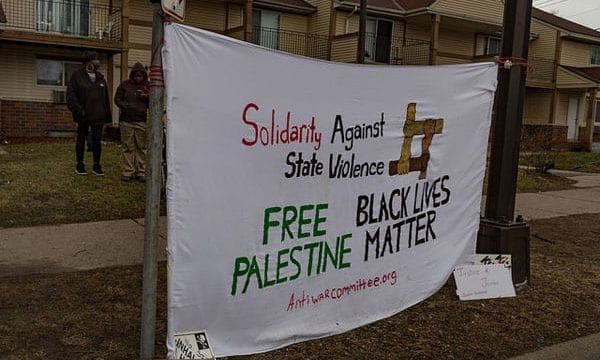
“Jamar Clark Community Gathering,” Tony Webster

December 9, 2018; Nation

In a time when the disparities in basic human treatment differ both predictably and wildly according to race, as well as many other social assignments, it is important to pay attention to the case of Dr. Marc Lamont Hill.

Dr. Lamont Hill, a Temple University professor, was recently fired from his contributor post at CNN for a speech he gave at the United Nations on November 28th where he criticized Israel’s “policies of oppression against Palestinians in the context of international law,” as Phyllis Bennis and Rev. Dr. William J. Barber write in the Nation.

The context for Dr. Lamont Hill’s speech is the UN’s 70th anniversary of “both the Universal Declaration of Human Rights and the Palestinian experience of the nabka, or catastrophe, of 1948—when 750,000 Palestinians were displaced from their homes, expelled from their land, and dispossessed of their country with the creation of the state of Israel.” One would have to do serious verbal contortionism to not talk about the human rights violation against the Palestinians in this context.

Bennis and Barber continue,

Hill depicted how the Palestinians, during that experience and since, have continued to be denied the very rights—political, civil, economic, social, and cultural rights—supposedly guaranteed to every human being in the Universal Declaration.

Sign up for our free newsletters

Subscribe to NPQ's newsletters to have our top stories delivered directly to your inbox.

By signing up, you agree to our privacy policy and terms of use, and to receive messages from NPQ and our partners.

They argue, “Dr. Hill’s comments were not anti-Semitic; they are anti-oppression.”

As we like to say in the hood, “Don’t get it twisted.” But twisting it is what it’s all about nowadays.

Israel passed a new nation-state law earlier this year declaring Israel an ethno-state for Jewish people, “which asserts that while more than 20 percent of Israeli citizens are Palestinian Christians and Muslims, ‘the right to exercise national self-determination in the State of Israel is unique to Jewish people.’”

Black people have long recognized our shared plight with Palestinians, as secondary citizens. The Washington Post’s Noura Erakat writes, “An overwhelming majority of [UN General Assembly] states, constituting the self-described Third World, considered Palestinian liberation as central to its agenda for challenging Western dominance and establishing a new international order.”

The Movement for Black Lives platform for the advancement of black freedom globally establishes solidarity with Palestinians and calls for Boycott, Divestment, and Sanctions. Erakat notes the backlash against BLM, “BLM member groups understood the backlash as an attempt to dictate the scope and vision of black freedom.”

Human rights have been overlooked by our sector as an important anchor for our work. It’s a strong attractor, but we don’t use it. Dr. Hill’s assertion that state rights do not precede human rights is right on and needs to be taken up by civil society to ensure that no spurious arguments that violate human rights are entertained as legitimate. Take note, because white nationalists in the US want a white ethno-state. It’s time to embrace human rights as foundational to nonprofits, as they have been for social movements, before it’s too late.—Cyndi Suarez


Our Voices Are Our Power.

Journalism, nonprofits, and multiracial democracy are under attack. At NPQ, we fight back by sharing stories and essential insights from nonprofit leaders and workers—and we pay every contributor.

Can you help us protect nonprofit voices?

Your support keeps truth alive when it matters most.
Every single dollar makes a difference.

Donate now
logo logo logo logo logo
About the author
Cyndi Suarez

Cyndi Suarez is the former president and editor-in-chief of NPQ (Nonprofit Quarterly). She is author of "The Power Manual: How to Master Complex Power Dynamics", in which she outlines a new theory and practice of liberatory power. Suarez has worked as a strategy and innovation consultant with a focus on networks and platforms for social movements. She has 20 years of experience in the nonprofit sector—in community-based, advocacy, organizing, consulting, infrastructure, and philanthropic organizations. She is passionate about elegant design and designing for power. Her studies were in feminist theory and organizational development for social change.

More about: Case StudiesDemocratic Practices (Economic Justice)Human RightsNonprofit News
See comments

Sidebar-WTC
You might also like
IDR Interviews | Flavia Agnes
Smarinita Shetty and Joeanna Rebello Fernandes
The First Indigenous Women in Congress Carry a Legacy Older Than American Democracy Itself
Errin Haines
The Yeses that Surprise You: Organizing Across the Lines of Cis and Trans
Jess St. Louis
If Solidarity Is Possible, So Is a Pro-Trans Majority
Jess St. Louis
Right in Our Backyard: Community-Based Organizations and the Potential to Build a New Democracy
Emily Blank
Democracy Dies in the Homeowners Association
Coty Poynter

Upcoming Webinars

Group Created with Sketch.
June 25, 2:00 pm ET

Reframing Organizational Risk

Register
Group Created with Sketch.
July 16, 2:00 pm ET

Readying for the 2026 Midterms

How 501(c)(3)s Can Educate and Advocate During this Election Season

Register

    
You might also like
Illustration of Flavia Agnes
IDR Interviews | Flavia Agnes
Smarinita Shetty and Joeanna Rebello Fernandes
A Black and white collage of Sharice Davids and Deb Haaland speaking and waving, layered over purple and tan graphic shapes.
The First Indigenous Women in Congress Carry a Legacy Older...
Errin Haines
A digital illustration of a blue hand with glitter nails and "YES" written across the fingers, holding a crystal ball filled with a crowd of people, surrounded by pink, yellow, and blue clouds.
The Yeses that Surprise You: Organizing Across the Lines of...
Jess St. Louis

Like what you see?

Subscribe to the NPQ newsletter to have our top stories delivered directly to your inbox.

See our newsletters

By signing up, you agree to our privacy policy and terms of use, and to receive messages from NPQ and our partners.

  • About
  • Advertise
  • Careers
  • Contact
  • Copyright
  • Donate
  • Editorial Policy
  • Funders
  • Media Relations
  • Privacy Policy
  • Submissions

We are using cookies to give you the best experience on our website.


Nonprofit Quarterly | Civic News. Empowering Nonprofits. Advancing Justice.
Powered by  GDPR Cookie Compliance
Privacy Overview

This website uses cookies so that we can provide you with the best user experience possible. Cookie information is stored in your browser and performs functions such as recognising you when you return to our website and helping our team to understand which sections of the website you find most interesting and useful.

Strictly Necessary Cookies

Strictly Necessary Cookie should be enabled at all times so that we can save your preferences for cookie settings.