

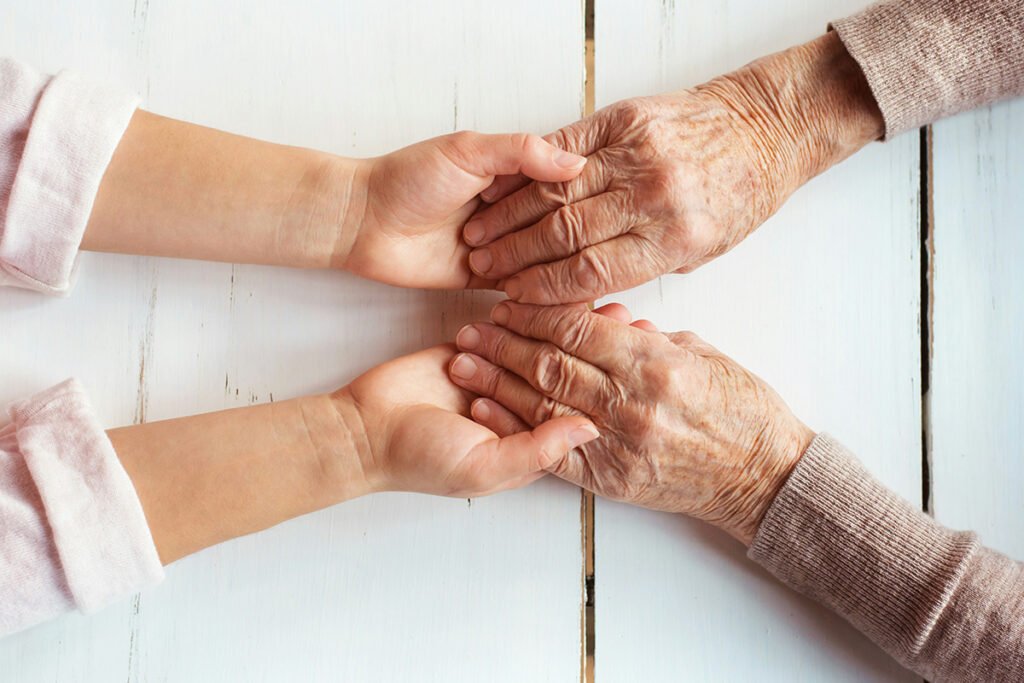
Across the United States, millions of grandparents are serving as primary caregivers for their grandchildren, often without adequate financial or social support.
There is a quiet narrative that has taken hold in our society. It shows up in policy conversations, in funding decisions, and how systems are designed. It suggests that elders are a growing burden on healthcare, on housing, on families, and on the economy itself. This framing is repeated so often that it begins to sound like fact. But it is not the truth. It is merely a reflection of how our systems have been structured, not an expression of who elders are or the role they’ve always held.
Many of our current systems were never designed with elders in mind. We design policies that treat our elders primarily as dependents. We create housing that isolates rather than connects. We build systems that prioritize efficiency, cost, and speed, while overlooking the relational roles that sustain real community life. When elders struggle under these conditions, it is an indicator of a structural failure. Yet the typical response is to frame these challenges as an individual problem caused by aging, which is simply not accurate.
Across the United States, millions of grandparents are serving as primary caregivers for their grandchildren, often without adequate financial or social support. In my work with elders and families through Grandmothers’ Village Project, Inc., I’ve seen firsthand the power elders carry and the systems of support they create. I’ve seen grandmothers raising grandchildren with limited resources—holding entire families together without recognition or support. I’ve seen elders who continue to function independently—offering guidance, stability, and care—long after systems have written them off as dependents. I’ve seen people who are still carrying, still giving, still holding, even as the structures around them fail to hold and nurture them in return. Elders are not a strain on our communities. They are the infrastructure that upholds and sustains them.
When the foundation of a community is weakened, the entire structure feels it.
Systemic Failures and the Erosion of Social Connection
Long before formal systems existed, elders carried knowledge, resolved conflict, raised children, and held communities together through hardship and change. That reality has not disappeared. It has simply become less visible within the frameworks we use to define value. Today, elders continue this work in quiet and often unrecognized ways. They continue to care for grandchildren, support extended families, preserve cultural knowledge, and maintain the relational fabric that no formal system can replicate. And yet, we have built societal systems that depend on this labor while failing to acknowledge or resource it.
Elders are not a strain on our communities. They are the infrastructure that upholds and sustains them.
These systems were designed around narrow definitions—of independence, productivity, and value—that do not include the contributions of elders. This limitation often leads to elders being excluded rather than integrated into systemic design. The result is not only isolation, but also a quiet destabilization of the communities these systems are meant to support.
We can see this most clearly in the everyday realities that rarely make it into policy conversations. Grandparents raising grandchildren on limited income. Elders stretching food benefits to cover more than just themselves. Older adults facing increasing levels of social isolation, with studies linking loneliness to serious health risks. These are not isolated situations. They are indicators of a broader misalignment in how we understand and support community life.
Sign up for our free newsletters
Subscribe to NPQ's newsletters to have our top stories delivered directly to your inbox.
By signing up, you agree to our privacy policy and terms of use, and to receive messages from NPQ and our partners.
When elders are separated from daily life, when their presence is reduced to appointments and check-ins, something essential is lost. The community members who once served as anchors end up living disconnected from the very relationships they helped build. That loss does not show up neatly in data points or funding reports, but it is felt in families, in neighborhoods, and in the erosion of social connection.
Investing in Elders Is Foundational for Community Resilience
To understand elders as infrastructure is to recognize that they are not extraneous, something to be accommodated, but a central element that needs to be integrated. Just as we would not design a city without roads or water systems, we should not design communities without fully considering the role of elders. Their presence strengthens social cohesion, supports intergenerational learning, and provides continuity and stability that no institution can replicate. When we invest in elders, we are not only supporting individuals, we are also reinforcing the resilience and stability of entire communities.
Fortunately, this kind of approach is already beginning to take shape in community-based models that center elders as integral to daily life. One example is the work of Grandmothers’ Village Project, Inc., including the development of Wisdom Tree Village—an ecosustainable, elder-centered community designed to restore connection, dignity, and intergenerational living. The intention is not simply to house elders, but to reestablish their rightful place within the fabric of community life, where their presence is not peripheral but central to society.
To understand elders as infrastructure is to recognize that they are not extraneous, something to be accommodated, but a central element that needs to be integrated.
When elders are positioned at the center rather than the margins, the narrative begins to change. They are no longer seen as people to be managed or accommodated, but as essential contributors to the health and continuity of community life. And when the center is strong, everything around it has a greater chance to thrive.
To achieve this requires a shift in how philanthropy, policy, and community planning approach the question of elder support. It asks us to move beyond seeing elder care as a cost and instead understand it as a foundational investment. It asks us to design housing that invites connection rather than isolation, to create shared spaces where elders can participate fully in community life, and to ensure access to nourishing food, culturally relevant resources, and opportunities for continued engagement. It also asks us to listen, not in a symbolic way, but in a structural way, by including elders as decision-makers, knowledge holders, and leaders in shaping the communities they have long sustained.
What is needed now is not more acknowledgment, but a realignment of priorities. We must begin to invest in community-based approaches that recognize relational labor, ensuring that elders are resourced in ways that reflect the value they already provide. When we recognize elders as infrastructure, our decisions begin to reflect that truth. And in doing so, we do not simply improve the lives of elders, we strengthen the very systems we all depend on.