
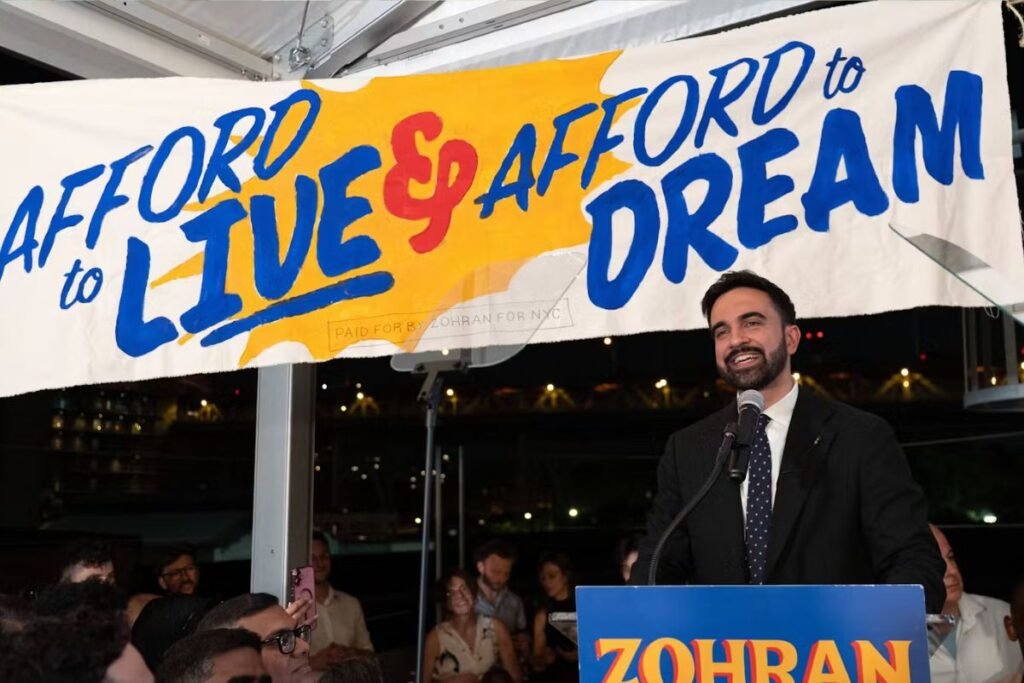
The election of Zohran Mamdani as the 111th mayor of the city of New York is a remarkable event, no matter how one looks at it. His election represents many “firsts.” Mamdani will be the city’s first Muslim mayor and its first avowedly democratic socialist mayor. Mamdani’s campaign has brought a focus on class, long ignored in US electoral politics, back into the mainstream. And, at age 34, Mamdani will be the city’s youngest mayor in over a century.
Mamdani’s campaign activated a younger generation….Now the challenge is to keep youth engaged and to lead across generations.
Across the country, a generational change in leadership is underway. Over time, this will change who is elected to leadership as well as who leads nonprofits. Prominent examples of younger federal politicians emerging in recent years include Rep. Alexandria Ocasio-Cortez (D-NY) and Rep. Maxwell Frost (D-FL). At the local government level, David Holt, Republican mayor of Oklahoma City, became the city’s youngest mayor in nearly a century when he was first elected to office in 2018.
But younger leaders often face considerable resistance. One telling indicator of this: In 2025, the average age of a member of Congress is 58.9 years, the third-highest level ever.
To move from campaign to governing, Mamdani and his team will have to negotiate many tensions. Age is perhaps an underappreciated challenge for Mamdani; it is also an underappreciated opportunity. There is little doubt that Mamdani’s campaign activated a younger generation that is often mistakenly seen as disengaged. Now the challenge is to keep the youth engaged and to lead across generations.
The Challenge of Young Leadership
When it comes to executive leadership, it’s clear that the success of young elected officials and nonprofit leaders depends critically on the support and engagement of a diverse team, including advisors and staff who vary in age, experience, and perspective.
The need for intergenerational governance—by which we mean where people from different generations are meaningfully included and empowered to make collective decisions—is critical, not only for resolving policy conflicts, but also because it taps into people’s unique experiences and expertise.
The conditions for successful intergenerational governance are not just goodwill but also enabling civic leaders to work across lines of difference, including generational difference. Experiential civics education is foundational to preparing young people to engage in community life and public service, providing them with the knowledge and tools to analyze complex issues and effectively build consensus. For young leaders to succeed, this preparation is essential for intergenerational governance as it pertains to public as well as private institutions.
For example, The California Endowment, a health equity grantmaking organization where author Karthick Ramakrishnan formerly served on the board, committed to having at least two board members under the age of 25 to make sure that the youth voice was at the board table. But shifting practice required more than that.
Experience is something that can be assembled in an intergenerational team. Younger leaders can tap into a diverse range of institutional experts.
The board also worked to shift its mindset, from worrying about whether young people would be “board ready,” to focusing instead on ways to change policies and norms to make the board more “youth ready.” This, in turn, led to improved board governance by introducing new practices for deliberation, learning, and collective problem-solving.
Sign up for our free newsletters
Subscribe to NPQ's newsletters to have our top stories delivered directly to your inbox.
By signing up, you agree to our privacy policy and terms of use, and to receive messages from NPQ and our partners.
Mamdani’s Challenge
It is undeniable that candidates for executive positions benefit from a track record of leadership; there are important lessons to be gained not only from a history of accomplishments but also from the battle scars of failure. This is especially true for high-stakes positions like the mayor of New York City or the executive director of a major nonprofit.
At the same time, there are other leadership qualities that don’t necessarily correlate with age or experience, such as being able to listen and adapt, to show up authentically in a variety of settings, and to provide a compelling vision for the future with a feasible roadmap to get there. Indeed, decision-makers such as voters or governing boards may decide that these other qualities outweigh the importance of experience, either because of the urgency of the moment or because alternative candidates with more experience have underperformed or have shown serious lapses of judgment.
Moreover, experience is something that can be assembled in an intergenerational team. Younger leaders can tap into a diverse range of institutional experts by recruiting seasoned advisors and partners. For example, Barack Obama leaned on Joe Biden’s expertise in the US Senate and Nancy Pelosi’s long-standing leadership in the US House of Representatives to pass the Affordable Care Act, a landmark legislative achievement in healthcare reform.
Recent reports indicate that the Mamdani team is considering a similar strategy, of relying on experienced hands in such key roles to instill confidence and enable effective administration early in his term. For while Mamdani has won the election, winning the challenge of governance remains in the future.
Mamdani’s election represents a potential breakthrough moment…in how people might view the possibilities for intergenerational governance.
Building the Bench
Mamdani’s win in New York City is inspiring, but it is also far too rare. The challenge is apparent in international statistics, where countries like Mexico have legislators who are, on average, nearly 10 years younger than their US counterparts.
There are tools that can build the bench over time and that can maintain the activation of young people in any campaign that has inspired them. For instance, Generation Citizen, a nonprofit that author Elizabeth Clay Roy directs, partners with school districts nationwide to engage middle and high schoolers in community-based civics: learning civics by solving real problems in their communities. They also work with the youth activism organization DoSomething and the Lincoln Center for the Performing Arts to host teens from across New York City to explore the intersection of art and civic engagement through the Future250 initiative. There are also inspiring examples from across the world, as examples from the Intergenerational Fairness Collaboratory and California 100 demonstrate.
Mamdani’s election represents a potential breakthrough moment, not only in terms of how people view the political agency of younger leaders, but in how people might view the possibilities for intergenerational governance in the United States. The playbook to retain that spirit and realize its full potential already exists. Four themes are central:
- Composition. Recruit young people to existing fiduciary and nonfiduciary boards, commissions, and committees for municipalities and nonprofits, particularly those that go beyond youth programs and instead guide policy, evaluation, and resource allocation across a range of issue areas. Ideally, at least two seats can be formally set aside for young people to avoid tokenism and anticipate political fluctuations that could jeopardize inclusion strategies.
- Governance. Address the intrinsic limitations of existing structures and processes that benefit from the expertise of new voices. This means shifting from a mindset of making young people “leadership ready” to making institutions better prepared to engage the leadership of multiple generations. Intergenerational governance also often requires innovative approaches to learning and engagement that can generate new ideas and solutions. Participatory budgeting, which has already been successfully tested in New York City, and other innovations from abroad can be adapted to local contexts in the United States, meaningfully incorporating not just youth voices but true intergenerational expertise.
- Infrastructure. One of the biggest pitfalls of well-intentioned inclusion programs is an assumption that a seat at the table is sufficient. Creating accessible opportunities to learn about the technical dimensions of traditional governance structures, augmented with problem-solving and consensus-building skills through civic learning, can activate the unique contributions of young people.
- Arts, culture, and entertainment can no longer be thought of as extracurricular. They are the dominant means of communication, connection, and change. Examples from around the world show that this is how to increase and sustain engagement—and encourage critical input for responsive governance.
The election of Mamdani as mayor in New York City proved beyond a doubt that young people want to be engaged. “People were excited to have someone at the door that cared about their city,” said one field organizer to NPQ this past summer after the primary campaign. Now comes the challenging part—on one hand, Mamdani will need to build coalitions across age groups; on the other hand, he has the opportunity to maintain youth engagement past the election.
Mamdani is the latest of a generation of young leaders charting a new path for political engagement, bringing vision and hope amid voter discontent over the status quo. To move from inspirational campaigns to effective governance, the mayor’s office will need to lean more strongly into youth civic engagement and intergenerational governance. In doing so, the Mamdani administration can provide fresh momentum to innovations already underway across the country—and inspire those yet to come.