A leading cause of maternal and infant illness and death, preeclampsia, occurs in five to eight percent of US pregnancies. This translates to roughly one in every 10-20 pregnancies experience, “a life-threatening hypertensive disorder unique to pregnancy and the postpartum period,” as described by The Preeclampsia Foundation. “It affects both the mother and the unborn baby, typically developing after the 20th week of pregnancy.”
According to a study by the Journal of the American Heart Association, incidences of hypertensive disorders, such as preeclampsia, doubled in the US from 2007 to 2019, yet public awareness and an understanding of the warning signs of this serious pregnancy complication are limited.
A leading cause of maternal and infant illness and death, preeclampsia, occurs in 5 to 8 percent of US pregnancies. This translates to roughly 1 in every 10-20 pregnancies…
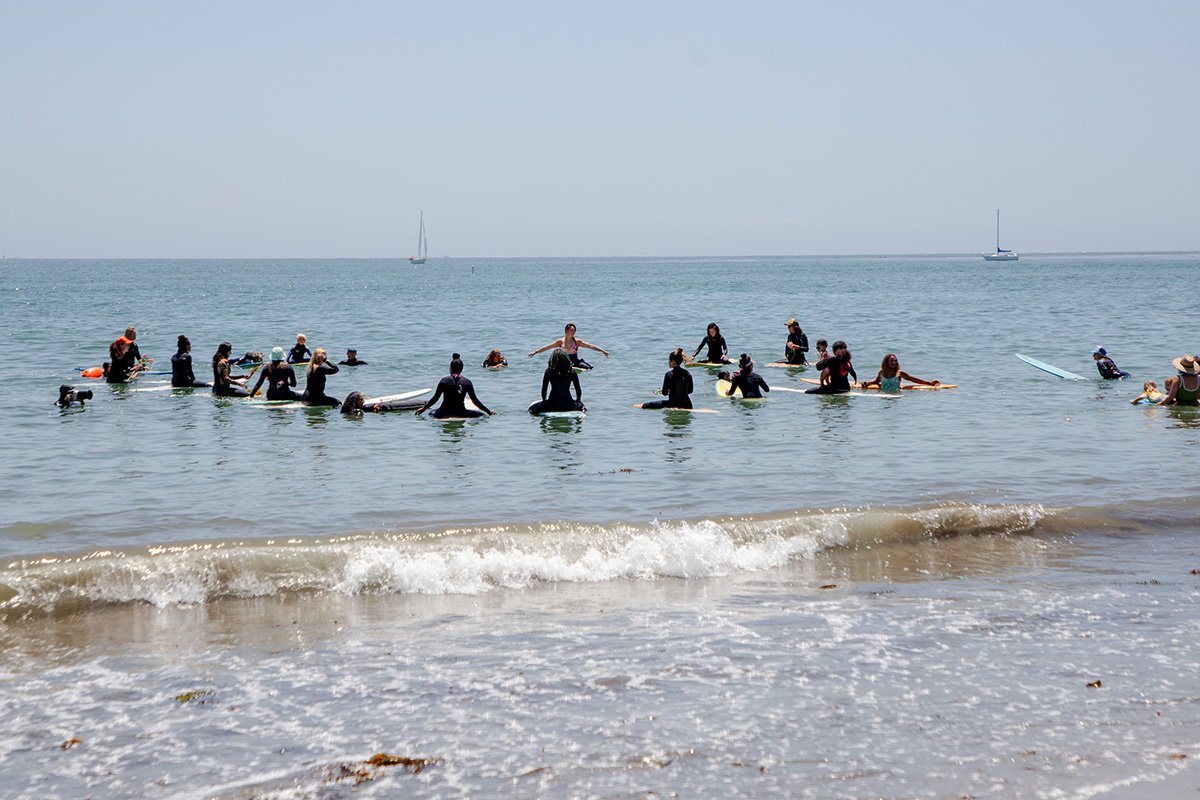
To help raise awareness, Chelsea Woody, a registered nurse, surfer and three-time preeclampsia survivor, partnered with the Preeclampsia Foundation to host a special Paddle Out event, where dozens of surfers—many of them mothers—gathered at Cowell Beach in Santa Cruz.
A Moment of Healing, Release, and Connection
“Having an outlet like surfing was important to me,” said Woody, in an interview with NPQ. “It helped me survive my pregnancy.”
The water was calm. Participants were given pink flowers and asked to think of someone in their life who has been affected by preeclampsia. They made a circle in the water and floated together, making space for their complex emotions toward this common but often misunderstood pregnancy complication that can be life-threatening.
They then released the flowers into the ocean.

“Having an outlet like surfing was important to me…It helped me survive my pregnancy.”“I’ve spent years feeling like my experience was somewhat unique and isolating,” Jody Wilfong, founder of Surf Therapy Santa Cruz who experienced preeclampsia with all three of her pregnancies, told NPQ. She led a grounding ceremony before the paddle out.
“Before this event, I had never met another surfer who had gone through preeclampsia,” she said, “let alone connected with a community of people who truly understood the challenges and impact it can have on your life.”
“Metaphorically, it’s meaningful,” said Dr. Sara Johnson in an interview with NPQ. Johnson is an OB/GYN, surfer, and fellow pre-eclampsia survivor who spoke at the event. She is working with March of Dimes on an initiative called “Low Dose, Big Benefits” to promote the successful use of low-dose aspirin to help pregnant individuals at risk for preeclampsia.
“Babies are floating in salt water in your belly,” she explained. “So it’s cool to be held in that way by the ocean.”

Many high-profile celebrities have shared their experiences with preeclampsia, including Beyonce, Kim Kardashian, Megan Markle and five-time Track and Field Olympian, Allison Feliz.
Anyone can experience it—rates of preeclampsia are seen across every racial and ethnic background: Black women account for seven percent of pregnancies who experience this complication; 4.7 percent among Latinx women; 4.3 percent among White women; and 2.9 percent among Asian and Pacific Islander women.
Women Experiencing Preeclampsia
Black women are disproportionately affected due to a combination of factors such as systemic racism, chronic stress, health care inequities, and a higher prevalence of cardiovascular risk factors, explains Woody, who is Black and Asian.
According to the Preeclampsia Foundation, the preeclampsia rate is than White women, and Black women are more likely to develop severe preeclampsia.
And anyone can experience it—rates of preeclampsia are seen across every racial and ethnic background: Black women account for seven percent of pregnancies who experience this complication; 4.7 percent among Latinx women; 4.3 percent among White women; and 2.9 percent among Asian and Pacific Islander women.
The exact cause of preeclampsia is not fully understood as many healthy people who have no known risk factors develop it. While most people are able to be monitored, deliver healthy babies and recover, it’s important to be aware of warning signs, because the condition can develop into a medical emergency very quickly.
Symptoms can continue or worsen even after childbirth—which is what happened to Woody.
“I’m a nurse, and I know how to navigate the healthcare system,” said Woody, who monitored her own blood pressure, caught her symptoms early and pushed to be admitted to the hospital. “But many women don’t know until they’re deep in the middle of a crisis.”
Symptoms of Preeclampsia
Wilfong shared that the first time she experienced preeclampsia at 24, she remembers blacking out and having what felt like an out-of-body experience. Her blood pressure had skyrocketed to 220/110. For comparison, a normal blood pressure is below 120/80.
“The medical team immediately started me on a magnesium sulfate drip to bring my blood pressure down and prevent seizures, but at the time I didn’t fully understand the seriousness of what was happening,” she said.
For Wilfong’s following pregnancies, greater precautions were taken. For her second pregnancy, she was placed on bedrest for five months. For her third pregnancy, she took blood pressure medication during the second trimester and was carefully monitored throughout.
Wilfong has three children. But people always ask Woody: how could you have had preeclampsia three times if you only have one child?
Woody experienced preeclampsia for the first time during her first pregnancy. It was during the height of COVID when there was limited access to healthcare. She gained 10 pounds in a week, had high blood pressure and her eyes became swollen.
Sign up for our free newsletters
Subscribe to NPQ's newsletters to have our top stories delivered directly to your inbox.
By signing up, you agree to our privacy policy and terms of use, and to receive messages from NPQ and our partners.
She tragically lost her first baby. Afterward, at 23-weeks post-partum, she found herself with blurred and double vision and a debilitating headache, not realizing she was experiencing preeclampsia for a second time with completely different symptoms.
Studies suggest that early-onset, late-onset and postpartum preeclampsia may have different underlying causes, and researchers are working to better understand these differences.
For Woody’s second pregnancy with her daughter, knowing she was at risk for preeclampsia, she was at the hospital every week of her pregnancy to monitor her lab results.

A Tool for Understanding the Warning Signs
“Looking back, I wish I had been more educated about the symptoms and risks… Raising awareness and helping women recognize the signs early could save lives.”
After these experiences, Woody founded the W.E. P.U.S.H campaign, which aims to build widespread awareness of preeclampsia symptoms—so patients can get to the hospital faster, receive treatment and survive.
Similar to B.E. F.A.S.T., a medical acronym used to recognize the sudden warning signs of a stroke, P.U.S.H. stands for:
P.: Persistent severe headache and or right upper stomach pain
U.: Unusual rapid swelling (eyes, face, hands) or weight gain (more than 5 pounds in a week)
S.: Sight changes (seeing spots, blurred or double vision)
H.: High blood pressure (over 140/90)
Woody also wants people to understand that severe preeclampsia can lead to life-threatening complications such as stroke, seizures, and organ damage. And even people whose preeclampsia is treated and resolved after pregnancy have a higher risk of heart disease, stroke, chronic high blood pressure, and kidney disease later in life.
“Looking back, I wish I had been more educated about the symptoms and risks,” Wilfong told NPQ. “Raising awareness and helping women recognize the signs early could save lives.”
Surfing as Therapy
As surfers, Woody, Johnson and Wilfong understand the ocean as a source of calm and strength.
“I started surfing after experiencing a personal family tragedy,” said Wilfong. “Like many people, I was looking for a way to cope, heal and reconnect with myself.
A board-certified music therapist, she later trained in surf therapy with Groundswell Community Project and started Surf Therapy Santa Cruz.
“Since then, I’ve witnessed surfing help people of all ages and abilities heal from grief, trauma, anxiety, depression, life transitions, and other challenges,” she said. “I’ve seen participants gain confidence, develop a sense of accomplishment, form meaningful relationships, and experience moments of joy and freedom that carry over into their everyday lives.”
Johnson recognizes that a lot of the ways that medical professionals talk about pregnancy complications is very fear- and crisis-driven. But feelings of helplessness don’t help the patient cope, she said.
“Fun, playfulness and connection are a good space to be in, when you’re also holding something that’s scary,” she said.
Woody is currently working on “High Risk Dreams,” a film documenting her experiences with preeclampsia.
“I wanted to use surfing to tell a story about maternal health,” she said, “I wanted to show that a complicated pregnancy doesn’t need to be sedentary. I wanted to show the importance of connecting to something that brings you joy.”
She hopes to bring the Paddle Out event to other cities and continue to create spaces to talk about women’s health outside of hospitals and medical conferences.
“I want to connect not only birthers, but the birth workers,” said Woody. “We want to honor the patients they had, as well as our family and friends, anyone who has been affected by preeclampsia.”