It was 2019, and conversations with the biggest partner we’d ever had — a collaboration between the Atlanta, GA mayor’s office and Women on the Rise— had come to a tense standstill over philosophical differences. After months of community engagement, the city came back to us with a request: repurpose the closed jail, but retain a few jail cells for active use. We gathered around the table with the mayor’s deputy, city staff, community organizers, and my team at Designing Justice + Designing Spaces (DJDS) to review plans for the future of the Atlanta City Detention Center.
Looking at what they’d requested, we realized this was the ultimate test of our values-based design. It was to be our highest-visibility project to date, but designing a carceral project, even one framed as “more humane” or “smaller,” would cement, quite literally, a decision to perpetuate the infrastructure of incarceration for generations to come. We knew at the end of the day, DJDS hadn’t come to make a jail more humane. We had come to abolish it.
It was intimidating to say, “We don’t build jails or jail cells, full stop; if that is a requirement, then we will have to leave the project,” out loud in a room with that much power in it. I looked around the table, holding my breath, waiting for their response. In that moment, the city rolled back their request for the active jail cell option.
The decision didn’t come from cost savings, a better rendering, or a more persuasive deck. It came from spending the one form of leverage an architecture firm actually has: the willingness to refuse to design something, backed by a steadfast belief in a world where repair and care are center stage.
A decade later, I look back on that refusal as less an isolated act of nerve and more a formative moment when we understood what we were actually in the business of doing. Not softening the edges of punishment, but deciding, room by room, building by building, what gets to last in our world. We would spend all our creative energy on imagining a world of care instead.
The Built Environment as a Moral Document
Architecture is never neutral. A highway overpass, a housing tower, a prison wall — every building is a series of decisions rendered in concrete, wood, steel, fiber. Unlike a law, which can be repealed by the next legislature, or a policy, which can be reversed by the next administration, a building often will stand to outlive the political era that produced it. It becomes the physical residue of a set of values, sitting on the land long after the people who designed and approved it have moved on, retired, or died. Everywhere we look, we see a built environment that is a physical manifestation and moral document of what those with design control have decided to value over time: A record of whose safety, dignity, and future were considered worth building for, and whose were not.
The built environment is imagination made real. And durability is exactly why the environment has so often been weaponized to divide and control.
In our 250th year as a country, we have an administration led by a real estate developer who has paid unprecedented attention to removing, rebuilding, and reorganizing both the political landscape and the built environment of Washington, DC – from ballrooms and reflecting pools to inhumane ICE detention facilities.
Meanwhile, as some parts of the country embark on significant construction and infrastructure projects — memorials, transit lines, public buildings, and redevelopment projects — others decay, break down, collapse entirely, or wither from social, political, and economic neglect. The question worth asking is not only what we are building, but whose imagination are we making permanent? Who is helping build our future, and whose futures are left outside without a chance to be heard?
Scholar Ruha Benjamin frames this directly in Imagination: A Manifesto: “Whether we turn to children playing in the sand or tech billionaires offering us solutions while they build underground bunkers to survive the climate emergency, it matters whose imaginations get to materialize as our shared future.” The built environment is imagination made real. And durability is exactly why the environment has so often been weaponized to divide and control.
A History Written in Concrete and Steel
American history offers a grim inventory of infrastructure deployed for exclusion. The Federal-Aid Highway Act of 1956 went beyond connecting cities; it routed interstates directly through thriving Black neighborhoods, using eminent domain to demolish communities under the banner of “progress.”
Redlining drew hard lines around neighborhoods deemed unfit for investment, and those lines still shape wealth gaps today, decades after the maps were officially discontinued. “Towers-in-the-Park” public housing concentrated poverty in isolated high-rises, severed from transit, jobs, and the informal social fabric that makes neighborhoods function, such as a parent’s ability to see their children play from home. The subprime mortgage crisis targeted Black and Latino homeowners with predatory loans, engineering a wave of foreclosures that erased a generation of family wealth. And the prisons, jails, and detention centers built at extraordinary public expense materialized a national commitment to punishment rather than repair, concentrated disproportionately in the same communities already harmed.
Between 1984 and 2005, the US built a new prison or jail every 8.5 days. During the prison boom of 1970-2010, 70 percent of new prisons were built in rural communities. These were often sold on promises of economic growth that never materialized; a 25-year study later found no meaningful economic difference between counties that hosted a prison and those that didn’t. As incarceration rates have fallen back to 1970s levels, these communities are watching the prison industry leave.
None of this was accidental. These were not neutral engineering choices or unfortunate byproducts of industrial growth; they were deliberate decisions, made by a relatively small and privileged set of planners, developers, and officials, whose consequences were foreseeable and whose burdens were not evenly shared.
But if the tools of world building can be weaponized and hoarded, they can also be reclaimed and democratized.
Consider the growing movement to repurpose shuttered prisons. In California, which incarcerates the second highest number of people in the country, as many as 12 correctional facilities, including prisons, conservation camps, and juvenile facilities, have closed in the past 20 years. And these “warm shutdowns” cost taxpayers money to maintain: the CA 2023-24 budget allocated $3.4M to maintain closed Division of Juvenile Justice facilities alone.
What if facilities could be transformed into something far more useful, humane, and fiscally responsible than the punitive function they once served? What if they could be turned into affordable housing, community space, even greenhouses and cultural centers, rather than left to decay or, worse, repurposed into new sites of detention? This is what it looks like to write a different moral document with the same physical materials: Not erasing the harm but refusing to let the built environment keep enforcing it.
Lessons from Ten Years: What Community Power Actually Reveals
The bulk of our work, though, extends beyond closed prison and jail redevelopment, and raises a bigger question: what else do communities need instead of prisons and jails altogether? What are the spaces and infrastructure necessary for communities to thrive in their own neighborhoods, at the locus of need?
The answer seems obvious: local communities know best. What’s more surprising is that traditional architecture, real estate, and planning rarely involve those communities directly in design and decision-making.
As a participatory-design-driven firm, we’ve learned that meaningful, durable spaces don’t come from a handful of credentialed experts and firms dropping their ideas and “best practices” into a community for blanket acceptance, or from a town hall where a few outside options are voted on as a rubber-stamp of community approval. That’s the default design process that treats community response as a checkbox, one where decision-makers still hold all the control and communities see no real shift in power.
Ten years of our practice has illuminated something closer to a discipline of letting go. Again and again, we’ve humbly discovered that communities already possess the imagination and solutions to shape their own environments. Our job as architects is to draw out that capacity, apply it to the creative design process, and steward it through the regulatory and financial systems — often prohibitive ones — that currently keep most people from exercising the self-determination to shape their own environment. This is how we help community dreams become physical reality.
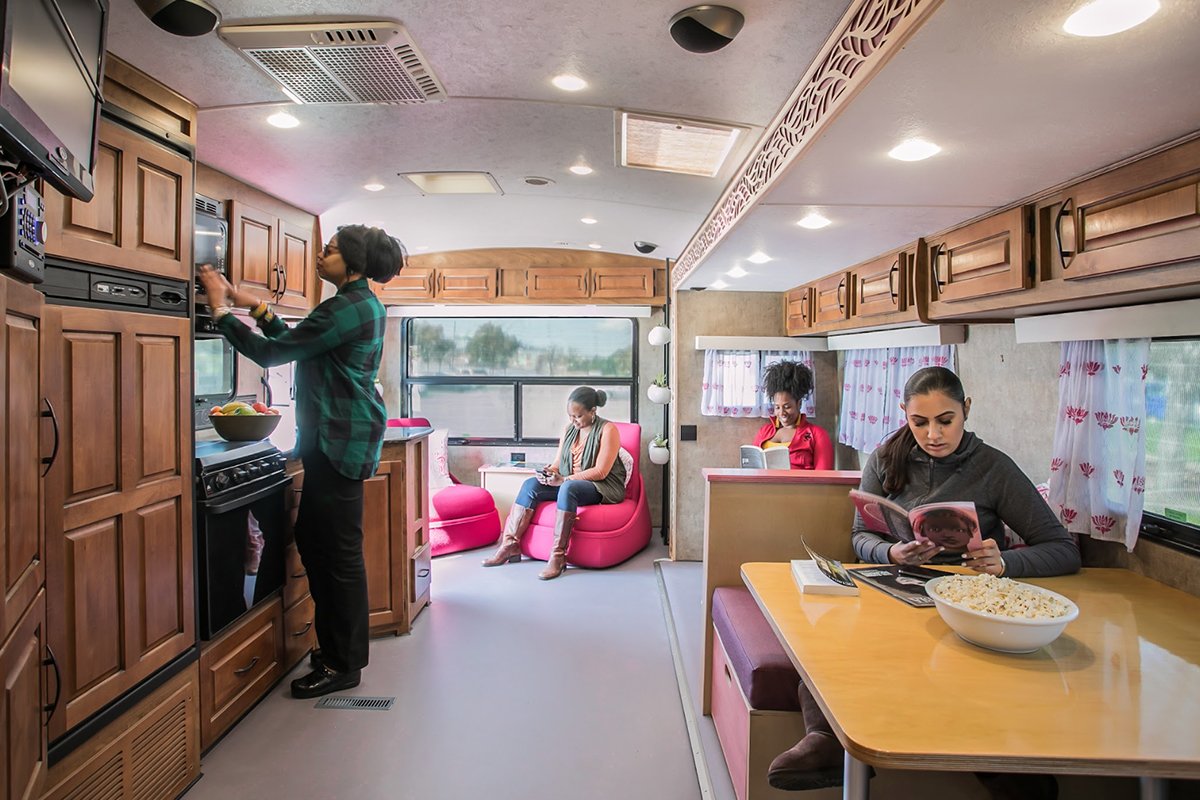
One project that shaped our approach early on was the Women’s Mobile Refuge Trailer. We took on work to address the challenges facing women and their personal safety when they’re released from incarceration in the middle of the night. Many of these women entered the carceral system with a history of abuse and trauma, physical and mental health issues, and needed additional supports between release and safe reintegration with their communities and social networks.
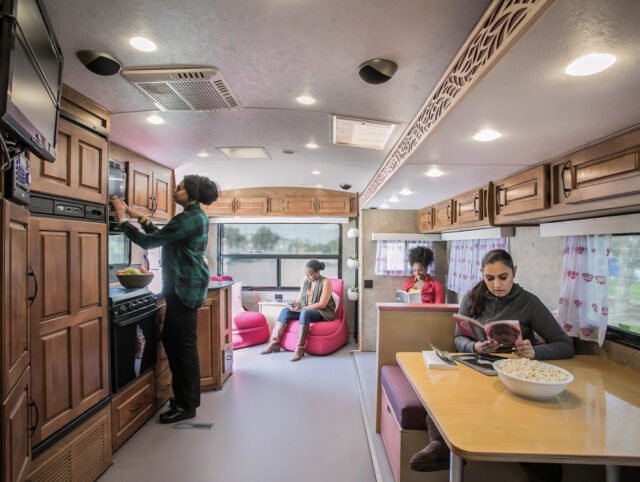
The DJDS team went into the project with a basic idea of what would provide rest and refuge: a room with beds, a place to lie down. But what the 60 women incarcerated at County Jail #2 in San Francisco actually asked for were lounge chairs, because the room needed to function less like a dormitory and more like a space where you could access services and care — the kind of space where you can use technology to find a place to go next, get essential medications, change into a clean set of clothes, sit with a social worker, or simply be upright and present rather than horizontal and withdrawn.
The design shifted from a sleeping space to a community-driven healing space. It was a small material change with a large implication: the DJDS team had correctly identified the need for rest and refuge, but had incomplete assumptions about the priorities of people who actually lived through the harm the carceral system inflicts.
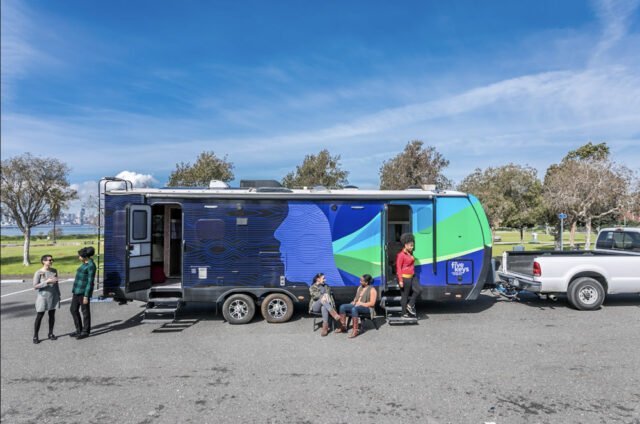
Nearly a decade later, working on short-term transitional housing for people re-entering after incarceration with the Mobile Refuge Room, our assumptions were once again challenged for the better. Alongside formerly incarcerated individuals in a workshop where we built full-scale cardboard mock-ups to test new ideas, we designed modular spaces that could be flat-packed, quickly assembled, and clustered in different configurations within existing spaces, adapting to individual preferences. DJDS’ team put casters — wheels — on every unit, reasoning that mobility signaled flexibility, adaptability, and responsiveness to changing needs (and made it easier to comply with building codes).
Sign up for our free newsletters
Subscribe to NPQ's newsletters to have our top stories delivered directly to your inbox.
By signing up, you agree to our privacy policy and terms of use, and to receive messages from NPQ and our partners.
The community read it the opposite way. Wheels didn’t say we can adapt this space for you. They said this space is not permanent, and neither is your claim to it. What the design team coded as flexibility, the people who would actually use the room experienced as a threat to psychological safety.
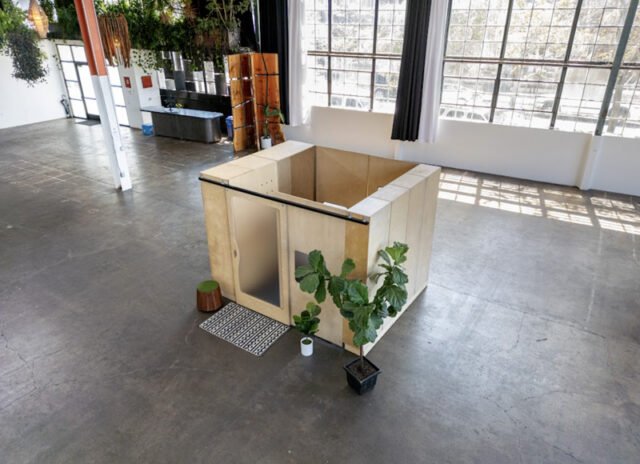
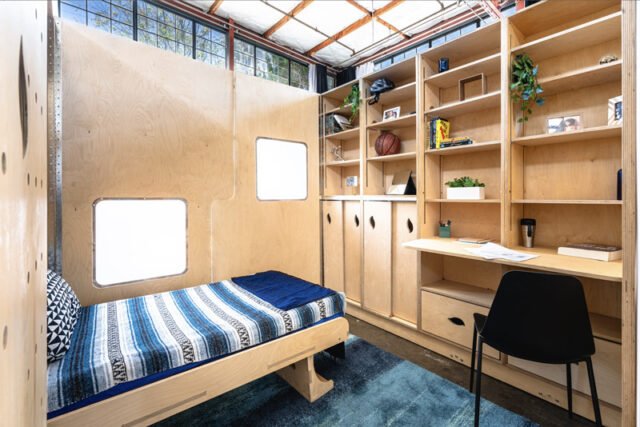
The wheels came off, but that’s a small design decision within a larger story. We brought the same workshop participants back multiple times to review design options, and the final unit is theirs at nearly every scale. It’s not only the absence of wheels but also the desk, Murphy bed, materiality, and modularity that reflect how they actually described wanting to live. The room that exists today is a direct translation of the full-scale mock-ups the community built themselves.
Throughout every project of the last decade, what continues to ring true and be missed by the field is that lived experience is its own credential.
Designed to Prioritize Relationship and Healing
These same discoveries apply to larger-scale, brick-and-mortar projects, including the adaptive reuse of a 20,000-square-foot commercial building into a restorative and economic-justice hub: Restore Oakland at the Ella Baker Center.
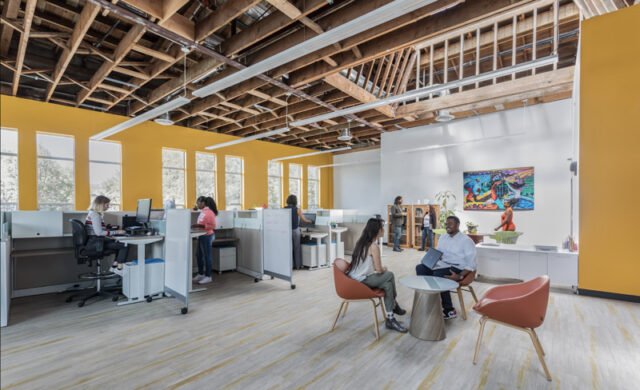
Through design workshops with partner tenant organizations, we set out to understand what a room dedicated entirely to peacemaking truly needed — physically, not just programmatically. Designing for restorative justice, we learned, means designing for the nervous system. It looks like spaces where people feel heard, can calm themselves, and see themselves reflected in the room around them.
The resulting Peace Room, on the top floor of the building, has soft colors, lighting that mimics clouds, greenery pulled toward every available source of natural light, and art rooted in the cultures of the people who would use the space. Each material choice was calibrated to bring a body down from crisis and into a relational mindset, not up into confrontation.
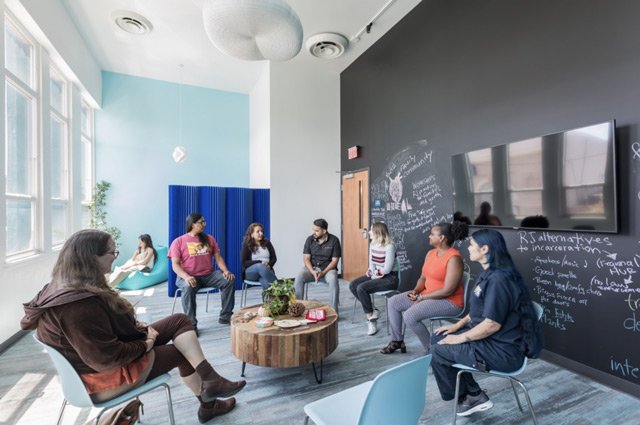
One of the most revelatory discoveries from that engagement process, though, had nothing to do with color or light. The practitioners we engaged told us the room needed two separate points of entry, so harmed and responsible parties could come and go without crossing paths. Clear, designated routes for difficult conversations. Spaces of refuge where someone could step out, breathe, and feel protected before stepping back in. A dedicated space where no other work could happen.
Later, our post-occupancy evaluation confirmed what the workshops had posited. Those choices didn’t just make the room feel different; they changed behavior. When people have a clear, embodied sense of how they’re expected to move and engage in a space, they engage differently, more safely, and more intentionally. It’s the same instinct that tells you how to hold yourself in a courtroom, where every bench, railing, and raised platform communicates a hierarchy of power and domination. The Peace Room asks a different question: what does a room look like when it’s designed to prioritize relationship and healing instead?
Throughout every project of the last decade, what continues to ring true and be missed by the field is that lived experience is its own credential. In every project, we have consistently heard people sharing, often with some surprise, that they had never been engaged in a design process like this before.
Participatory design is usually framed as a way to gather input. What a decade of practice taught DJDS is that it’s better understood as a way to redistribute the authority to define expertise itself — and that when you do so honestly, communities don’t just shape better buildings. They build something that unlocks futures we could not even imagine alone.
A Vision for the Next Fifty Years: Building the Future We Deserve
Picture a different kind of groundbreaking. A community meeting three years before anyone breaks ground, where the people who will live, work, and gather in a space help decide what it will become. A development process where “community input” means more than a comment period tacked onto plans already finalized. A restorative justice framework applied to the built environment itself — spaces designed to repair rather than confine, to nurture people rather than warehouse them.
This is already happening in pockets, in projects that prove community-led development isn’t slower or less rigorous than top-down planning, but is, in fact, more durable because the communities who shaped it have a stake in defending it.
The next fifty years—the lifespan of most modern buildings—will be shaped by what gets built with, not just for, communities. An asset-building movement is emerging within community organizations, treating real estate as a tool for change: land trusts, cooperative ownership models, and community-controlled development corporations.
What would you have said, if someone had handed you the pen instead of the finished design?
These opportunities also open up avenues for organizations and businesses that are not ready to own, to rent from values-aligned partners, and to put their dollars toward a future they want to build, rather than to landowners who further marginalize them through other means. Equity, permanence, and safety are the pillars these new institutions aim to establish.
None of this is possible without imagination. If we can reimagine a courthouse as a peace-and-reconciliation house, a former prison as a vertical farm, a highway corridor as a boulevard lined with basic needs and healthcare services ( (like our Pop-up Village) that people can walk to from their homes — we can build it. Imagination is not the ribbon cutting at a building opening; it is the load-bearing structure that keeps the building standing for generations.
What Actions Must We Take?
“Abolition is not absence, it is presence. What the world will become already exists in fragments and pieces, experiments and possibilities. So those who feel in their gut deep anxiety that abolition means knock it all down, scorch the earth and start something new, let that go. Abolition is building the future from the present, in all of the ways we can.” – Ruth Wilson Gilmore
Think about the community you grew up in. The place where you first learned your address by heart and how to get to your friend’s home nearby to play. The buildings that were suddenly torn down and changed, or the pool that was once a public hangout and the next year was fenced off and privatized.
Somewhere in that landscape is a decision you never got to weigh in on — a zoning meeting you didn’t know was happening, a development plan finalized before anyone asked what you needed. What would you have said, if someone had handed you the pen instead of the finished design?
Now think about the spaces that held you, where you felt like you belonged. The kitchen table where you shared countless meals. The local public library with resources for growing knowledge, skills, and spaces for connection. The corner store where the clerk knows your name and your favorite items. The spaces that are built for people to connect and simply exist. What do you see, hear, smell, touch? What made these places special?
Your answers are how we start to imagine, design, and build a world that loves and cares for all of us. What are the foundational blocks – material, practice, and policy – that we need to lay down today to create a more just and humane future in 50 years, at the 300th anniversary of the United States?
- Centering community voice at every stage of development: not as consultation after the fact, but as authorship from the first sketch.
- Making architectural and real estate processes transparent and accessible: demystifying zoning boards, financing structures, and planning timelines so participation isn’t a luxury reserved for those who already speak the language of power.
- Investing in physical power bases for marginalized groups: land trusts, community-owned buildings, and permanent institutional homes that can’t be zoned away when political winds shift.
- Redefining “justice architecture” to support healing, not punishment: designing spaces that assume people deserve dignity rather than surveillance.
- Treating the built environment as a living record we all have the right, and responsibility, to co-author.
Together, let’s build a world that loves us back. It starts with you, today.