The story of a white teacher, Barbara Henry, and a six-year-old Black student, Ruby Bridges, integrating a New Orleans elementary school is an iconic civil rights story. But going deeper into that story illustrates key leadership dilemmas that we still face today.
Many of us have been inundated with ideas of leadership deeply rooted in a dominant Western viewpoint—one that leans heavily on the fearless, rugged individualist who moves through the world with absolute certainty. Or perhaps a leader on a hero’s journey, gaining knowledge and wisdom by way of slaying their personal dragons. While these archetypes may contain some truths, treating them as universal facts without accounting for social context, race, and gender, distorts our understanding of effective leadership.
Indeed, scholars such as Laura Morgan Roberts, Anthony J. Mayo, David A. Thomas, bell hooks, among others, have long shown that these archetypes reflect patriarchal and Eurocentric norms of authority. Relying on solitary figures erases the decentralized, group-centered networks that actually drive movement building and organizational change, while insisting on certainty assumes that complex human situations have simple answers—making it impossible for people to admit mistakes, build trust, or keep each other safe.
While these [Western] archetypes may contain some truths, treating them as universal facts without accounting for social context, race, and gender, distorts our understanding of effective leadership.
Yet even when a narrative follows a single figure, leadership is rarely solitary; her true strength is drawn from the connection she built with the person beside her.
Barbara Henry: An Introduction
Ten years ago, at a house party a few houses down the street in my new Boston neighborhood, a stylishly dressed woman came up to me, warmly shook my hand, and introduced herself: “Hi, I’m Barbara Henry.”
Her name was familiar, but I couldn’t quite place it. I cocked my head to the side, in slow recognition. She laughed and said, “Yes, that Barbara Henry—Ruby Bridges’ teacher.”
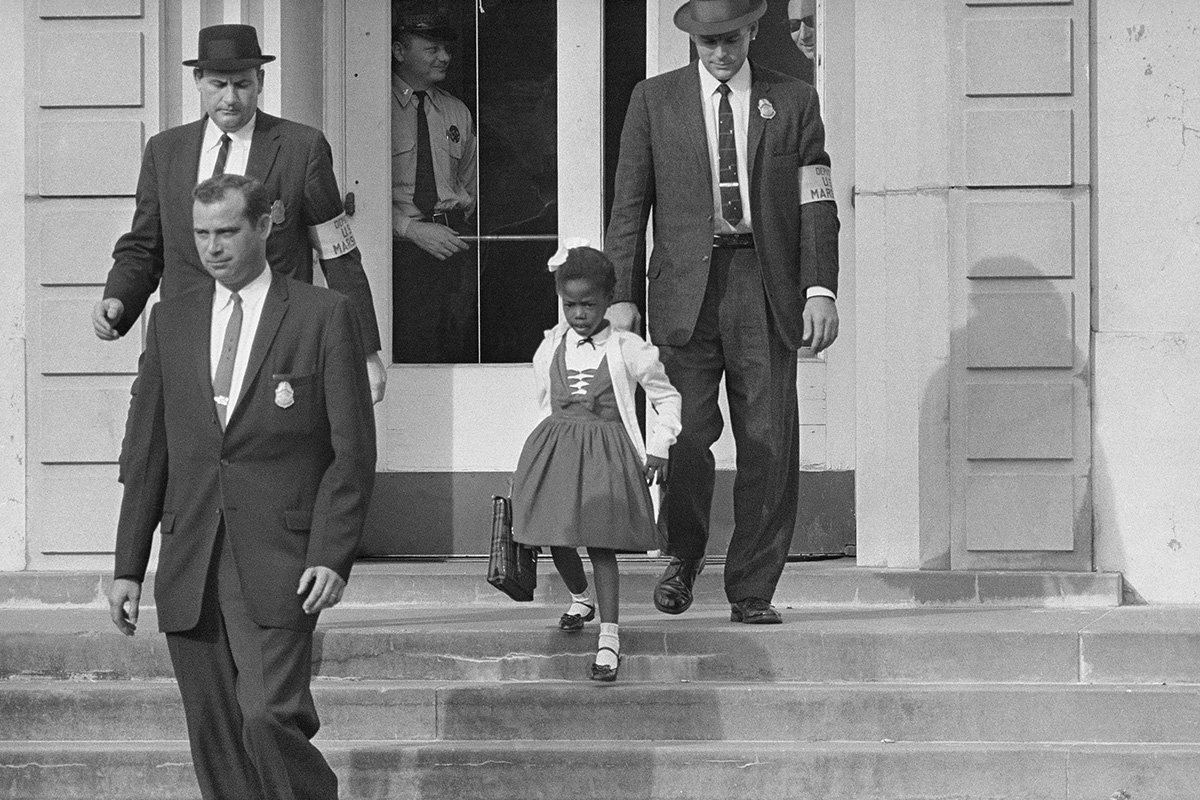
I knew who Barbara Henry was because I knew the story of six-year-old Ruby Bridges depicted in the famous black-and-white photograph, flanked by US marshals escorting her to the William Frantz Elementary School in the Upper Ninth Ward of New Orleans in 1960–1961, a school desegregated by court order.
Since that party, we’ve had many conversations over the years about neighborhood happenings, gardening, and politics. As an organizational strategist and leadership coach working with professionals who are developing their skills to lead their teams and organizations, I have a deep curiosity about effective leaders. I wanted to understand what 28-year-old Barbara was thinking when she found herself at that school with Ruby, and what a 90-year-old Barbara thought about the experience from her present vantage point.
After years of putting off asking her for an interview over the worry of being seen as an intrusive neighbor, I finally mustered the courage to ask for one, which she gladly accepted. On a chilly December morning in 2022, Barbara welcomed me into her home with a smile, dressed in a light olive shirt, gold-colored earrings, and understated makeup. I set up my laptop and microphone in her living room with a view of the street adjoining our homes.
As I settled onto her couch, I asked whether she would describe herself as a leader. I thought this was a slam dunk question, one that would deepen the conversation about her leadership. Instead, Barbara raised her eyebrows and responded, “No, I have never used that word myself. This is the first time that someone has asked me that question. So, it’s very interesting and provocative. I think probably I was one who was willing to take risks and be the first one [to act], but I never saw myself as a leader.”
Her answer caught me off guard. Feeling unsure of what to ask next, I decided to take a step back and asked her to share her story.
Barbara Henry’s Path to the New Orleans Ninth Ward
Barbara was born in Boston in 1932 and grew up in the house next door to the one she lives in to this day. She studied and graduated from Boston’s Girls’ Latin School, an academically renowned public high school where, as Barbara said, “The student body was a microcosm of the city’s racial, ethnic, religious, cultural, and socio-economic diversity.” Barbara gives credit to the school’s faculty who “treated every student, regardless of the class, color, or community they were from with the same respect and sense of worth.” This foundation prepared her for the challenges of Boston College, furthered her interest in the history and government master’s program, and fueled her desire to go to Europe to visit the primary sources of her studies.
After graduating, she learned about a government program created to teach the children of Air Force personnel. Barbara applied, hoping it would provide an avenue to go abroad. However, after being accepted, she was dismayed to draw Alaska as her scheduled landing spot. Disappointed that she wouldn’t have the opportunity to experience Europe, she wrote to the Massachusetts senator at the time, John Kennedy. He wrote back suggesting that because she was so young and just barely made the cut, that she wait another year and reapply.
In 1958, at age of 26, she received a posting in Dreux Air Force Base School in France. It was here she taught in a desegregated school for children of US Air Force personnel. Barbara recalls that the risk was rewarded with an extraordinary cultural experience as well as meeting Hank, an Air Force first lieutenant. After pursuing a second teaching post in Germany, she returned home to Boston, where she married Hank—her husband for 65 years.
Following Hank to his hometown of New Orleans, she found herself “lonesome for her teaching career.” Barbara applied for a teaching position within the city’s school district, and not long after, she received a call from the New Orleans superintendent of schools about an opening. On the call, he divulged a secret: The position was at an elementary school that was soon to be desegregated.
“Would that make a difference to you?,” he asked.
Barbara was stunned by the question and appalled by its implications. She accepted the offer. The superintendent told her that the police would have her name when she arrived at the school.
The constant stream of dominant culture messaging I took in made it patently clear that someone like me—a young Black lower middle-class girl—was not a hero and would not, could not, be a leader.
Sign up for our free newsletters
Subscribe to NPQ's newsletters to have our top stories delivered directly to your inbox.
By signing up, you agree to our privacy policy and terms of use, and to receive messages from NPQ and our partners.
That first day of school, scared and unaccompanied, Barbara walked surreptitiously (“no one knew who I was”) through the irate mob that assembled as soon as the white parents found out it was their children’s school that was being desegregated. The New Orleans police were “not sympathetic” to her plight. The front doors of the school were locked, and she had to knock a few times and wait—the furious crowd at her back—until finally she was let in. Barbara recalled the faces of the faculty she encountered inside the school, “frozen with fear and anger.” It was then that she learned that she was the one who would be teaching the desegregated classroom.
By midday on that first day, most students had been withdrawn by their parents, leaving the school nearly empty except for officials and staff. Despite the difficult circumstances, Barbara felt empowered by her own beliefs, which had been shaped by experiences in attending and teaching in desegregated schools in Europe. Undeterred, Barbara was told she’d meet her new student the next day—and she confidently affirmed she would return. The rest, as we know, is history.
Facts vs. Fiction
My own early ideas of leadership were a tangle of superheroes: Larger than life
figures who performed superhuman deeds and solved difficult problems. Growing up, I dreamed of a superhero who would swoop down and find me, find my emotionally volatile and financially struggling family, and make our situation better. The superhero dream morphed into a fantasy of leadership.
The constant stream of dominant culture messaging I took in made it patently clear that someone like me—a young Black lower middle-class girl—was not a hero and would not, could not, be a leader. My life experiences and observations undoubtedly shaped my lifelong inquiries about the nature of leadership and power, seeking stories of all types in which leadership takes form. But Barbara’s story of leadership led me to contemplate what I thought I knew, because of what I heard.
Barbara went on to talk about Ruby Bridges, “She was strong…she would come every day, back to school, knowing that she wasn’t going to have playmates to play with, or anybody to talk to, but me,” Barbara said. She added that “[Ruby] was interested in learning and achieved, of course. She was chosen because she was smart.”
As Barbara continued, her voice deepened, “But when I found out that there were three or four other kids in a room hidden in the basement of the school…” Her voice trailed off.
One day, Barbara went to the basement to fetch materials and discovered a few white students in a room with a teacher, playing music. She went to the principal and demanded to know what was going on and why these kids weren’t in her classroom with Ruby. The principal explained that the teacher refused to teach Ruby. Outraged by the situation, Barbara declared she would teach all the students.
“We did things such as social studies and science that we would do communally,” Barbara recalled. “I never taught them reading…the other teacher kept them [the white students] in the mornings, and then I had [all] the kids in the afternoon. And so, in the afternoons, we desegregated the school, literally and factually.”
As I conducted my own research, I found many meaningful details that were omitted from the popularized version of the “Brave Ruby” story. The entire family dealt with the harsh consequences of their desire to give Ruby a better education and the opportunities they never had. Both of her parents lost their jobs. Ruby’s grandparents were evicted from the rural Mississippi farm where they had lived and sharecropped for a quarter century. Ruby would have nightmares about the mob gathered at her school. And while the struggle to integrate the William Frantz Elementary School was taking place, a powerful movement was already successfully underway to keep schools racially partitioned, as segregation academies took full bloom.
The unredacted glimpse of Ruby Bridges’ and Barbara Henry’s experience might offer us guidance in place of a fable; it confirms that even within our daunting challenges and uncertainty, we are not lacking.
Dismantling Fables in Favor of Complex Truths
After my conversation with Barbara Henry and reading accounts from Ruby Bridges herself, I wondered if the story, much like the fables of leaders, has been so stripped down as to become fantasy? It certainly makes for a simpler story, to be able to omit many of the facts.
While these details provide a more accurate version of Ruby’s story, it’s likely less satisfying for those who want neat lines and conclusive endings. But these facts matter because they speak to a broader picture of risk, courage, and a process of transformation that rarely, if ever, happens as cleanly or as rapidly as these fables lead us to believe. These more complex stories might give leaders navigating daily ambiguities a more honest template for living and leading. It confirms that even the most determined among us will be met with victories, partial successes and, at times, outright failure. The unredacted glimpse of Ruby Bridges’ and Barbara Henry’s experience might offer us guidance in place of a fable; it confirms that even within our daunting challenges and uncertainty, we are not lacking. We are having a truly human experience.
Consider, for example, how exhausting is must have been for Barbara to have US marshals stationed outside her classroom door for safety, the lack of support from the school superintendent and principal, and the isolation she felt from the other teachers. Yet her singular focus remained on being a good teacher to Ruby, creating a vibrant learning experience for her. The relationship resulted in a deep and long-lasting friendship between Ruby (71) and Barbara (94).
As our two-hour conversation wound down, Barbara reflected on her teaching career. “You really are a leader when you’re a teacher. You can actually use that word. You are in a classroom facing 30 or more students. You definitely have to be,” she said.
The path of leadership is not a straight line but a road map that is complex with vagaries and ambiguities along the way. The more complicated stories are those that allow us to learn from each other and take comfort in the fact that we are not alone, as we walk our unique leadership path. It is a path that must be shaped by our full humanity, by our traumas, by our strengths, and by our triumphs.
I’ve observed that our connections to each other can make all the difference; these connections can be people who are willing to open doors for us or, just as importantly, those who help share our emotional burden as we, as leaders, navigate difficult waters in the midst of uncertain times. My conversations with Barbara Henry created a new way for me to consider how leadership can take flight, especially from those who don’t describe themselves as such.