
Before the celebrations of America’s 250th anniversary conclude, we must acknowledge a tension facing civil society: organizations working to advance and protect democracy increasingly must defend their own right to exist. To be clear, we have much to celebrate, including the critical efforts to safeguard democratic principles, processes, and institutions in this country and beyond—work made possible, in part, by philanthropic support. Still, with that tension in mind and with cautious optimism, we must look beyond the topline numbers to ask how democracy funding is faring.
Avoiding careful analysis does not serve civil society; it simply cedes the data to less scrupulous hands.
Generally speaking, philanthropic support for democracy efforts is growing steadily, with institutional pro-democracy grantmaking reaching up to three billion dollars over the last four years. However, embedded in the narrative of growth sit deeper funding trends that merit further analysis and discussion. On one hand, disparities in payout rates among funders point to untapped philanthropic capital, capacity that could be deployed now, given what’s at stake. On the other, the pluralist nature of democracy efforts, spanning a spectrum of competing values—for example, from religious liberty to secular governance—complicates any shared sense of what “democracy funding” even means. Together, these tensions raise serious questions about whether the field is ready, both to expand philanthropic capital and to absorb it well.
For our research on the Frontlines of Democracy Project at Syracuse University, we drew on hundreds of thousands of IRS 990 filings on public record, and specifically analyzed the 2023 990PFs, the tax forms private grant-making foundations submit annually. Using a combination of large language text modeling and cross-referencing of existing democracy funding databases, we assessed patterns of payout rates across foundations, whether and how references to democracy surface in grantmaking text data, and what these trends point toward.
The intent of this analytical work is diagnostic and forward-facing, not prescriptive. 990 data has long served as a backbone resource for civil society, and the organizations that track pro-democracy funding deserve credit for using it to guide both philanthropic decisions and on-the-ground efforts. Increasingly, though, these filings face misuse as surveillance instruments or blunt sector-wide census. Though avoiding careful analysis of this data does not serve civil society; it simply cedes the data to less scrupulous hands. Our approach uses 990 data carefully and with its limits in mind, without singling out individual funders or specific nonprofits.
The will to deploy capital for democracy efforts clearly is present, but mobilizing larger, wealthier foundations to give proportionally more remains an open and pressing challenge.
What would it take to mobilize untapped philanthropic potential for democracy?
990PFs reveal a familiar tension in how philanthropic capital is distributed in the US. Payout rates among foundations generally meet or slightly surpass the federally mandated five percent floor, averaging around 5.5 percent in the 2023 fiscal year. However, that average obscures a sharp divide by asset size. Larger foundations with assets in the billions tend to pay out a lower percentage of their assets, often hovering near the five percent legal minimum, while smaller foundations with hundreds of thousands in assets frequently pay out a much higher share, sometimes reaching 7 to 11 percent or more. Foundations with a democracy focus show a similar pattern, with payout rates above average at 6.3 percent, again with notable disparities by asset size.
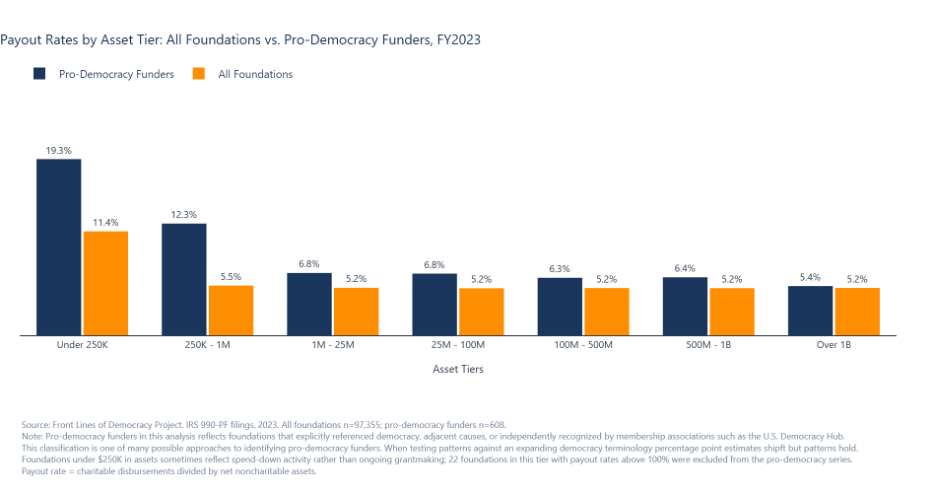
The will to deploy capital for democracy efforts clearly is present, but mobilizing larger, wealthier foundations to give proportionally more remains an open and pressing challenge. It is worth asking, even rhetorically, whether the federal five percent payout floor, largely unchanged for decades, still fits the urgency of the moment, and whether peer norms among large foundations can move faster than policy does. A few foundations are already setting new, higher floors for their own payout rates, which is encouraging. However, bringing more pro-democracy funders along will likely require new strategies, including giving vehicles that bypass traditional foundation structures altogether (e.g., LLCs, donor-advised funds, giving circles). Many in the democracy funding field do not need convincing that this work matters, but the case for pro-democracy funding may not yet have reached the growing pool of American billionaires, many of whom already run family philanthropic offices and are weighing options for giving.
Is the Double Edge of Pluralism in Pro-Democracy Efforts a Feature or Fracture?
The reasons behind disproportionate payout rate distributions are worthy of inquiry. Is it that strategic philanthropic frameworks prioritize long-term investments, that mimetic norms within foundations prevent needed deviations from the status quo, or that pluralism among democracy frontline nonprofits also clouds funding decision-making? Our data suggest that pluralism—defined here as the wide range of divergent strategies, values, and perspectives under which work gets done in pursuit of a shared broad goal—may be one reason democracy work struggles for mainstream funding priority.
Sign up for our free newsletters
Subscribe to NPQ's newsletters to have our top stories delivered directly to your inbox.
By signing up, you agree to our privacy policy and terms of use, and to receive messages from NPQ and our partners.
This kind of pluralism is common across civil society, and democracy efforts are no exception, though how much pluralism is healthy remains an open question. Among 990 funding text data, only a few hundred foundations explicitly use the word “democracy” to describe their grantmaking. Yet thousands of foundations reference efforts that are integral to democracy—including electoral protection, government accountability, civic participation, human rights, independent media, or freedom. This illustrates just how elastic and contested democracy’s boundaries truly are. Moreover, there is neither a silver bullet for preserving democracy nor a consensus on how to describe the work, which means efforts can be easily mis-, under-, or over-construed. Other philanthropic sectors—such as education, environmentalism, and health—have found partial coherence through flagship institutions or shared narratives. Whether the democracy field wants or needs that kind of consolidation, which may run counter to its own pluralist values, is a question worth asking.
The underlying question is whether the field is ready to receive more capital strategically, with enough shared vision to ensure that new funding strengthens rather than fragments an already pluralist field.
Pluralism presents more than a methodological challenge for evidence and research. It also shapes funding dynamics in ways that go deeper than a reference problem. Pluralism may welcome divergent efforts around a common core, but too many factions can thin an already narrow capital pool and blur the unified vision that mainstream funders tend to seek. Efforts that are severely underfunded must reckon with finding ways to broaden their revenue base, build coalitions with aligned funders, and explain to potential funders why their work falls under the democracy umbrella even when the tone or language does not match perfectly.
Pro-Democracy Philanthropic Capital and the Readiness it Requires
The ongoing transfer of wealth in America, projected at trillions over the next two decades, could bring a new generation of engaged funders into democracy work. It remains to be seen whether they will bring the same pluralism already evident across frontline pro-democracy nonprofits. The case for new or expanded pro-democracy capital is warranted, given the stakes and disparities discussed here. But frontline nonprofits have work to do too: demonstrating readiness through clear pathways to impact, and opening themselves to a broader, more unconventional donor base than the field is used to.
Over the last several months, philanthropists from across the political spectrum have voiced concern and commitment to democracy efforts. This broadening base of support is welcome, and in a field with capital challenges, necessary. But for frontline democracy nonprofits, a broader donor base means more than relief or new resources. It also means navigating engaged funders who arrive with varied views, specific expectations, particular strings, and exacting asks. Less certain is how those dynamics will play out in this field. The underlying question is whether the field is ready to receive more capital strategically, with enough shared vision to ensure that new funding strengthens rather than fragments an already pluralist field.
As the United States marks its 250th year, democracy funding data, imperfect as they are, point to more capacity, more capital within reach, and a need for more aligned efforts. Additional research could help move from anecdotal or descriptive data toward generalizable patterns, but the real test will be practical relevance.
Data on, for, and about pro-democracy efforts exists—sometimes at scale, often piecemeal—but it cannot be used by funders and frontline nonprofits if it arrives too late or falls short on practical insight.
America’s democracy funding is more than a fixed number of dollars or a set of predetermined outcomes. It reflects an ongoing commitment to wide-ranging values—continuously earned, celebrated, and renewed—and its next test is bringing more funders, and more capital, fully into the work.