
logo logo
Donate
    • Membership
    • Donate
  • Social Justice
    • Racial Justice
    • Climate Justice
    • Disability Justice
    • Economic Justice
    • Food Justice
    • Health Justice
    • Immigration
    • LGBTQ+
  • Civic News
  • Nonprofit Leadership
    • Board Governance
    • Equity-Centered Management
    • Finances
    • Fundraising
    • Human Resources
    • Organizational Culture
    • Philanthropy
    • Power Dynamics
    • Strategic Planning
    • Technology
  • Columns
    • Ask Rhea!
    • Ask a Nonprofit Expert
    • Gathering in Support of Democracy
    • Humans of Nonprofits
    • The Impact Algorithm
    • Living the Question
    • Nonprofit Hiring Trends & Tactics
    • Notes from the Frontlines
    • Parables of Earth
    • Reimagining Philanthropy
    • State of the Movements
    • We Stood Up
    • The Unexpected Value of Volunteers
  • CONTENT TYPES
  • Leading Edge Membership
  • Newsletters
  • Webinars

Infographic: Optimal Times to Post on Social Networks

Aine Creedon
April 3, 2014


Clock Nonprofit Times

March 31, 2014; Entrepreneur

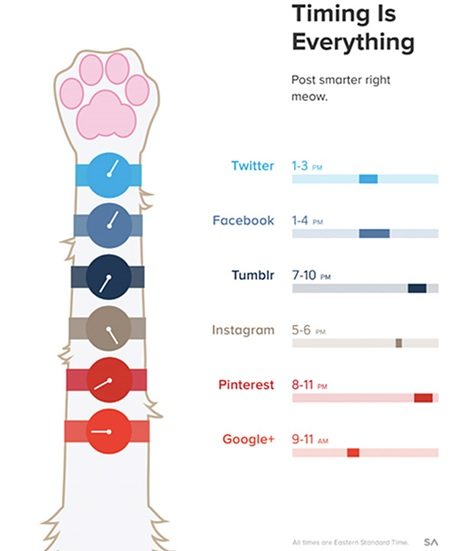
SumAll.com has taken data analytics from the social media activities of a series of companies, from larger corporations to small businesses, to determine the best times to post on social media platforms. SumAll is a data-analyzing firm that has allocated 10 percent of its ownership to a nonprofit the company created to leverage the power of data for social good.

The infographic below features the optimal times to post on Facebook, Google+, Instagram, Pinterest, Tumblr, and Twitter:
Infographic Nonprofit Times

Sign up for our free newsletters

Subscribe to NPQ's newsletters to have our top stories delivered directly to your inbox.

By signing up, you agree to our privacy policy and terms of use, and to receive messages from NPQ and our partners.

The graphic shows that platforms such as Facebook and Twitter tend to be more popular in the afternoon, when the work day is slowing down, while image sharing networks like Tumblr and Pinterest are more commonly used in the evening and later into the night. The SumAll.com data also showed that Pinterest is used most over weekends, when users most likely have more time for crafts and DIY projects.

One noteworthy point was online users tend to be active on the majority of social networks during their downtime, such as during work commutes or the evening hours at home.

Organizations should also take time to collect their own data on when posts are getting the most attention and be aware of your audience for posting times—for example, an organization serving students might find that the times they are most active online vary closer to when school is ending. Those who use social media for marketing or fundraising campaigns should find this information valuable in reaching your online audience at the best times.—Aine Creedon


Nonprofit times

Our Voices Are Our Power.

Journalism, nonprofits, and multiracial democracy are under attack. At NPQ, we fight back by sharing stories and essential insights from nonprofit leaders and workers—and we pay every contributor.

Can you help us protect nonprofit voices?

Your support keeps truth alive when it matters most.
Every single dollar makes a difference.

Donate now
logo logo logo logo logo
About the author
Aine Creedon

Aine Creedon is Nonprofit Quarterly's Director of Digital Operations and has worn many hats at NPQ since 2011. She has extensive experience with social media, communications and outreach in the nonprofit sector, and spent two years in Americorps programs serving with a handful of nonprofits across the nation as well as a community organization in Dorchester, Boston. Aine currently resides in Denver, Colorado where she enjoys volunteering, seeing live music, and hiking with her pups Frida and Tucker.

More about: Nonprofit NewsPolicySocial MediaTechnology
See comments

You might also like
How to Undermine Authoritarian Control: On Empowering Parallel Institutions
Gretchen Goldman and Saul Levin
What Is the SAVE America Act?
Marissa Martinez
Disability Groups Are Standing United for Trans Rights. That Hasn’t Always Been the Case.
Sara Luterman
How the NAACP Is Stopping Dirty Data
Abre’ Conner
New Student Loan Limits Could Threaten Diversity in Nursing and Public Health Programs
Lauren Nuttall
‘I’m Heartbroken’: Trans Kansans Reckon with Their Driver’s Licenses Being Invalidated
Sherman Smith and Morgan Chilson

Upcoming Webinars

Group Created with Sketch.
April 23, 2:00 pm ET

Receiving & Giving Feedback

Essential Practices for Healthy Organizations and Communities

Register
Group Created with Sketch.
May 14, 2:00 pm ET

Equitable Compensation in Practice

A New Values-Aligned Toolkit & Discussion Guide

Register

    
You might also like
A pair of red and blue zippers, with tracks intertwined to reveal a small gap in between them. Where one zipper stops, the other zipper starts.
How to Undermine Authoritarian Control: On Empowering...
Gretchen Goldman and Saul Levin
A crowd of people hold signs that read "Stop the SAVE Act", "End Voter Suppression" and "Defend Our Democracy"
What Is the SAVE America Act?
Marissa Martinez
A person at a march holds a sign with the blue, pink, and white trans flag that reads “We See You, We’ve Got You”
Disability Groups Are Standing United for Trans Rights. That...
Sara Luterman

Like what you see?

Subscribe to the NPQ newsletter to have our top stories delivered directly to your inbox.

See our newsletters

By signing up, you agree to our privacy policy and terms of use, and to receive messages from NPQ and our partners.

  • About
  • Advertise
  • Careers
  • Contact
  • Copyright
  • Donate
  • Editorial Policy
  • Privacy Policy
  • Funders
  • Submissions

We are using cookies to give you the best experience on our website.


Nonprofit Quarterly | Civic News. Empowering Nonprofits. Advancing Justice.
Powered by  GDPR Cookie Compliance
Privacy Overview

This website uses cookies so that we can provide you with the best user experience possible. Cookie information is stored in your browser and performs functions such as recognising you when you return to our website and helping our team to understand which sections of the website you find most interesting and useful.

Strictly Necessary Cookies

Strictly Necessary Cookie should be enabled at all times so that we can save your preferences for cookie settings.