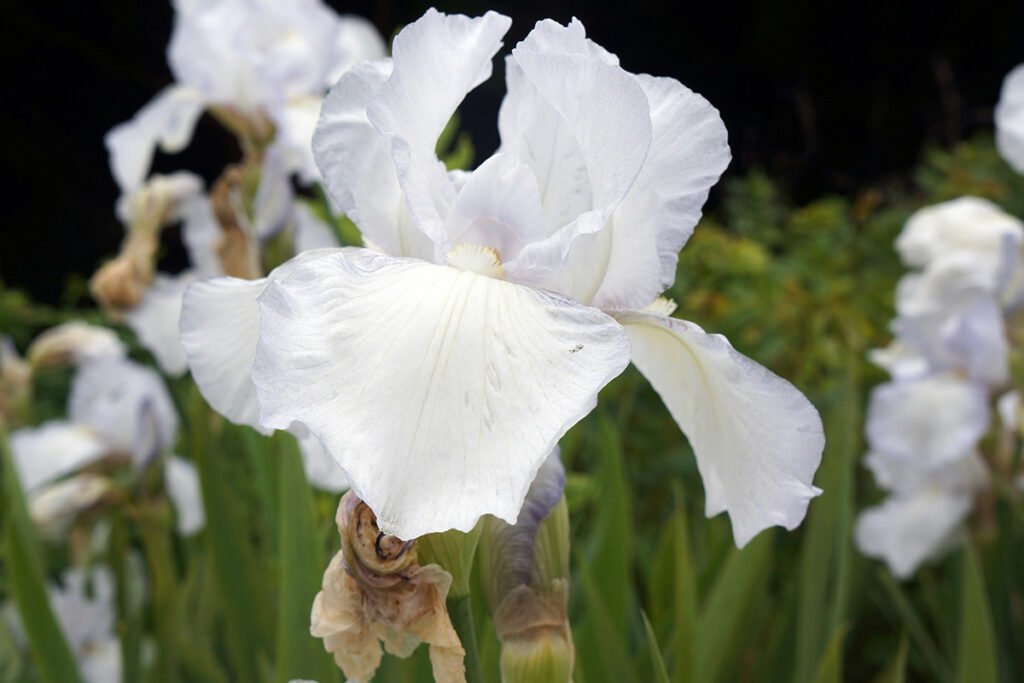
Pat Cunningham moved to Cedar Creek, an unincorporated community in Bastrop County, Texas, in 2020. Located just southeast of Austin, Cedar Creek offered the retired nurse and her husband, who moved from St. Louis, Missouri, a chance to be with family and enjoy milder winters.
Unbeknownst to the couple, their new home also came with a unique retirement project that has occupied them since its discovery in March 2021: a historic Mexican cemetery, forgotten for decades and in urgent need of protection and restoration.
Texas’s Mexican cemeteries are sacred sites of significance to descendants, as well as cultural heritage sites that can continue to serve their communities when they are preserved and made accessible to visitors.
“We found it because we were doing yard work, and I saw this sea of white,” Cunningham recalled. Hundreds of white irises were blooming just beyond the Cunninghams’ fenceline, and further inspection revealed wrought-iron decorations and over a dozen grave markers on a roughly one-acre plot. The grave markers held Spanish-language names and birthdates carved in stone, dating as far back as the mid-1800s. “They were beautiful and obviously very old,” Cunningham said. “It was just astounding.”
The cemetery that Cunningham discovered is one of over 200 Mexican cemeteries scattered throughout Texas, according to an analysis of the Texas Historical Commission’s Texas Historic Sites Atlas by nonprofit organization Latinos in Heritage Conservation. That organization is committed to preserving Latinx historic places, which are often overlooked by existing national frameworks. Federal preservation institutions, such as the National Register of Historic Places, were designed to prioritize preserving sites tied to an Anglo-American retelling of the nation’s past. Today, less than one percent of sites on the National Register are associated with Latinx communities.
Texas’s Mexican cemeteries are sacred sites of significance to descendants, as well as cultural heritage sites that can continue to serve their communities when they are preserved and made accessible to visitors. “For many Mexican and Indigenous traditions, death is not viewed only through the lens of loss; grief and celebration exist side by side,” explained Sehila Mota Casper, executive director of Latinos in Heritage Conservation. “Cemeteries become places where families gather to remember, share stories, and honor ancestors.”
For example, during Día de Los Muertos, cemeteries are a place for building altars for los ofrendas, meaning “offerings,” as well as other preparations. That annual celebration, which takes place in November and is called the Day of the Dead in the United States, has been a part of Latin American tradition for centuries. Casper said the occasion is a way of “celebrating lives that continue to shape families and communities across generations.”
As historic sites, Mexican cemeteries in the US–Mexico borderlands reveal the close ties that have long existed between the two nations. They can also help uncover histories that might otherwise be overlooked or excluded from the historical record. “Historic Mexican cemeteries are among the most important historical records in many borderland communities,” said Casper. “In places where written archives are incomplete or where Mexican families were historically excluded from official records, cemeteries preserve names, dates, family relationships, military service, religious traditions, and migration patterns.”
“Historic Mexican cemeteries are among the most important historical records in many borderland communities.” – Sehila Mota Casper, executive director of Latinos in Heritage Conservation.
Cedar Creek was once part of Spanish Texas and then Mexican Texas until the Texas Revolution ended in 1836. From 1821 to 1836, the Mexican government granted land in the area to emigrants from the U.S. to encourage colonization of its difficult-to-protect borderlands. Historians who have reviewed the archived deeds believe the land that now forms part of the Cunningham property may have been one of the last plots Mexico granted before the revolution.
Sign up for our free newsletters
Subscribe to NPQ's newsletters to have our top stories delivered directly to your inbox.
By signing up, you agree to our privacy policy and terms of use, and to receive messages from NPQ and our partners.
Today, southern Texas is no longer home to wide-open borderlands but some of the fastest-urbanizing zones in the nation. Population growth in places like Austin and the smaller cities of Round Rock and Georgetown that help make up the greater Austin metro area has sparked building booms in the suburbs. More recently, data center development, supporting the surge in artificial intelligence use, has also eaten up more land.
Texas’s breakneck pace of development makes identifying and preserving its abandoned Mexican cemeteries more urgent than ever. Cunningham’s efforts to protect the cemetery on her property began when she spotted the white irises. From there, she connected with Latinos in Heritage Conservation, as well as the Bastrop County Historical Commission and the Bastrop Museum. Those groups helped Cunningham through the application for designation as a Historic Texas Cemetery, offered through the Texas Historical Commission.
That designation was granted in 2024, and the Mexican cemetery in Cedar Creek is now one of over 2,400 designated historic cemeteries in the state. It also has a new name: The Hinojosa-Perez-Saucedo Cemetery, after three people buried there in the nineteenth century whose grave markers are still legible. Because the cemetery is only accessible via the Cunningham’s property, the couple has only opened it to preservationists, researchers, and descendants by appointment. But they hope that with the speed of development in the area, the municipality will connect it to a public road soon.
Garnering designation is crucial for historic Mexican cemeteries not only because it recognizes their historical significance, but also because it can help protect the sites from vandalism and theft. That was a concern at Elgin Mexican Cemetery in the town of Elgin, about a half-hour drive north from Cedar Creek. “When people knock over markers, or take things, or break things, the only way to report it to our local police is if there’s a sign that says, ‘This is a cemetery,’” explained Debbie Wahrmund, treasurer of the Elgin Mexican Cemetery organization. “The first step to preserve the cemetery is to identify it.”
“Success is measured by more than the number of cemeteries preserved. It means ensuring that these places continue to tell the stories of the communities they represent and that Latino history is recognized as an essential part of America’s shared heritage.” – Sehila Mota Casper, executive director of Latinos in Heritage Conservation.
Elgin Mexican Cemetery is much younger than Hinojosa-Perez-Saucedo Cemetery in Cedar Creek, though it has also been a designated Historic Texas Cemetery since 2023. The cemetery was established in 1915, and in recent years, has faced vandalism and recurrent flooding because it is built in the footprint of an old brick mine. Elgin Mexican Cemetery was established during an era of segregation and abuts a so-called Anglo cemetery. Many of those buried in its roughly 115 plots worked in the brick mine, and many of its modest graves feature handmade crosses decorated with a mosaic of ceramic pieces that appear to have come from old dishes.
The cemetery was named to Latinos in Heritage Conservation’s list of most endangered Latinx landmarks in 2025. “That invigorated us because it got us more exposure, and as a result, it built up our confidence and our knowledge of what we needed to do to tackle real preservation,” said Wahrmund. This year, Elgin Mexican Cemetery received funding through Latinos in Heritage Conservation’s grant program Nuestra Herencia, meaning “Our Heritage,” to support preservation planning, documentation, and long-term stewardship preparation.
Wahrmund said her organization is honored to be taking on the work of preserving and making the local historic Mexican cemetery more accessible to future generations. “It is about more than the cemetery,” she said. “It’s the names; it’s the people who matter here, and they’re part of our story. We can lose that history so quickly.”
Ultimately, Casper added, “success is measured by more than the number of cemeteries preserved. It means ensuring that these places continue to tell the stories of the communities they represent and that Latino history is recognized as an essential part of America’s shared heritage.”