“Oligarchs always want to keep an elected government poor, because public power threatens private power. Slaveholders knew this. They were afraid that an elected government, even one elected only by propertied white men, would tax slavery out of existence.”—Vanessa Williamson
My grandfather was the son of Italian immigrants, born on a farm in rural California. Yet, in 1952, without family wealth to rely on, he was able to gain access to enough capital to open the first Save Mart store. That store grew from one to many over the course of several decades, expanding to over 200 stores by the 2010s under my father’s leadership. It was an empire that my grandfather could have hardly imagined when he opened that first store.
I used to think it was a story of hard work and a little luck, a true “American Dream.” Now I know it was also a story of access. The loans that built our business were loans routinely denied to Black entrepreneurs by both law and practice. Our family company grew thanks to Reagan-era tax breaks, loose antitrust enforcement, and business-friendly policies. While our gains compounded over generations, for many Black families across America, harm and exclusion from wealth-building compounded instead. That harm has never been repaired.
Just eight percent of Black families inherit anything at all, compared with 26 percent of white families. Our family’s access to capital created generations of wealth. For millions of Black families, that security was never permitted because the access to foundational capital was denied. We see the effects of this playing out today.
I used to think it was a story of hard work and a little luck, a true “American Dream.” Now I know it was also a story of access.
These realities became truly personal for me when I was the one leading the business. We prided ourselves on being a family-owned business that took care of its team and paid fair union wages. However, when we began tracking our data, I realized that many of our employees couldn’t afford to feed their own families; they were using public benefits to buy groceries at our stores.
From my first day on the job, I followed the business rulebook I was handed: pay the least amount of taxes, manage labor as an expense, and return the most to the top. But when I saw the barriers my own employees faced to meet their families’ most basic needs, I knew that my ethics and the so-called “best business practices” I had learned were fundamentally at odds.
I tried for 10 years to lead the business in alignment with my values. But over time, I came to realize that closing this gap could not be left to the conscience of individual business owners alone. It is the work of fair taxation.
Some will call that overreach: the government taking what people have rightfully earned. But if that money is earned on the backs of workers who cannot afford to live decent lives, we are creating an economic system where inequality and authoritarianism are baked into the math. Under our current tax code, work is punished and wealth is rewarded, creating a widening gap between the haves and the have-nots. As it stands now, our tax structure taxes passive income at a lower rate than earned income. If we expect our economy to grow and thrive, we cannot treat money differently depending on how it is earned.
Sign up for our free newsletters
Subscribe to NPQ's newsletters to have our top stories delivered directly to your inbox.
By signing up, you agree to our privacy policy and terms of use, and to receive messages from NPQ and our partners.
Right now, our tax system makes the wealthy wealthier, while the working person pays the price. But the real danger of concentrated wealth has never simply been that a few have too much. It is what that concentrated wealth does to erode the governing power of the many. It is what it does to threaten our democracy. When money becomes power, you must confront the source of the power.
Reparations help heal the past, and lay the groundwork for societal transformation/ Fair taxation accelerates progress toward a transformed world. Together, they strengthen the foundation of democracy.
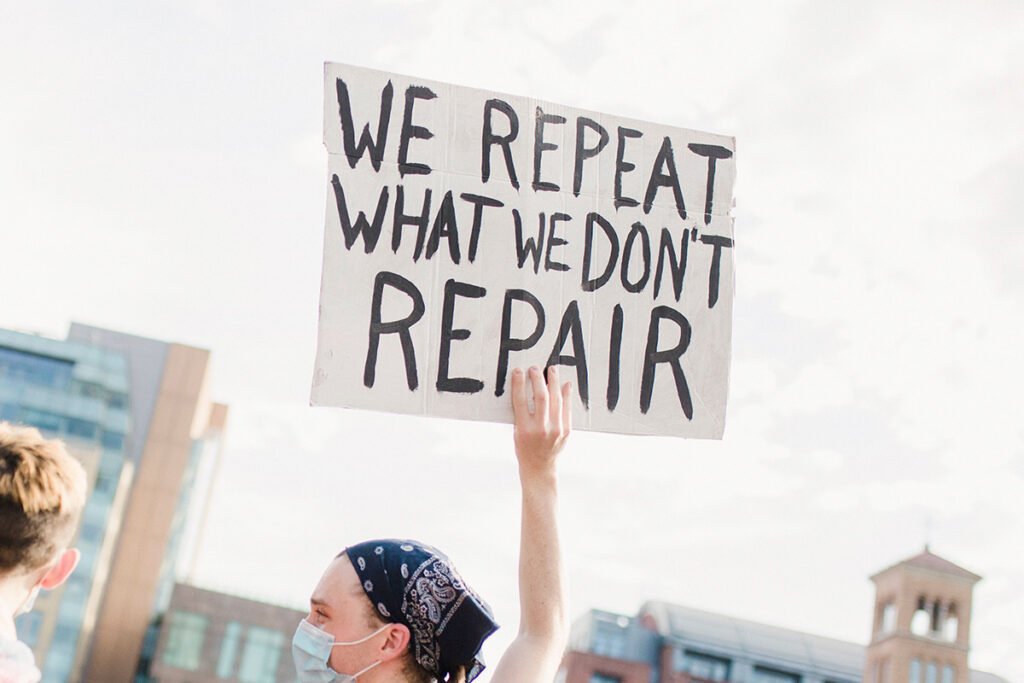
This is the link between fair taxation and reparations. So much of the wealth that has been built and accumulated in the United States was enabled by policies that extracted from and/or excluded Black people: from chattel slavery all the way to its legacies today. This is why redistributing power in this country requires repairing this country’s founding harms.
Fair taxation is an important first step to equalizing today’s imbalances, but it is not reparations in itself. Reparations are the process of the state making amends for harm, and that process must include reckoning with what happened, acknowledging it, and being accountable for it—not simply providing financial redress. It means that for the families who were turned away from the loans my family was handed, shut out of neighborhoods, schools, and opportunities to create generational wealth, the government finally acknowledges the injustices it perpetrated and takes concrete steps to make things right.
Reparations help heal the past, and lay the groundwork for societal transformation. Fair taxation accelerates progress toward a transformed world. Together, they strengthen the foundation of democracy.
More than a century ago, Supreme Court Justice Louis Brandeis warned that vast fortunes are “inconsistent with democracy.” A country, he argued, “can have great wealth gathered in a few hands, or it can have self-government—but not both.” Modern-day research supports his point: a recent study spanning democracies around the world found that economic inequality proved one of the strongest predictors of whether a democracy erodes.
Taxing the rich without repairing the founding harms is incomplete. It tends to some of the symptoms but leaves the wound. To create a stable, enduring democracy that will survive the next 250 years, we must do both. Done together, these are not sacrifices. They are investments: in an economy a trillion dollars larger, in working families who finally share its gains, and in a democracy that can no longer be bought out from under the people it belongs to—a country, in other words, that finally works for all of us.