Catastrophes have repeatedly revealed the importance of what we sometimes call third places: spaces that exist beyond the realms of our homes (first place) and work (second place), where our social lives unfold. Sometimes also referred to as “commons,” characteristics that make these spaces possible include accessibility, inclusivity, affordability, spontaneity, and a sense of being free from formal obligations.
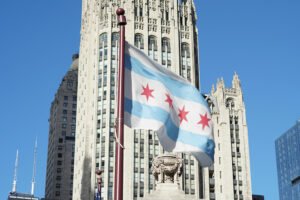
Social bonds helped people weather a horrifying Chicago heat wave from July 14-17, 1995. More than 700 people died. People who lived alone had about 2.3 times the risk of heat-related death, while those who did not leave their homes faced about 6.7 times the risk, according to a study published in the New England Journal of Medicine. In contrast, researchers showed that having social contacts, whether through friends, family, or by participating in group activities, greatly reduced the risk of death.
In Heat Wave: A Social Autopsy of Disaster in Chicago, sociologist Eric Klinenberg examines the role of public spaces during intense heat waves. He describes how, in an earlier 1955 heat wave in Chicago, families camped outdoors in parks because their homes lacked air conditioning, stressing how this seemingly “simple strategy…helped to keep the mortality rate during the 1955 crisis down to roughly half the level of the 1995 disaster.” In other words, the community’s collective use of the public park saved lives in 1955.
The Chicago example is not the only disaster in which public spaces have acted as a support system. While we may lack such detailed documentation for every crisis, social spaces have repeatedly provided refuge, connection, and support.
Conversation is the primary activity in these spaces, according to sociologist Ray Oldenburg, who coined the term “third place” in his book The Great Good Place: Cafés, Coffee Shops, Bookstores, Bars, Hair Salons, and Other Hangouts at the Heart of a Community.
But what role do third spaces play in our everyday lives, beyond moments of crisis? Just as these provided a form of climate resilience during heat waves, social infrastructure provides broader societal resilience—especially in a world increasingly designed to keep different realities separated by class, gender, race, and religion. We may live in the same cities, but we move through them differently. In the increasingly parallel lives we lead, free public places like libraries, parks, and community centers are some of the few “commons” that allow us to move beyond walls and connect with people we might otherwise never encounter.
When we talk about city infrastructure, we rarely think beyond the obvious: housing, transportation, and economic opportunities. Social infrastructure is often relegated in states’ conversations or overlooked altogether because their depletion is difficult to discern in ordinary times. The erosion of civic spaces can go unnoticed because its effects are either insidious, barely perceptible, unfolding gradually over time, or catastrophic. Multiple factors contribute to the outcome, making the loss of these spaces difficult to isolate as a cause.
While it is widely recognized that the underlying function of third spaces is community and social proximity, they are often sidelined in the government’s priorities that direct limited resources toward more urgent, demand-led services. Recent UK Parliament evidence, for example, shows that local authorities facing emergency funding pressures have less room for universal and neighborhood services, including libraries and road maintenance. In the United States, public libraries similarly compete for local funding alongside other public priorities—a 2025 survey found that 71 percent of public libraries cited limited funding availability as one of their key challenges.
In the increasingly parallel lives we lead, free public places like libraries, parks, and community centers are some of the few “commons” that allow us to move beyond walls and connect with people we might otherwise never encounter.
Libraries, parks and playgrounds, and community centers
A public library is one such notable institution that functions as a third space, morphing from a knowledge center to a community space that facilitates conversations between individuals who might never cross paths otherwise. Yet when choosing between social cohesion and commercial value, the state often opts for the latter, and global data corroborates this. Countries with long-established public library systems are facing a similar force of threatened closure or sale.
In the United States, budget cuts have placed libraries at risk despite citizen support for this institution: More than 90 percent of respondents in a Pew Research Center survey said that public libraries improve the quality of life in their communities, while more than half said that the closure of their local library would have a “major” impact on their community. Yet this problem is not confined to libraries. One of the most comprehensive studies of not just one but 12 third spaces across the country found widespread closures across all 12 categories it examined between 2019 and 2021, including recreation spaces and senior centers.
Public spaces that have proved to bring communities under one roof, holding the incredible capacity to bridge the social gap, remain understated, under-discussed, and underinvested. Parks, community playgrounds, and community centers are forms of social infrastructure that bestow more than their stated functions and visibly suffer from the same chronic neglect.
Looking beyond the United States, for instance, Asian countries experiencing rapidly aging populations are redesigning their cities by building parks and open spaces for senior citizens—an example of public space supporting social resilience. India, on the other hand, isn’t ready infrastructurally to cope with the same aging challenge because it lacks what scholars call “breathing spaces.” And the already scant community centers in India, long valued for fostering a collective sense of belonging, are either crumbling under poor maintenance, being shut, or awaiting demolition.
Sign up for our free newsletters
Subscribe to NPQ's newsletters to have our top stories delivered directly to your inbox.
By signing up, you agree to our privacy policy and terms of use, and to receive messages from NPQ and our partners.
Can advocates for third spaces become key stakeholders not just in protecting them, but in managing them?
The problem worldwide is not simply a lack of parks; the stock of public open space itself is under pressure. In these instances, we must ask: Should the nonprofit sector intervene?
Can NGOs be custodians and connectors?
Globally, civil society organizations have a long history of becoming guardians of threatened social spaces. They have opposed laws meant to dismantle public places for commercial projects. For instance, Greenpeace India, an environmental advocacy organization, joined resident groups and other organizations like Bangalore Environment Forum, CIVIC-Bangalore, and a lake improvement trust in mobilizing public opposition to a proposed amendment that would have allowed portions of Bengaluru’s parks to be diverted for infrastructure projects. The mission to save the commons brought organizations working in environmental advocacy, civic engagement, and community-based environmental work together, which subsequently led to more than 20,000 people signing a petition calling for the parks to be protected.
Their role has not been limited to campaigning. NGOs have also taken legal routes against encroachment, questioned their dilapidated state, advocated for better law enforcement, and sought court interventions. But can advocates for third spaces become key stakeholders not just in protecting them, but in managing them?
The question is not whether nonprofits can substitute for the state to maintain social infrastructure needs, nor is it about who has centralized power over free third spaces. It is about whether NGOs can be part of the larger state ecosystem, not as external but as internal stakeholders—intervening before the decay of public spaces, which is often a core reason for their shutdown.
Civil societies working on commons usually intervene after the place is already threatened. While we certainly need them as defenders, we also need them as custodians to fill the critical gaps left by the government. NGOs cannot match the funding, scale, and administrative capacity of the state to build public infrastructure, but they have something the state needs: local reach. NGOs have an incredible capacity to mobilize citizens—via community activities and awareness campaigns—to activate spaces at risk of disappearing. The grassroots knowledge they carry can also be leveraged for management, programming, maintenance, and stewardship, including co-management. These capacities can position nonprofits to become co-actors in sustaining public spaces.
NGOs working across public infrastructure are relatively rare. Different parts of social infrastructure often fall within the objectives of different organizations. Parks, for instance, may come under NGOs working on the environment or green spaces; libraries may be part of the work of organizations focused on education; and youth centers may fall within broader community-development initiatives. This sector-specific expertise itself makes them invaluable partners. And the growing philanthropic interest in systemic change and community development rather than short-term projects, creates opportunities to move beyond responding to loss.
We need nonprofits to be advocates, custodians, connectors, and drivers in bringing the social infrastructure and its role in everyday lives to the center of conversations.
The case for social proximity
Nonprofits have commonly entered the social-infrastructure space through an equity and access lens, often with the objective of addressing disparities in the number and quality of public spaces in poor neighborhoods, and rightfully so. Yet we also need organizations working on third spaces with the primary objective of diverse community engagement, including cross–class and racial relationships, rather than interventions designed for a specific population. Nonprofits act as mediators between individual donors or philanthropists and vulnerable communities; they recognize the importance of empathy while delivering equitable opportunities—and empathy demands connections between people who inhabit different worlds.
Moreover, social space can play an incredible complementary role in closing the gaping fissures of our society in the simplest possible ways, especially when so much of the development sector’s effort and resources is directed only towards addressing the consequences of social division rather than creating spaces that can prevent those divisions from deepening. For example, Klinenberg draws on the work of developmental psychologist Roger Hart to show that playgrounds can function as training grounds for civic life. On the playground, swings and slides require children to negotiate turns and share limited space. By including others, they begin to practice inclusion, fairness, and responsibility. In playgrounds children learn to manage conflict and disagreement and navigate perspectives different from their own.
The conversations, encounters, routines, and relationships around the commons only make headlines during crises. We need nonprofits to be advocates, custodians, connectors, and drivers in bringing social infrastructure and its role in our everyday lives to the center of conversations. Otherwise, we will have no place to fall back on or escape the isolation in an extreme event. And during ordinary days, we will be standing on the most marvelous feats of engineering, designed only for efficiency, wondering where we went wrong.