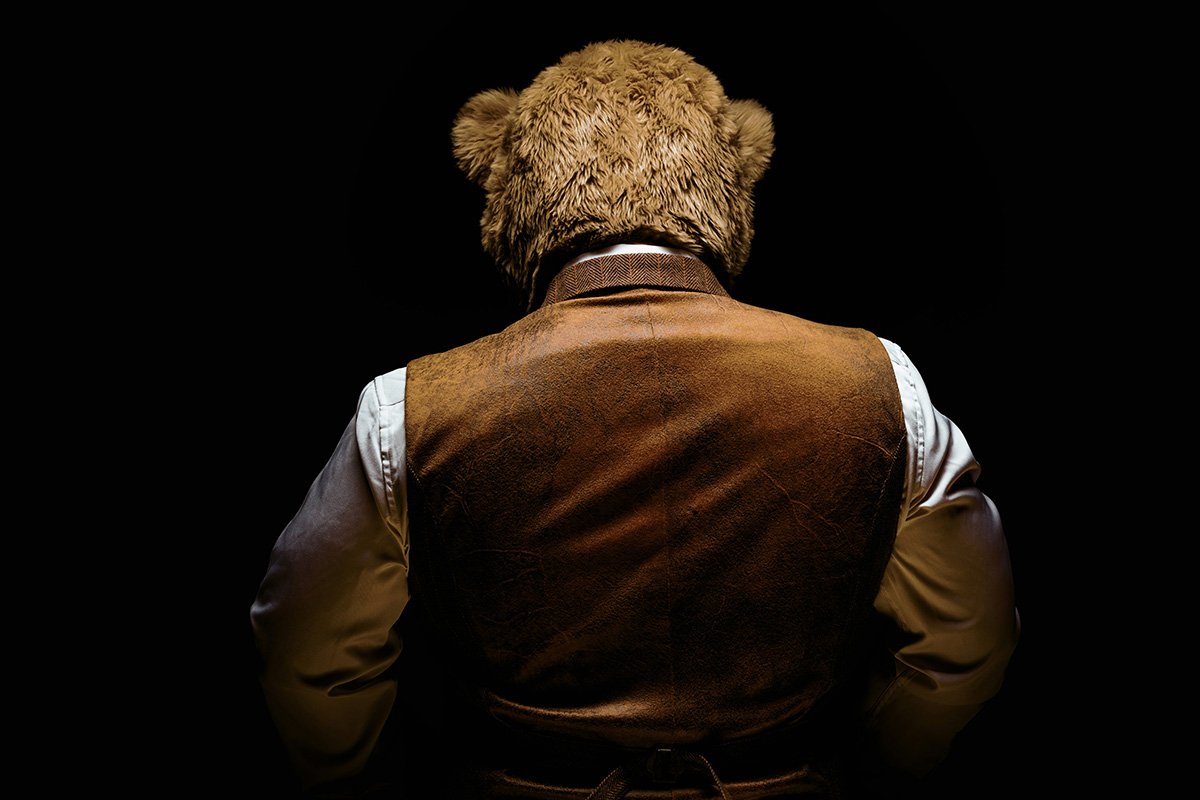
In November 1665, three men stood before a court in Accomack County in the British colony of Virginia, facing serious charges. However, William Darby, Cornelius Watkinson, and Philip Howard were not accused of stealing livestock, nor of assaulting a neighbor, nor of plotting rebellion. Instead, they were charged with “acting a play.” Earlier that year, on Sunday, August 27, in a local bar called Fowke’s Tavern in the small settlement of Pungoteague, the trio wrote and performed an original work entitled Ye Bare and Ye Cubbe, generally recognized as the earliest documented English-language play performed in what would become the United States.
Court records document that they were ordered to produce the script (“give a draught of such verses or other speeches and passage”) and to perform it again in costumes (“those habiliments that they then acted in”)—this time before the colonial court. Because Puntoteague was a tiny coastal community, it just happened to be held in the very same tavern where the play had first been staged three months earlier.
After the command performance, the three men were found not guilty of any offense. Their accuser, Edward Martin, a local Quaker who most likely hadn’t even seen the original performance, was reprimanded and ordered to pay costs. Ye Bare and Ye Cubbe itself was never performed again after that, and its script has since been lost to time. But while the play didn’t survive, the accusation did.
That irony is more than a historical curiosity. It may be one of the earliest lessons American theater offers about civic life: the earliest surviving record of a play exists because someone believed performance deserved official scrutiny.
It may be one of the earliest lessons American theater offers about civic life: the earliest surviving record of a play exists because someone believed performance deserved official scrutiny.
That pattern reaches far beyond theater history. Archives are indispensable, but they are never neutral. They preserve what institutions choose, or are compelled, to record. Court records preserve indictments. Governments preserve regulations. Newspapers preserve controversies. What remains is often a reverse image of public life—evidence that people gathered, imagined, argued, laughed, or provoked someone enough to be noticed. The performances themselves, being ephemeral by nature, often disappear.
Yet democracy has always depended upon those fleeting moments. Long before laws are enacted or public consensus emerges, communities gather to test ideas, inhabit competing perspectives, and imagine different futures. In the theater, we call that rehearsal. More broadly, rehearsal is the social practice of exploring possibilities before deciding what to believe. It is where disagreement becomes inquiry rather than division, where uncertainty becomes something to inhabit rather than immediately resolve.
The history of American performance is filled with moments when that rehearsal proved unsettling to those in power. William Henry Brown’s The Drama of King Shotaway, among the earliest known plays by an African American playwright, has also disappeared. What survives instead are reports of police intervention, White mobs disrupting performances, and the eventual destruction of the African Grove Theatre. During the Great Depression, the Federal Theatre Project—part of FDR’s Works Progress Administration—treated performance not as luxury but as public infrastructure, employing thousands of artists while bringing theater into communities long excluded from professional stages. It lasted only four years before Congress dismantled it amid accusations that publicly funded artists had become politically dangerous.
In the 1960s, El Teatro Campesino emerged alongside the United Farm Workers movement, but as organizers came under FBI surveillance, so too did the company’s performances. In the 1990s, the controversies surrounding the NEA Four reminded Americans that support for the arts could quickly become a struggle over artistic freedom itself. Even today, amid proclamations of a new “Golden Age of Arts and Culture,” artists and cultural institutions continue to negotiate the uneasy relationship between public performance and political power.
Again and again, American performance reaches us less through artistic preservation than through institutional resistance. People gather. They perform public life. Institutions respond. Someone declares the gathering dangerous, indecent, partisan, or un-American. Then another generation begins again. The names and circumstances have changed, but the underlying question has not: what kinds of public performance are communities willing to sustain?
Seen this way, Ye Bare and Ye Cubbe is more than the first surviving record of a colonial play. It is an early glimpse of a recurring American argument, not simply over theater, but over whether public imagination itself deserves room to exist.
Sign up for our free newsletters
Subscribe to NPQ's newsletters to have our top stories delivered directly to your inbox.
By signing up, you agree to our privacy policy and terms of use, and to receive messages from NPQ and our partners.
That argument eventually lands in an unexpected place: the nonprofit sector. We often describe nonprofit theaters, museums, libraries, universities, historical societies, archives, and community arts organizations as preserving culture. That description is true, but also incomplete. Their deeper function is to sustain public rehearsal.
Rehearsal is the social practice of exploring possibilities before deciding what to believe.
In theater, rehearsal is where possibilities remain open. Actors test choices before audiences decide what works. They argue, fail, revise, abandon ideas, recover forgotten ones, and discover new relationships through collective experiment. Healthy democracies require analogous spaces. Before policies become law or public opinion hardens into certainty, citizens need places where difficult questions can be explored without requiring immediate agreement. They need spaces where competing interpretations can coexist long enough to become conversation rather than conflict. Before a democracy can decide what it believes, it must have places where people can imagine alternatives together.
That is what nonprofit cultural institutions make possible. Libraries do more than preserve books. They convene public inquiry. Museums do more than safeguard objects. They invite communities to reinterpret shared histories. Historical societies rescue local memory before it disappears. Universities bring scholarship, artistic practice, and public debate into sustained conversation. Community theaters, choirs, galleries, archives, and neighborhood arts organizations create recurring opportunities for strangers to gather around stories larger than themselves. They preserve less the products of democratic culture than the habits that make democratic culture possible.
Markets rarely reward that work consistently. Governments sometimes support it and sometimes scrutinize it. Civil society occupies the space between, sustaining forms of public encounter whose value cannot be measured solely through revenue, efficiency, or immediate political agreement.
That role feels increasingly visible today. Across the country, nonprofit cultural organizations find themselves navigating funding uncertainty, legislative pressure, programming controversies, and competing demands over whose histories deserve public recognition. These debates are often framed as disputes over budgets, curricula, exhibitions, or performances. They are also debates about whether communities will continue to have places where uncertainty itself can be practiced.
Before policies become law or public opinion hardens into certainty, citizens need places where difficult questions can be explored without requiring immediate agreement.
In a democracy, mechanisms like voting, legislation, and fair trials are indispensable. Democracies cannot function without those acts of resolution. But they also cannot flourish without institutions where questions remain open long enough for citizens to test ideas together before choosing among them. Elections settle questions, while rehearsals open them. Legislatures make decisions, while rehearsals explore. Courts issue judgments, while rehearsals force many different constituents to ask what justice might yet require.
Theater makes that process visible because rehearsal is its ordinary practice. Yet the principle extends far beyond the stage. Every oral history project, every community archive, every neighborhood museum, every public reading, every collaborative exhibition, every difficult classroom discussion, and every devised performance become an opportunity for people to encounter one another before consensus has formed.
As the United States commemorates its 250th anniversary, attention has turned toward constitutions, declarations, monuments, and founding documents. These belong within our national archive. But anniversaries also invite us to notice what rarely survives.
We will never recover the words spoken in that Virginia tavern in 1665. The archive falls silent where the performance once lived. But perhaps that silence is itself instructive. The significance of Ye Bare and Ye Cubbe lies less in the missing script than in what its disappearance reveals: Americans have always gathered in uncertain public spaces to test ideas before one another. Our “first American play” may be gone, but the rehearsal continues.