Editor’s note: Language and identities evolve. This article uses historical terms alongside modern ones. Because groups, generations, and local communities have different language preferences, these choices reflect a best effort to honor both the people who lived this history and those in the movement today.
Sixty years after a trans woman at a San Francisco diner ignited the first well-documented queer uprising in US history, local activists are again mobilizing to support individuals and families fleeing government attacks on trans existence. It’s a crisis that underscores that American liberty has never been a guarantee, but a right demanded by communities that resist not just through protest, but also by organizing networks of care and defense.
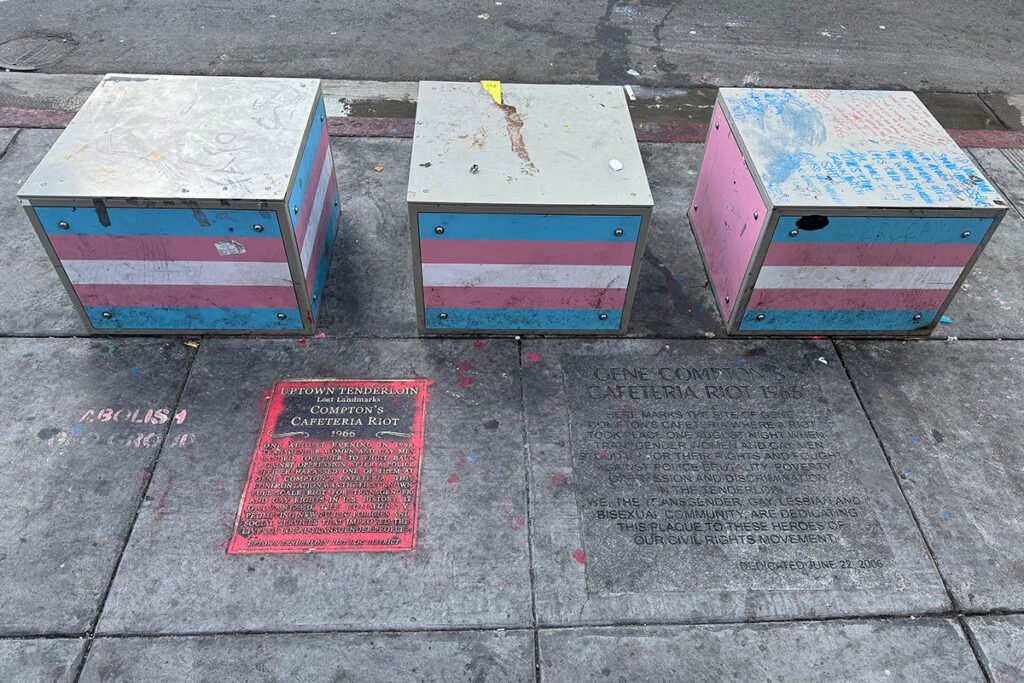
The 1966 Compton’s Cafeteria Riot—which happened three years before Stonewall and is still finding its rightful place in public consciousness—didn’t just mark a turning point in queer resistance. It catalyzed the creation of a groundbreaking network of trans-affirming organizations and services, built by and with the community.
Its legacy endures. In the decades since, trans organizers in San Francisco have kept pushing forward, sometimes in partnership with government and other times in spite of it. Today, the trans community is reclaiming the neighborhood where the riot took place and taking steps to turn it into a permanent home for queer pride and power. As transphobic policies escalate around the country, that work is not merely symbolic, but an urgent tactical response to an all too familiar systemic hostility.
Discrimination Leads to Resistance
To understand why a diner became a flashpoint, it helps to look at the crushing prejudice, exclusion, and violence that pushed its customers to fight back.
Today, the trans community is reclaiming the neighborhood where the riot took place and taking steps to turn it into a permanent home for queer pride and power.
For decades before San Francisco’s Castro District became a famous LGBTQ+ neighborhood, much of the city’s queer population was pushed into the Tenderloin—a small, densely populated, low-income area that functioned as a containment zone. Even within this neighborhood nicknamed the “gay ghetto,” trans people, drag queens, and others whose identities didn’t fit rigid gender norms—who were disproportionately young people of color—faced further exclusion. Shut out of stable housing, employment options, and even many gay businesses, they were forced to the margins of an already marginalized neighborhood.
In the 1960s, as is still true today, trans people faced acute discrimination and violence, beyond even what was already inflicted on the predominantly white and cisgender gay community that had been gaining economic, cultural, and political influence in San Francisco. The city’s police relentlessly harassed gender-nonconforming people, weaponizing laws against female impersonation, using the “wrong” toilet, sex work, or simply standing on the sidewalk to justify humiliations, arrests, and beatings.
In this hostile environment, a diner called Gene Compton’s Cafeteria was a rare late-night refuge where trans people, drag queens, and queer youth could get a meal and socialize somewhere safer than the city streets. Yet even at Compton’s, management discriminated against its customers, sometimes calling in the police to escalate the harassment. Management also hired a private security guard, banned regulars for lingering, and started charging fees just to sit down. This discrimination drew the attention of Vanguard, a new gay youth liberation group formed under the sponsorship of Glide Memorial Church, which picketed the diner in July 1966.
By August, tensions boiled over. According to accounts, one night a Compton’s employee called police to remove some customers. When police arrived and an officer tried to arrest a trans woman, she flung a cup of coffee in his face. Trans people, drag queens, and others threw objects, flipped tables, hit officers with purses, shattered windows, and forced police into the street where the riot continued. Confrontations flared up repeatedly in the following days.
The exact date the coffee cup flew is unknown because newspapers ignored it and police claim no records exist. The story stayed buried for nearly 30 years, until historian Dr. Susan Stryker uncovered a reference to it in the 1972 San Francisco Gay Pride program, in the archives of the nonprofit Gay and Lesbian Historical Society of Northern California (now called the GLBT Historical Society). The finding launched Stryker on a years-long research project that culminated in her 2005 documentary, Screaming Queens.
Reflecting on her archival find in the documentary, Stryker said she initially wasn’t sure if the story she had stumbled onto was true. “But if it was,” she said, “that riot might represent the transgender community’s debut on the stage of American political history.”
Stryker’s research verified the riot was real and her documentary restored the Compton’s Cafeteria Riot to the historical record, establishing it as one of the catalysts for the trans organizing that followed.
What the Riot Built
In the months and years after the riot, San Francisco’s trans people and allies built a first-of-its-kind network of gender-affirming organizations and services.
A key part of the pivot was when activist Louise Ergestrasse demanded support for trans people from Sergeant Elliott Blackstone, the first police liaison to the gay community in the nation in 1962, giving him a copy of Dr. Harry Benjamin’s groundbreaking book, The Transsexual Phenomenon. Already sympathetic, Blackstone became an unlikely champion, working closely with the trans community on improving police treatment of residents, increasing access to trans-supportive services, and fundraising at his church for hormone therapy when the city government refused.
Sign up for our free newsletters
Subscribe to NPQ's newsletters to have our top stories delivered directly to your inbox.
By signing up, you agree to our privacy policy and terms of use, and to receive messages from NPQ and our partners.
Trans organizers and Blackstone also targeted government programs, pressuring the city’s Department of Health to provide services, including referrals for gender-affirming surgery, which was just becoming available in the US. As a result of this grassroots organizing, the city hired trans people to work at a job training program and issued an identification card bearing the trans individual’s name and gender, making it possible to open bank accounts, sign leases, and secure documented employment.
By 1967, trans activists, with the support of Glide Church and Blackstone, had launched Conversion Our Goal (COG), the nation’s first formal trans organization and a vital entry point for gender-affirming services. This soon evolved into the National Transsexual Counseling Unit (NTCU), the world’s first peer-run trans advocacy and support organization. Other organizations followed, including the California Association of Transsexuals Society (CATS) and Helping Hands Center.
The courage of the trans women, drag queens, and young queers who fought back at Compton’s created a legacy of fierce self-determined resistance that still anchors San Francisco’s trans community today.
This progress was part of a fragile truce with a still-hostile society. Trans people and their allies remained under constant threat from anti-trans discrimination that had not gone away. In 1973, San Francisco police ran a sting operation, entrapping an NTCU peer counselor on drug charges, and attempting to frame Officer Blackstone. Around the same time, some gay liberation coalitions were drawing new borders around who belonged in the movement—and trans people and drag queens were not included.
The years that followed brought new crises and new organizing. The devastating HIV/AIDS epidemic in the 1980s again demanded that the community build the healthcare and mutual aid infrastructure that the government refused to provide. The trans movement itself underwent internal shifts, driven by pioneering builders who broadened the understanding of trans identity while successfully pushing the medical establishment to decouple gender identity from sexual orientation. There were also significant policy victories along the way, such as in 1974, when San Francisco ended its ban on cross-dressing, and in 1995, when the city added “gender identity” to its law prohibiting discrimination in housing and employment.
But the organizing never stopped. The courage of the trans women, drag queens, and young queers who fought back at Compton’s created a legacy of fierce self-determined resistance that still anchors San Francisco’s trans community today.
The Transgender District works to ensure that trans people can stay in the Tenderloin neighborhood, access the care they need, and build economic lives on their own terms. It is, in the most direct sense, the riot’s institutional heir.
Defiantly Fighting Back
As the 60th anniversary of Compton’s Cafeteria Riot approaches, San Francisco’s trans community has converted defiance into infrastructure, and infrastructure into a base from which to fight the next transphobic attacks.
In 2017, three Black trans women founded the first legally recognized transgender cultural district in the world, anchored in the same Tenderloin area where the riot took place. The Transgender District works to ensure that trans people can stay in the Tenderloin neighborhood, access the care they need, and build economic lives on their own terms. It is, in the most direct sense, the riot’s institutional heir.
Trans political power is visible in many other ways. The city government now has an Office of Transgender Initiatives, a Gender Health program, and a Drag Laureate position whose second and current holder, Per Sia, is a transgender first generation Mexican-American. In 2024, San Francisco declared itself a sanctuary city for transgender and gender-nonconforming people and gender-affirming healthcare providers.
More protections are in the works. San Francisco supervisors may soon vote on expanding the city’s Fair Chance Ordinance to extend employment and housing protections to people who have convictions related to gender expression and healthcare that is legal in California. Honey Mahogany, Director of the Office of Transgender Initiatives and a co-founder of the Transgender District, said that trans-serving organizations are seeing a surge of “40 percent increases in participation, especially from people coming to San Francisco seeking sanctuary from other states.” The proposed legislation, she said, is meant to ensure that “the discrimination that they faced in their home towns doesn’t follow them here.”
While the site of the riot was listed in the California and national historic registers last year, the building that housed Compton’s until it closed in 1972 remains out of reach. The building is owned by GEO Group, a private prison corporation and major ICE contractor, which runs what it calls a “residential reentry center.” A trans-led group called Comptons x Coalition is trying to get GEO Group removed from the building so the site can be “transformed from a place of carceral harm into a community-stewarded hub for culture, care, and belonging.”
The story of the riot is also being brought to life a few blocks from where it happened. The Compton’s Cafeteria Riot play, produced by the nonprofit Tenderloin Museum, places the audience inside a functioning replica diner—complete with cups of hot coffee—where the cast recreates the night the community fought back.
Sixty years on, it’s one way San Francisco’s trans community is making sure its demands to exist without oppression are still heard loud and clear.