
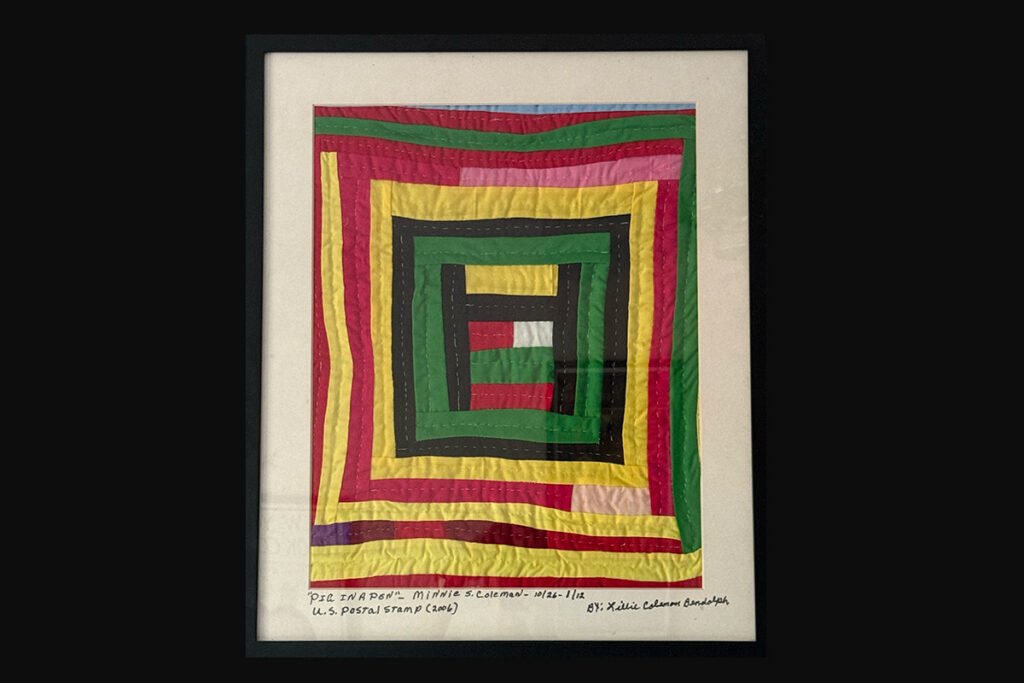
In 1966, colorful quilts dotted the landscape of Gee’s Bend in Alabama and traveled far beyond the banks of the Alabama River. Sewn by Black women whose families endured generations of brutal slavery and exclusion from the economy, the cooperative enterprise, the Freedom Quilting Bee was born under the guidance of master quilters and artists Estelle Witherspoon, Aolar Carson Mosely, and Father Francis X. Walter. The quilts were sold nationwide, which connected the small Alabama community to larger economic networks and empowered Black women in Wilcox County.
But the Freedom Quilting Bee was more than a quilting cooperative. It was a community-built institution that helped create financial security and democratic participation during a period when Black Americans, particularly Black women, were limited from doing so, especially in one of the most historically marginalized regions of the rural South.
Gee’s Bend and the Need for Local Solutions
How curious a land is this—how full of untold story, of tragedy and laughter and the rich legacy of human life; shadowed with a tragic past and big with future promise.
The Souls of Black Folk, W. E. B. Du Bois
The [Freedom Quilting Bee] coalition consisted of 60 members from across the Black Belt, the region of Alabama that became a focal point for the fight for civil rights.
The isolated location of Gee’s Bend and the persistent poverty forced communities to develop their own institutions to meet their local needs, and the Freedom Quilting Bee was just that. The area takes its name from North Carolina enslaver and planter, Joseph Gee. In 1816, he acquired 6,000 acres of land along a horseshoe bend in the Alabama River and built a plantation with 17 enslaved people. By 1845, Gee had relinquished ownership of the plantation and the slaves to Mark H. Pettway, a relative, enslaver, and then sheriff of Halifax County, NC. The following year, Pettway transported his family and furnishings in a wagon train from North Carolina to Gees Bend. Historical reports from Souls Grown Deep shared that Pettway made his 100 slaves complete the journey on foot.
Life didn’t get easier following the Civil War and the emancipation of slaves. During this period, a system of sharecropping or tenant farming was practiced in Gee’s Bend. However, unpredictable harvests and corrupt landowners left the farmers in perpetual poverty. Then came the Great Depression, which made life even harder for the farmers. But hope emerged in 1966 when an Episcopal priest, Francis Walter, was lost in the rural community and noticed bright quilts hanging on clotheslines. According to Alabama Heritage, Walters believed that the quilters could benefit from forming a quilting coalition to fund civil rights activities.
During the busiest time, the cooperative produced 30,000 shams, a small decorative pillow to accompany a quilt, every six months which raised family income by as much as 25 percent in the area.
Building the Freedom Quilting Bee
On March 2, 1966, the Freedom Quilting Bee was established and found a home in founder Estelle Witherspoon’s home. The coalition consisted of 60 members from across the Black Belt, the region of Alabama that became a focal point for the fight for civil rights. With Walter’s assistance, two quilt auctions were staged in New York, and records reveal that only five of the over 100 quilts were not sold. While the cooperative was founded as a way to fund civil rights activities, it also became a way for Black women to start earning an income.
Lucy Mingo, Freedom Bee piecer and quilter, reflected on the opportunities created: “There are so many ladies here in Boykin [also known as Gee’s Bend] who really didn’t have the opportunity and didn’t have the skills to go out and get a job. But once they got to the quilting bee, that was something for them. I just didn’t only want it for myself. I wanted it for whoever would get able to get them a job there.”
By April 2, 1966, the Freedom Quilting Bee was legally incorporated into a nonprofit cooperative association, with Witherspoon as president, Minder Coleman as vice president, Addie Nicholson as secretary, and Mattie Ross as treasurer. Through the years that followed, the Freedom Quilting Bee became a thriving business that allowed Black women to learn how to conduct business and have economic freedom. During the busiest time, the cooperative produced 30,000 shams, a small decorative pillow to accompany a quilt, every six months which raised the quilter’s family income by as much as 25 percent in the area.
Sign up for our free newsletters
Subscribe to NPQ's newsletters to have our top stories delivered directly to your inbox.
By signing up, you agree to our privacy policy and terms of use, and to receive messages from NPQ and our partners.
Quilting as Civic Infrastructure
While the Freedom Quilting Bee did kickstart a nationwide quilting revival, the cooperative was more than simply producing quilts.
“Quilts have always engaged the pressing social and political issues of their time. They have been deployed throughout history by marginalized people to confront instances of violence, oppression, and exclusion,” said curator Lauren Applebaum in an interview with Smithsonian Magazine.
For the citizens of Gee’s Bend, quilting was an outlet that provided shared decision-making, collective responsibility, economic self-help, and community leadership. The cooperative plays a critical role in the county’s broader 250-year history, as communities like Gee’s Bend were building democratic life outside formal recognition in places where democratic participation was largely impossible.
As the country looks back on 250 years of history, the Freedom Quilting Bee is a reminder that democracy is not only built or sustained through government.
Throughout most of America’s history, democratic participation while framed with a governmental lens, often looks like mobilizing on a community and local level. Cooperatives like the Freedom Quilting Bee are examples of how communities build systems of mutual support to solve local problems while allowing their people to build collective power.
During the running years of the Freedom Quilting Bee, the cooperative secured design contracts with big names such as the Chairman of the Columbia Broadcasting Company and Sears, Roebuck & Co. Nettie Pettway Young, a member of the cooperative, said, “The Bee was the first business Black people in Wilcox owned. It was the first time I knew I was special, the first job I had—excusing cotton picking.”
Despite the disbandment of the group in 2012 following the passing of the last original board member, Nettie Young, the legacy of the quilters from Gee’s Bend continues to live today.
The colorful quilts drying on clotheslines in Gee’s Bend represented far more than craftsmanship. They became a source of income and helped connect an isolated community to national markets during a period when such opportunities were limited. Through shared purpose and collective labor, the members of the Freedom Quilting Bee built an institution of democracy.
As the country looks back on 250 years of history, the Freedom Quilting Bee is a reminder that democracy is not only built or sustained through government. The cooperative is an example of how oppressed local communities of ordinary citizens built their own institutions when others failed them.