
In the wake of the killing of Renee Nicole Macklin Good by an ICE agent in Minneapolis, MN, on January 7, confusing and often contradicting information swiftly spread, from the murdered woman’s name to whether she was a volunteer observer of ICE activity in her neighborhood when she was shot, shortly after dropping off her young son at school.
The Trump administration has also repeatedly attempted to deny, discredit, and mischaracterize multiple videos recorded at the scene that show an ICE agent shooting the woman in her car.
“We are here to love each other, care for each other, and keep each other safe and whole.”
One fact that has not been disputed? Good was an artist. Specifically, she was a musician and poet. And that matters.
Good’s Poetry
While Good was a student at Old Dominion University and went by the name Renée Nicole Macklin, she won a 2020 Academy of American Poets Prize, one of the college and university prizes awarded annually by the nonprofit Academy of American Poets. Though a now-deleted bio mentioned other literary journal publications, Good’s prize-winning poem “On Learning to Dissect Fetal Pigs” is the only poem of hers readily available online.
In the poem, the narrator wrestles with two guiding principles of her life, faith and science, along with childhood wonder and adult knowledge:
it’s the ruler by which i reduce all things now; hard-edged & splintering from knowledge that used to sit, a cloth against fevered forehead.
can i let them both be? this fickle faith and this college science that heckles from the back of the classroom
On NPR, Scott Simon described the poem as “wry and funny as she tries to reconcile science and faith.” In a statement provided to Minnesota Public Radio (MPR News), Good’s wife, Becca Good, wrote that “Renee was a Christian who knew that all religions teach the same essential truth: we are here to love each other, care for each other, and keep each other safe and whole.”
Good sang in high school and studied music while majoring in English in college. Her social media has been made private, but in her bio, she described herself as a guitar player. That a poet would also sing is not surprising; poetry is the literary art that deals the most with musical language. As one of my poetry professors used to lecture, I don’t care what the poem says as long as it’s musical.
We look to poems not to make sense, though logic and passionate and informed arguments are found there, but to be moved, including by the emotional and universal language of music.
The poetry and social justice connection is also a strong one: Poems are, by their very nature, words of resistance, speaking truth to power. As poet Charlotte Pence wrote, “poetry’s great power [is] to hold space for what others have tried to silence.” Poetry is one of the “oldest art forms to articulate resistance,” she wrote. “Partly why all art forms—and poetry in particular—are key vehicles for resistance is that at their core, they are unpredictable. And it’s that quality that fascists hate, because unpredictability makes a group harder to control.”
And poets have a long, important history of fighting for justice on the page and beyond it.
Poetry as Resistance
From Audre Lorde and Adrienne Rich, who wrote poems of feminism and queer identities; to Langston Hughes and James Baldwin, who wrote of Black lives and experiences of racism; to Denise Levertov’s anti-war poems, poets create from the fabric of their lives.
Many poets from Allen Ginsberg to Maya Angelou were also activists beyond the written word. Andrea Gibson performed at Take Back the Night events and pressured hospitals to be transparent in their pricing for patients. Poets have organized protests against the war in Gaza and raised not only awareness but funds through readings, events, and other initiatives.
“The derisive tone when the right says ‘poet’ in relation to Renee Good is pretty telling of the world of ugliness they wish to live in.”
That strong tradition of resistance is ongoing. Poets are speaking out and acting up for stemming climate change and against the human rights violations perpetuated by ICE. In 2019, the Los Angeles Review of Books published an article titled “Poetry Against ICE,” which focused on the work of Jose Bello, an immigrant poet and activist.
At such an unstable and dehumanizing time, what good can poetry do? Like any art, poetry has the power to influence hearts and change minds. The power of poetry even now can be seen in the discourse surrounding Good’s death. Fox News host Jesse Waters disparaged her on air calling her “a self-proclaimed poet from Colorado with pronouns in her bio.”
Sign up for our free newsletters
Subscribe to NPQ's newsletters to have our top stories delivered directly to your inbox.
By signing up, you agree to our privacy policy and terms of use, and to receive messages from NPQ and our partners.
As user Schooley wrote on Bluesky, “The derisive tone when the right says ‘poet’ in relation to Renee Good is pretty telling of the world of ugliness they wish to live in.” That’s a world that has decimated the National Endowment for the Arts, formerly the country’s leading support for writers, and has gone all in on AI, despite issues on everything from child sexual abuse imagery to the loss of work for human creators and the proliferation of data centers ravaging communities.
One group immediately accepted Good as a poet—people who care about poetry, including readers and writers. Multiple poems about and dedicated to Good have already been published, including one by Cornelius Eady, cofounder of the African diaspora literary organization Cave Canem. As poet and Minneapolis resident Danez Smith wrote in Harper’s Bazaar:
Neighbor, you should be alive. Neighbor, you should have risen into another good morning with your wife. Neighbor, you should have made it home to your child, to the bright warmth of his laughter, but our country is at war with its people, and your goodness makes you an enemy, a citizen insurgent.
It’s not hard to imagine that Renee Good would have also found writing and artistic community in the city, had she lived.
Literary Tradition
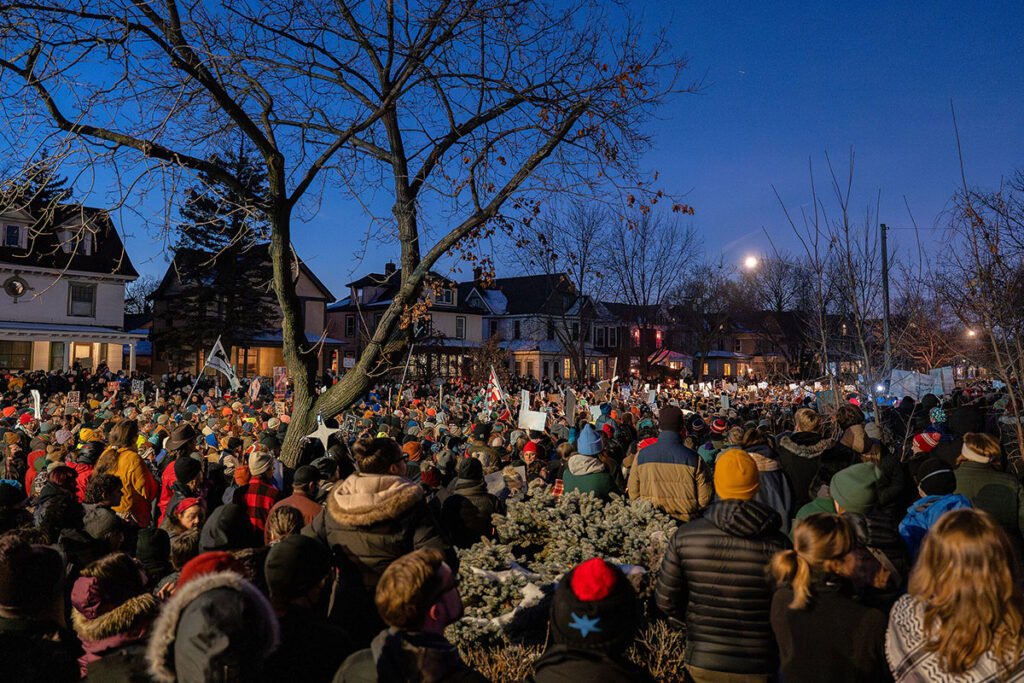
Minneapolis, where Good was killed and where neighborhoods are being besieged by ICE, has roots in the civil rights movement. The city mobilized in community support and protests after the murder of resident George Floyd.
Minneapolis is also a city of writers. The city has a long history of well-known and respected literary nonprofits, from the Loft Literary Center, one of the country’s leading literary arts centers, which hosts classes, readings, conferences, and more; to Graywolf Press, a nonprofit literary publisher of fiction, nonfiction, poetry, and translation. Both nonprofits have been active since the 1970s.
Becca Good said their family had recently moved to Minneapolis from Colorado: “Like people have done across place and time…to make a better life for ourselves. We chose Minnesota….What we found when we got here was a vibrant and welcoming community, we made friends and spread joy.”
It’s not hard to imagine that Renee Good would have also found writing and artistic community in the city, had she lived, with its thriving nonprofits like the Minneapolis Center for Book Arts and the literary gathering center Open Book.
As Becca wrote in the statement, “There was a strong shared sense here in Minneapolis that we were looking out for each other. Here, I had finally found peace and safe harbor. That has been taken from me forever.”
Kent Wascom, one of Good’s former creative writing professors at Old Dominion University—where she finished her degree at the start of the COVID pandemic as a nontraditional student who was pregnant and working—told The New York Times, “What I saw in her work was a writer that was trying to illuminate the lives of others.”
Good was doing so in her actions—observing and witnessing—when she was killed. That witness is the job of poets, and it’s not just work but a calling. As Smith, Good’s neighbor, wrote, “The role of us poets is to witness the world.”
For More on This Topic
How Black Literary Organizations Are Continuing the Work of Liberation