logo logo
Donate
    • Membership
    • Donate
  • Social Justice
    • Racial Justice
    • Climate Justice
    • Disability Justice
    • Economic Justice
    • Food Justice
    • Health Justice
    • Immigration
    • LGBTQ+
  • Civic News
  • Nonprofit Leadership
    • Board Governance
    • Equity-Centered Management
    • Finances
    • Fundraising
    • Human Resources
    • Organizational Culture
    • Philanthropy
    • Power Dynamics
    • Strategic Planning
    • Technology
  • Columns
    • Ask Rhea!
    • Ask a Nonprofit Expert
    • Gathering in Support of Democracy
    • Hope in the Dark
    • Humans of Nonprofits
    • Inside the States
    • In Defense of Civil Society
    • The Myth of Heroic Leadership
    • Notes from the Frontlines
    • Notes from the Long Arc
    • Reimagining Philanthropy
    • The Unexpected Value of Volunteers
    • We Stood Up
  • Newsletters
  • NPQ Online Events
    • Learn Out Loud
    • Leading Edge Webinars
    • Partner Events
    • On Demand
  • Leading Edge Membership

Another City Comes Out for Converting Local Businesses into Worker Cooperatives

Ruth McCambridge
August 9, 2017
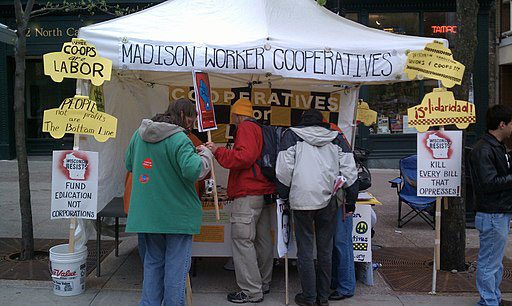
By cometstarmoon from Madison, Wis., United States of Disregard [CC BY 2.0], via Wikimedia Commons

August 7, 2017; Voice of OC

Over the years, NPQ has covered several stories where a city declares itself as open and ready to actively support worker cooperatives. Some examples are Rochester, N.Y., New York City, and Madison, Wisconsin. Now, top officials in the city of Santa Ana, California, have unanimously passed a resolution to support small business development through worker cooperatives.

Last week, the city council said that establishment of cooperatives keeps wealth flowing more broadly within the community. They suggested that when local business owners begin to consider if they may want to retire, conversions to worker cooperatives should be encouraged.

In 2015, advocates helped push a bill through the California Legislature, establishing a legal framework for co-ops across the state and affording them certain tax benefits and active support by local government would be invaluable.

Sign up for our free newsletters

Subscribe to NPQ's newsletters to have our top stories delivered directly to your inbox.

By signing up, you agree to our privacy policy and terms of use, and to receive messages from NPQ and our partners.

Staff were directed to study what actions the council might be take to support such conversions. Some of the measures to be investigated are incentives like access to grants and lower cost business licenses. Further, staff has been asked to work with local stakeholders to explore what might be included in a business ordinance encouraging worker cooperatives. The report is due back in 90 days.

Councilman Jose Solorio says that support of cooperatives is a good way the city can help “reduce exploitation” of workers currently in underground jobs while growing a healthy shared local economy.

Santa Ana, with a population which is 80 percent immigrant, is already home to a number of immigrant cooperatives supported by Santa Ana Building Healthy Communities, a 10-year initiative of the California Endowment. Around 22 percent of the Santa Ana community lives below the poverty level, according to the latest census, and some workers cannot be legally hired due to their undocumented status. Sandy Chiang, program manager at Building Healthy communities, said that some of the motivation for the recent interest in facilitating cooperative development is the gentrification of the area. This, she says, has resulted in a lot of hipster shops replacing local mom-and-pop shop endeavors.—Ruth McCambridge


The work isn’t done. Neither is our commitment.

The challenges facing nonprofits aren’t going away. Neither can the journalism that informs, connects, and amplifies the sector.

Help NPQ keep this work free and accessible.

Give Today
logo logo logo logo logo
About the author
Ruth McCambridge

Ruth is Editor Emerita of the Nonprofit Quarterly. Her background includes forty-five years of experience in nonprofits, primarily in organizations that mix grassroots community work with policy change. Beginning in the mid-1980s, Ruth spent a decade at the Boston Foundation, developing and implementing capacity building programs and advocating for grantmaking attention to constituent involvement.

More about: Community DevelopmentCooperatives and Employee OwnershipEquity-Centered ManagementNonprofit NewsPolicy
See comments

Stuffing-1
You might also like
What do we mean when we talk about political education? Community organizations and the fight for a better democracy
Emily Blank
How a renewable energy cooperative is bringing economic justice and community to Chicago’s south side
Chelsea Crandall
Proposition 40 and the question at the heart of America’s safety net: Who should pay?
María Constanza Costa
Why the good offers seem to go to others
Rhea Wong
Can a deck of cards interrupt bias in grantmaking?
Devyn Taylor
American farmers’ politics are more complicated than headlines suggest
Lisa Held

Upcoming Webinars

Group Created with Sketch.
December 3, 2:00 pm ET

After the Midterms

What’s Next for Nonprofits?

Register
Group Created with Sketch.
January 28, 2:00 pm ET

Democratic Staff Structures

Weaving Shared Leadership and Union Practice in Nonprofits

Register
You might also like
A pair of hands cups a handful of water from the surface of a lake of water. Below the hands, water ripples out.
What do we mean when we talk about political education?...
Emily Blank
A Black woman with braids kneels down among a set of solar panels with a clipboard.
How a renewable energy cooperative is bringing economic...
Chelsea Crandall
A person holding up a protest sign that reads, “Tax the Rich”
Proposition 40 and the question at the heart of America’s...
María Constanza Costa

Like what you see?

Subscribe to the NPQ newsletter to have our top stories delivered directly to your inbox.

See our newsletters

By signing up, you agree to our privacy policy and terms of use, and to receive messages from NPQ and our partners.

  • About
  • Advertise
  • Careers
  • Contact
  • Copyright
  • Donate
  • Funders
  • Editorial Policy
  • Media Relations
  • Privacy Policy
  • Submissions

We are using cookies to give you the best experience on our website.


Nonprofit Quarterly | Civic News. Empowering Nonprofits. Advancing Justice.
Powered by  GDPR Cookie Compliance
Privacy Overview

This website uses cookies so that we can provide you with the best user experience possible. Cookie information is stored in your browser and performs functions such as recognising you when you return to our website and helping our team to understand which sections of the website you find most interesting and useful.

Strictly Necessary Cookies

Strictly Necessary Cookie should be enabled at all times so that we can save your preferences for cookie settings.