The Palmer Memorial Institute opened in the small town of Sedalia, NC, at the turn of the twentieth century. Now, the historic school that once served Black youth but fell into disrepair after closing in 1971 is on a path toward much-needed rehabilitation, preservation, and adaptive reuse. Community members, alums, and professional preservationists and architects collaborated to develop a bold new vision for the site, thanks to support from the National Trust for Historic Preservation (NTHP). Now, they’re fundraising to make that vision a reality.
Charlotte Hawkins Brown, a Black teacher educated in Cambridge, MA, opened the Palmer Memorial Institute in 1902, when another local school closed, leaving an entire community of Black children with no access to formal education. Brown was only 19 at the time and just beginning a career that would see her become a major leader in the movement for Black education in the Jim Crow-era South. She named her school for Alice Freeman Palmer, who had been an activist in the nineteenth-century movement for women’s education and a mentor to Brown.
Over the next almost 70 years, until a fire forced the school to close in 1971, it grew from its humble beginnings in an old blacksmith’s shed to fourteen buildings across a 300-acre campus. It became a nationally recognized preparatory school, and about 2,000 students passed through its classrooms and dormitories.
Brown, who served as the school’s president for 50 years, was known for her community-first approach. As part of their education, Palmer Memorial Institute students volunteered on the school farm, contributed to the construction of new campus buildings or worked in the school’s cafeteria and bookstore. Brown also valued the arts, and some Palmer Memorial Institute graduates and staff went on to become successful painters or performers.
“The whole reason that this partnership exists is because there are so many sites out there in this country like the Charlotte Hawkins Brown Museum and the Palmer Memorial Institute—these sites of incredibly important and overlooked women’s history that are in considerable need.”
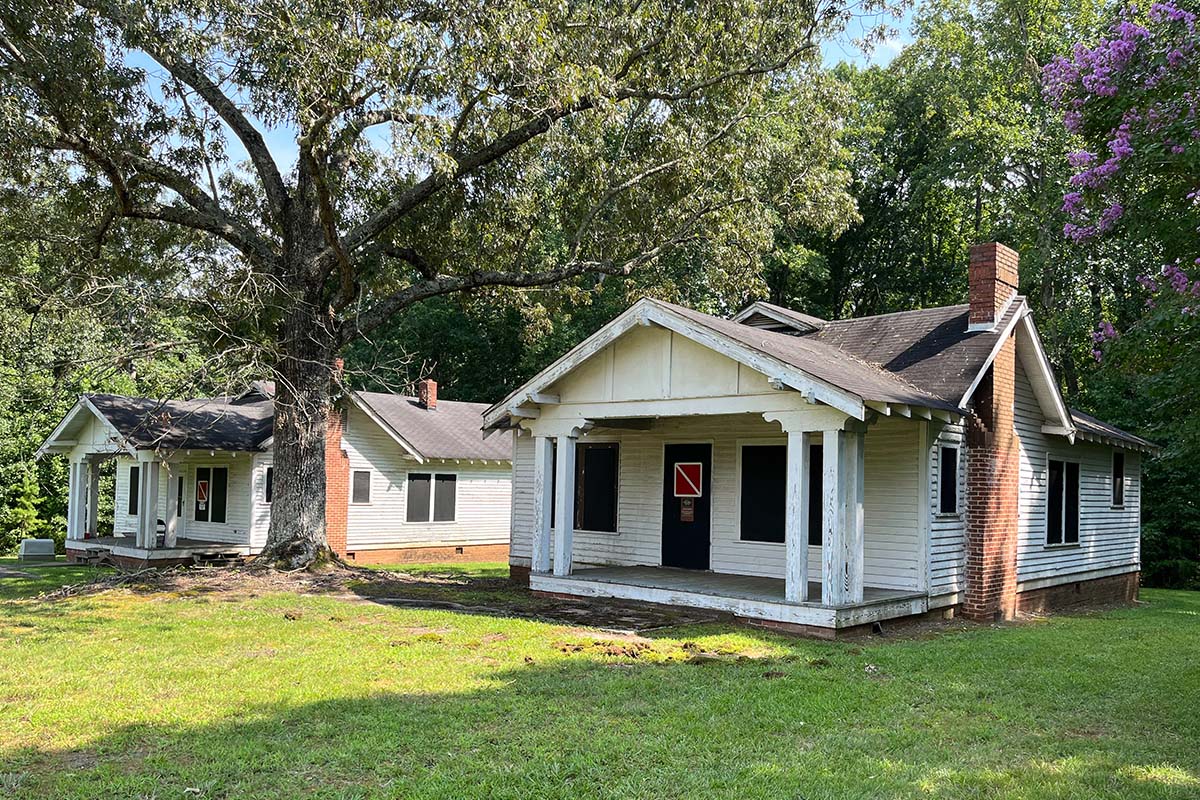
But the school’s storied past has faded as the campus fell into disrepair since its closure. Though a 35-acre portion of the campus with 12 remaining buildings was designated a North Carolina state historic site in 1987 and remains the only Black women’s history site recognized as such in the state, a lack of funding and competing priorities at the state level made maintenance and rehabilitation of many of the buildings almost impossible.
While the site is in desperate need of support, it has nonetheless continued to serve some community functions. The cottage where Brown lived during the decades she served as the school’s president has been restored and now operates as the Charlotte Hawkins Brown Museum, a historic house museum. The school’s old dining hall is also used as an early voting location and rented for events, such as weddings and reunions. Every year, the city hosts a gathering there to honor the town’s elders and Brown’s legacy. A youth group from the local YMCA also maintains a small community garden on site.
The Future of the Institute
A grander vision for the site’s future began to come into focus when it was named to National Trust for Historic Preservation’s list of 11 Most Endangered Historic Places in 2022. That listing noted that the site’s most at-risk buildings were the three main dormitories, whose ceilings and walls had begun to crumble and whose roofs were threatening to collapse from water and fire damage and deferred maintenance.
The listing also attracted the attention of NTHP’s Where Women Made History initiative, whose team recognized the site as a perfect candidate for a partner program it operates with Robert A.M. Stern Architects, or RAMSA, a national firm headquartered in New York. That program offers grants of design, planning, and technical services to endangered women’s history sites.
“The whole reason that this partnership exists is because there are so many sites out there in this country like the Charlotte Hawkins Brown Museum and the Palmer Memorial Institute—these sites of incredibly important and overlooked women’s history that are in considerable need,” said Christina Morris, manager of WWMH.
But because rehabilitating the site had been little more than a faraway dream for so long, the Charlotte Hawkins Brown Museum team had no concrete plans for where to start. To move forward, it launched a collaborative, community-based visioning and planning process to develop goals to inform RAMSA’s work at the site.
Sign up for our free newsletters
Subscribe to NPQ's newsletters to have our top stories delivered directly to your inbox.
By signing up, you agree to our privacy policy and terms of use, and to receive messages from NPQ and our partners.
“The main goal was to transform this site into this cultural hub, a space for resources, a space for rejuvenation, and learning, and education.”
“When we first started working with the site, they had an enormous amount of need,” Morris recalls. “There was also an enormous amount of interest and philosophical and spiritual support, but not the financial support that they really needed.”
The first listening session with alums and members of the Sedalia community was held in March 2023. “We definitely wanted to make sure that the history isn’t forgotten,” said Cam Dungee, who, as Sedalia’s town manager, was involved in discussions about the future of the historic campus. “We’re trying to make sure that Charlotte Hawkins Brown’s legacy is still in the forefront because that has always been a really important part of Sedalia.”
The entire process took about three years, unfolding through constant collaboration among Sedalia locals, Palmer Memorial Institute alums, the Charlotte Hawkins Brown Museum’s team, and the preservationists, architects, and other professionals at NTHP and RAMSA.
“The main goal was to transform this site into this cultural hub, a space for resources, a space for rejuvenation, and learning, and education,” said Tanesha Anthony, the museum’s site manager.
Ultimately, RAMSA developed an ambitious adaptive reuse plan for the site and marketing materials to support the Charlotte Hawkins Brown Museum as it fundraises to bring the plan to life. Cheryl Lu Xu, an associate at RAMSA, said the years-long collaborative process helped ensure the finished plan would meet the site’s needs and honor Brown’s legacy.
“Successful campus plans are shaped not only by institutional goals, but also by the perspectives of the people who use and experience the campus every day,” she said.
The completed adaptive reuse plan was shared for the first time in February 2026 and later celebrated at an event at RAMSA’s New York City offices in May. The plan organizes the sprawling campus into program-specific zones, each addressing a pillar of the museum’s new strategic vision that emerged from the community visioning process. Those pillars are economic development, education, community, and leadership.
Organizing the campus into zones also allows for phased implementation—vital because the Charlotte Hawkins Brown Museum is still fundraising to bring the plan to life. To support this work, in 2024, NTHP’s African American Cultural Heritage Action Fund awarded the museum $75,000 for the long-term planning, preservation, and education work. This will help establish an endowment and its own nonprofit organization, giving it greater financial and decision-making independence from the state of North Carolina.
A new nonprofit will be responsible for securing the fundraising needed to move the project forward. Its first goal will be restoring the school’s old science building in the center of campus and reopening it as the site’s new visitor center and gift shop. Later, cottages will be restored as artist and scholar-in-residence housing and maker spaces. The campus plan also boasts new outdoor infrastructure, including walking and bicycling trails and a community garden inspired by Brown’s appreciation of wellness and nature.
Rehabilitation and preservation work at the Charlotte Hawkins Brown Museum site is far from over. But the positive impact of the community visioning process is already clear. Morris said it resulted in an adaptive reuse plan designed not only “for the benefit of the physical place, but for the benefit of the people—and here, this is an entire town—and also those descendants, and the legacy of the site.”