
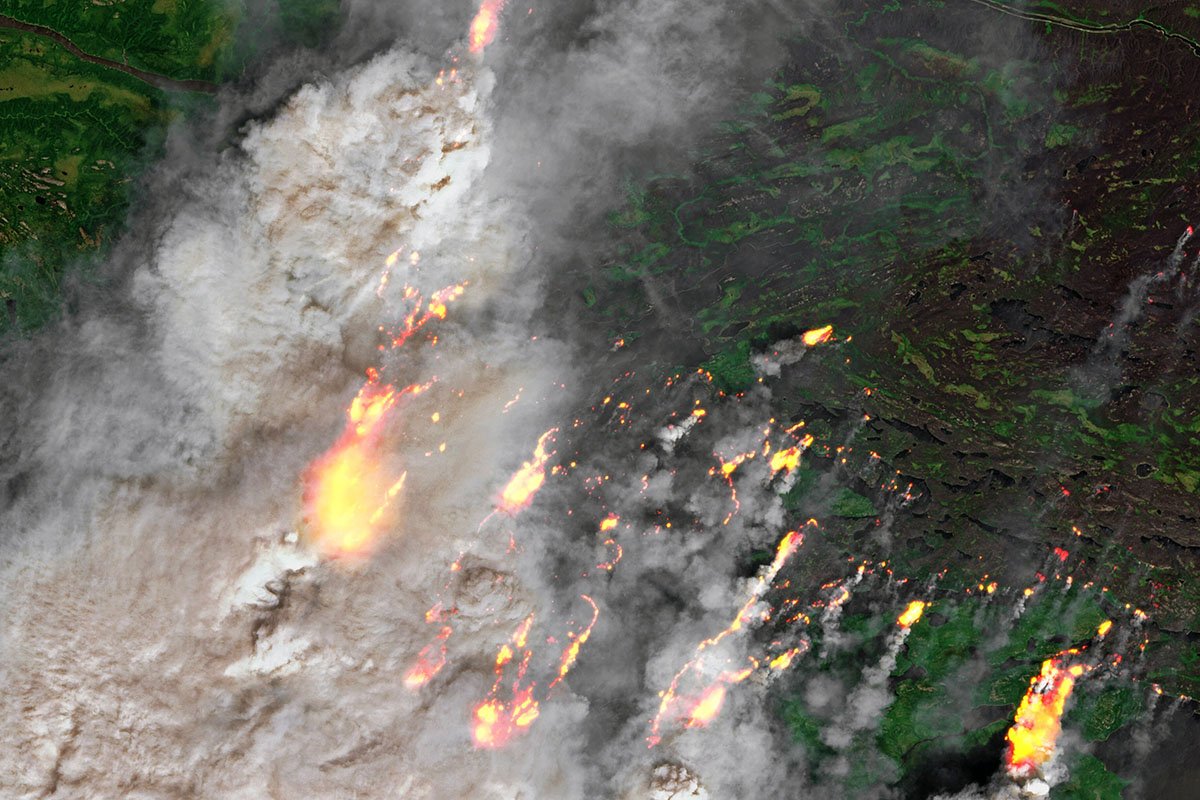
Currently, there are more than 900 wildfires burning across more than 3 million hectares of Canada.
“The boreal forest is evolved to burn—that’s how it replaces itself,” Chelene Hanes, a wildland fire scientist with the Canadian Forest Service, told ScienceNews. “It’s ecologically responsible to let fires do what they do.”
As long as fires are not threatening communities, she added.
Communities are being impacted, though, and those communities are disproportionately Indigenous.
Kept From Decisions Yet Burdened by Them
A 2024 study found that between 1980 and 2021, almost 42 percent of wildland fire evacuations in Canada took place in predominantly Indigenous communities. Yet, Indigenous people make up just 5 percent of the Canadian population. The study authors put the cost of evacuations alone at $3.7 billion CAD, a number that jumps to $4.6 billion CAD if productivity loss is included.
“First Nations are having to deal with the costs on their own to put the infrastructure in place to fight these fires,” Robert Phillips, a member of Tsq’escen’ (Canim Lake Band) and political executive of the First Nations Summit, said in an interview with NPQ. “Traditionally we have ways of protecting our lands and dealing with forest fires. We’ve been working with British Columbia and Canada to put those ways in place, but the capacity and the dollars, especially now with governments—they’re not exactly funding a lot of things. And prevention doesn’t seem to be top of order.”
“Especially now with governments—they’re not exactly funding a lot of things. And prevention doesn’t seem to be top of order.”
Amy Cardinal Christianson (Métis), lead author of the 2024 study and director of Fire Stewardship at the Indigenous Leadership Initiative, said that the situation is one in which Indigenous communities are effectively kept from being able to make decisions about land management, while being disproportionately burdened by the impacts of the management decisions. Christianson was also previously an Indigenous fire specialist at the National Fire Management Division of Parks Canada.
“What we’re seeing right now across Indigenous nations in Canada is just a real frustration,” she said in an interview with NPQ. “These wildfire events are going to happen. We know they disproportionately impact our communities, yet we’re continually kept out of being able to honestly do much about it.”
Indigenous-Managed Land
Since as far back as 1610, state regulations have been in place to prevent people from setting fire to woodlands. But these regulations offer no exception for the cultural practices that Indigenous communities have used to successfully manage their land for centuries.
“Boreal forest is really a fire-dependent forest and so are many other forests in Canada,” said Christianson. “By excluding fire from them, it’s created these basically unhealthy landscapes that are not really able to deal with these climate change-induced wildfires that we’re seeing.”
Like Christianson, Hanes believes the ecological responsibility isn’t letting wildfires rage; it’s instead preventing wildfires through the consistent and controlled fires at the heart of many Indigenous communities’ practices.
In recent decades, non-Indigenous government agencies have begun conducting prescribed burns. Because fire exclusion has created such overgrown and essentially unhealthy landscapes, these large-scale interventions are now needed, Christianson said, but only as a course correction, not as a long-term solution. That’s where Indigenous practices come in.
Sign up for our free newsletters
Subscribe to NPQ's newsletters to have our top stories delivered directly to your inbox.
By signing up, you agree to our privacy policy and terms of use, and to receive messages from NPQ and our partners.
Indigenous communities are diverse and distinct. While each has their own relationship with and practices around fire and burning, Indigenous communities tend to practice smaller, slower, cooler burns.
“The best I’ve heard is from an elder in northern Saskatchewan who described it as fires you can walk beside,” Christianson recalled.
“We know they disproportionately impact our communities, yet we’re continually kept out of being able to honestly do much about it.”
Anchored in millennia of intimate Indigenous knowledge of landscapes, these fires take place at intervals that are determined by nature, not by schedule. Christianson noted that most agencies don’t start getting ready to do prescribed burns until the spring, but she burns while there’s still snow on the ground to offer natural fire breaks. This year, that was in February.
Not only do these smaller fires take their cues from nature, but they also carry important cultural significance that’s essential to the practice. Indigenous understanding of, and relationship with, fire considers it a wise teacher rather than a mere management technique. That’s what separates prescribed burns from cultural burns. It’s cultural burns and the wisdom behind them that many Indigenous communities want to see embraced and practiced more broadly—but under Indigenous leadership.
What the Nonprofit Sector Can Do
This, Phillips said, is where nonprofits and other organizations can come into play. In practice and policy, nonprofits can start by creating relationships that allow them to support work that’s Indigenous-led, which will then become a more holistic approach.
From there, nonprofits can help First Nations secure the funding they need to do that work. “Then First Nations can start taking care of the land, returning the health of the lands; we can get our people trained and skilled, we can get the capacity and the infrastructure to not just fight these fires, but make them not happen in the first place,” added Phillips.
While Meaghan Daniel, a lawyer and activist working with First Nations affected by the wildfires, agreed that Indigenous people themselves need to determine what recovery looks like on a community-by-community basis, she cautioned that emphasizing the role of nonprofits can “unintentionally obscure the fact that First Nations are governments.”
“While the nonprofit sector plays an important and valuable role, these are fundamentally government-to-government relationships and responsibilities,” Daniel told NPQ. Losing sight of that, according to her, risks depoliticizing what is, at its core, a political issue that sits at the intersection of public responsibility, Indigenous self-government, and governmental accountability.
Daniel sees the work of nonprofits as complementing those responsibilities rather than substituting them. “We should be ensuring governments are fulfilling their legal responsibilities, [be concerned with] whether First Nations governments have the resources and authority they need to lead emergency response and recovery, and whether recovery efforts respect Indigenous self-determination.”
According to Daniel, “Recovery should not simply mean rebuilding what existed before the fire. It should be supporting First Nations governments to define for themselves what recovery looks like.”
Daniels concurred with Phillips that nonprofit organizations can make enormous contributions, but she added that they’re most effective when they begin by listening to First Nations and supporting their locally identified priorities. Those priorities may come in a sequence that might seem unexpected. The key is holding space for what nonprofits and other non-Indigenous entities do not yet know—that which Indigenous communities have managed to hold on to and pass down for generations.