

These are not people who drifted away from democracy. They are people the system moved to the sidelines.
In January 2025, 178,395 Louisiana voters were listed as “inactive”—six percent of the rolls. By July 2026, that number was 450,086. More than one in seven registered voters in the state now carries the label.
Inactive is not the same as removed. But it is the step before removal, and adds friction at the exact moment a voter shows up to cast a ballot.
These are not people who drifted away from democracy. They are people the system moved to the sidelines. Of the 450,000 voters listed as inactive in Louisiana, 52,981 cast a ballot in November 2024. Nearly 84,000 more voted in 2020 or 2022.
Cleanup by mailbox
It turns an unanswered envelope into a change in voting status. And mail is a blunt instrument. It doesn’t reach people who moved across town, who share a mailbox, who don’t read English, or who set aside official-looking letters they assume are junk.
Secretary of State Nancy Landry has said the increase stems from a 2024 law that let her office send address-confirmation mailings to anyone who hadn’t voted in 10 or more years. This cycle was the first time the tool was used. Voters who didn’t respond were moved to inactive.
On paper, that sounds like routine housekeeping. Federal law requires states to make a reasonable effort to keep their rolls current, and outdated lists carry real costs: mail sent to empty addresses or inflated registration counts, for example.
What the data shows is that this method also caught a large number of voters who were neither gone nor disengaged. It turns an unanswered envelope into a change in voting status. Mail is a blunt instrument. It doesn’t reach people who moved across town, who share a mailbox, who don’t read English, or who set aside official-looking letters they assume are junk.
The results show the bluntness. Every one of Louisiana’s 64 parishes saw its inactive rate rise. And while the law targeted voters who hadn’t cast a ballot in a decade, tens of thousands who voted in 2024 ended up on the inactive list anyway. This is because the state’s inactive list also includes voters whose addresses couldn’t be verified in the annual review of the rolls, including anyone whose mail came back undeliverable, no matter how recently they voted.
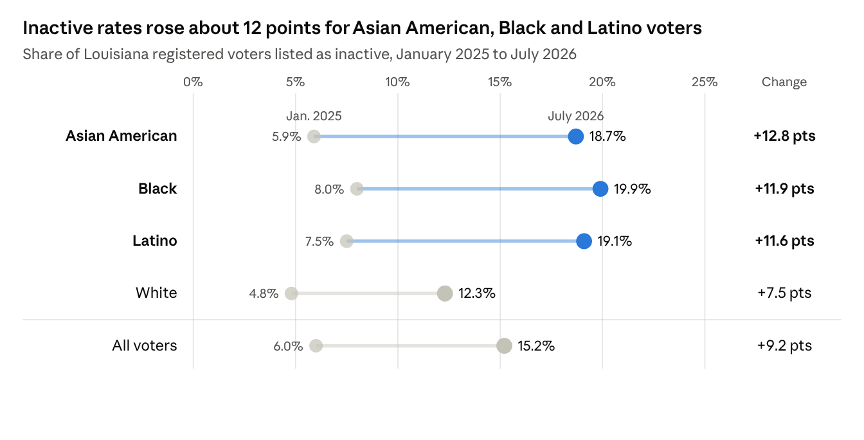
Asian American voters saw the steepest climb of any group: their inactive rate more than tripled, from 5.9 percent to 18.7 percent.
The burden isn’t shared evenly
If this were neutral housekeeping, you’d expect the increase to land roughly evenly.
Rise Forward Foundation and the ACLU of LA analyzed the state voter file from January 2025 and July 2026, and the gaps are hard to miss:
- Black voters are 1.6 times as likely as white voters to be inactive (19.9 percent vs. 12.3 percent). They make up 31 percent of Louisiana’s voters but 41 percent of the inactive list.
- Asian American voters saw the steepest climb of any group: their inactive rate more than tripled, from 5.9 percent to 18.7 percent.
- Latino voters’ rate rose from 7.5 percent to 19.1 percent.
- Registered Democrats are nearly twice as likely as registered Republicans to be inactive (17.4 percent vs. 9.1 percent). The two parties have almost exactly the same number of registered voters in Louisiana, but Democrats make up 41 percent of the inactive list and Republicans 22 percent.
- Voters ages 25 to 44—the people most likely to be moving for jobs and raising kids—are inactive at about 21 percent, more than double the rate of voters 65 and older. Among Black voters ages 35 to 44, it’s 28 percent.
After Rise Forward Foundation flagged the surge and shared its voter file data, the ACLU of Louisiana ran its own analysis, covering January 2025 through May 2026. It reached the same conclusion in its report, Who Gets Flagged Inactive?: “the burden of inactivity does not fall equally whether by race or party.” Zoom in and it gets starker. In East Carroll Parish, the inactive rate jumped more than 17 points, to 32.6 percent—the highest in the state. Nearly 39 percent of Black voters there are now inactive, compared with 16 percent of white voters.
In Tangipahoa Parish, 41.7 percent of Black voters are inactive—more than 9,000 people—compared with 23.7 percent of white voters. This is a parish whose school system was granted unitary status, resolving a 60 year old desegregation case last week. The history of who gets left out of public systems there is not abstract.
We’ve seen this before
Louisiana has shrunk its electorate through the rolls before. When the state adopted its 1898 constitution, nearly 44 percent of its registered voters were Black. The new constitution added a poll tax, a literacy test, a property requirement, and a grandfather clause that exempted many white men. Black registration fell from 130,344 to 12,902, and by 1900 the state counted just 5,320 registered voters of color.
In the 1950s, after Black registration had climbed back to about 15 percent of the rolls, a state legislative committee and the Citizens’ Councils began what the US Supreme Court later called “a wholesale challenging of Negro names already on the voting rolls.” Thousands of Black voters, and virtually no white voters, were purged.
Sign up for our free newsletters
Subscribe to NPQ's newsletters to have our top stories delivered directly to your inbox.
By signing up, you agree to our privacy policy and terms of use, and to receive messages from NPQ and our partners.
That history is why, from 1965 until 2013, Louisiana had to get federal approval before changing its voting rules and show that the change wouldn’t harm voters of color. The Supreme Court ended that requirement in 2013 in Shelby County v. Holder. The 2024 mailing law is the kind of change that once would have needed that review. Instead, we’re learning its impact after the fact, from the voter file.
“Inactive voters can still vote”
The Secretary of State’s office says inactive status doesn’t take away anyone’s right to vote. Under state law, an inactive voter who still lives at the address on file can vote after signing a written affirmation at the polls. Voters can also reactivate online through GeauxVote or at their parish registrar’s office.
That assurance got tested again this month. On Oct. 5, 2026, what the Secretary of State’s office called “human error” during routine database maintenance switched about 67,000 voters statewide to inactive, the Louisiana Illuminator reported. The office said it caught the mistake quickly, began restoring voters’ status, and that no one’s eligibility was affected. But voters like Courtney Price, who has lived at the same East Baton Rouge Parish address for more than a decade, logged on four weeks before Election Day to find themselves listed as inactive.
In practice, that safeguard depends on poll workers applying the rule the same way in every parish, and on voters knowing to ask for it. Inactive status also starts a clock: under the same law, a voter who doesn’t vote through the next two federal general elections can have their registration canceled.
In the 2024 presidential election, Louisiana rejected 3,032 of the 3,926 provisional ballots cast, or 77 percent, according to Secretary of State data analyzed by the ACLU of Louisiana. Across the last four presidential elections, 70 percent were rejected. The published figures don’t show how many of those ballots came from inactive voters, or why they were thrown out.
Not just Louisiana
Louisiana isn’t alone. Across the South, states have leaned harder on mail-based list maintenance, and inactive rolls have grown with it. In Florida, nearly one million voters moved off the active rolls in 2023 after a new state law tightened list-maintenance requirements. Georgia has close to one million inactive voters out of 8.4 million registered, and last year flagged another 219,000 through a “no contact” audit of people with no recorded activity in five years. Alabama’s inactive list nearly doubled between 2020 and 2024, to about 11 percent of voters. In each state, inactive status starts the same clock: miss two federal general elections and your registration can be canceled.
Mississippi shows how much harder that step can be. There, inactive voters can’t use the voting machines. They must cast a signed paper ballot at the polling place for the precinct where they live, and it counts only if they affirm they still live at their registered address or in the same precinct, Mississippi Today reported. Voters who have moved to another county must re-register there. As in Louisiana, those who skip the next two federal general elections can be purged.
Mississippi also flags voters with a different tool. Mississippi Today reported that the state’s Secretary of State used unverified Experian credit data—a product called TrueTrace—to flag roughly 50,000 voters as inactive, without first giving them a chance to confirm their address.
Credit-bureau data was built to find debtors, not to decide who is eligible to vote. When it’s wrong, the voter pays for the error—often without knowing it until Election Day.
A fix that can’t be done by hand
Right now, the job of finding these voters and helping them get back to active status falls mostly to community organizations. This cycle, Rise Forward Foundation has mailed more than 15,500 Mississippians on the inactive list and sent more than 47,000 voter registration mailers in Louisiana.
Even at that scale, community outreach can’t keep pace with 450,000 people in one state, let alone the rest of the country. Nonprofits are left reverse-engineering, one mailer at a time, a problem the state created in a single mailing. We would never accept that in disaster response: handing out sandbags one at a time after the levee has already been breached. Yet that is how we’re handling the voter rolls.
This is an infrastructure problem, and it has infrastructure solutions:
- Verify before you flag. No voter should be moved to inactive based on an unanswered envelope or unverified commercial data alone. States should make a second, different attempt to reach voters—and publish the impact by race, age, and parish before acting, not after.
- Make the safeguard real at the polls. If inactive voters can vote, states need clear, consistent guidance in every parish and county, along with real poll worker training—and voters need to know their rights before they arrive. States should track and publicly report how many inactive voters were turned away or given provisional ballots, how many of those ballots were counted, and why any were rejected, including whether poll worker error played a role.
- Share the list, and fund the follow-up. Inactive voter lists should be easy for nonpartisan groups to access, with dedicated, year-round funding for re-engagement—not a scramble in the weeks before an election.
For now, the most useful thing anyone can do is check. Louisiana voters can look up their status on GeauxVote, and inactive voters who haven’t moved can still cast a regular ballot by signing an address affirmation at the polls. In Mississippi, inactive voters can still vote, but on a signed paper ballot. Voters who are told they can’t vote can ask for that affirmation or for a provisional ballot.
Rise Forward Foundation and the ACLU of Louisiana plan to run an analysis after the November 3, 2026, elections. The results should tell us whether inactive status kept eligible people from voting, and they should inform what the state does before its next annual canvass.