

For the past year and a half, I’ve worked with researchers to study beliefs about reparations and to translate that research into language that advocacy groups and organizations can use to change their aims and practices. Our findings yielded a new understanding about how narrative infrastructure can connect to day-to-day organizing and communications work.
As a narrative practitioner, I realized the problem was on my end: I hadn’t explained how to truly integrate these powerful research findings into the day-to-day work.
Reparations may seem like a complicated issue, but at its core the definition of reparations is simple: “Reparations” is the process of a government making amends for harm. While most people think of reparations solely in terms of money, they include a variety of material, systemic, and symbolic repairs for victims, their families, and society. The process involves four steps that can be taken in any order: reckoning, acknowledgement, accountability, and redress.
But advocating for a social justice issue that has so much history, emotional complexity, and misconceptions surrounding it can be confusing. Just when I thought I’d convinced someone that reparations were politically feasible, I’d learn that they didn’t think slavery impacted the present and therefore reparations wouldn’t be needed at all.
The reparations movement is backed by a lot of research—including polls, surveys, national reports, and message testing—and I was adding to the list. Still, I initially wasn’t sure how to use the research in my advocacy work, and I didn’t see anyone else using it beyond an initial press release. As a narrative practitioner, I realized the problem was on my end: I hadn’t explained how to truly integrate these powerful research findings into the day-to-day work. To do this took a significant shift in my approach.
Back at the drawing board, I imagined an aerial view over a small town: the wide-range perspective makes it easy to see the interlinked systems of roads between hospitals, markets, and schools where goods are delivered across locations. But on the ground, unable to view the town’s layout entirely, it’s easy to feel lost and unsure of how to get from one place to another to access the right resources.
The narrative field has developed narrative infrastructure, the “roads” or set of systems maintained in order to deliver messages and narratives consistently over time. These systems include strategic planning, collaborative networks, funding, data, and technology. Communications teams have become skilled drivers of reliable “vehicles” that include press releases, social media posts, speeches, events, film and television content, and art. These vehicles deliver a range of essential “goods”: messages, stories, and ideas.
Similarly, the social justice strategy and narrative research projects I was so passionate about were offering incredible bird’s-eye views of the best ways to connect data and campaigns. When these projects land in the hands of community organizers and communicators on the ground, however, the same research is often skimmed and passed over in favor of habitual tactics that get the job done quickly.
What I needed was a map with clear directions to effectively travel to our campaign goals and achieve our vision for a better future.
What Is a Belief Arc?
My team and I developed what we call a belief arc—a narrative map that outlines the series of beliefs a person adopts as they come to understand a complex social issue in a fundamentally different way.
A well-researched belief arc shows us an individual’s mental processes as they change their mind about a specific issue. It reveals not just where people stand, but the specific beliefs they hold along the way.
Structurally, belief arcs follow a three-part foundation:
- A series of foundational beliefs about society at large
- An issue-specific solution proposal
- A series of issue-specific beliefs
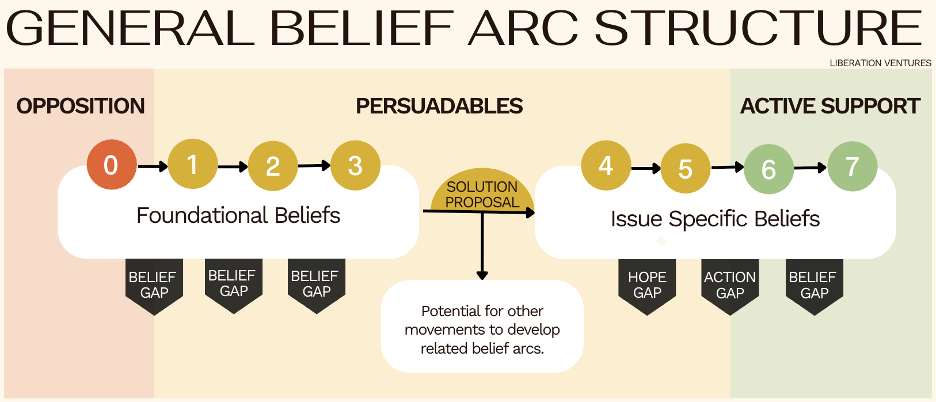
Along the arc, different audience segments fall into various stages depending on their held beliefs. Narrative strategists are able to move audiences from each group—from opposition to persuadable to active support—by tackling theoretical “gaps.” Belief gaps are related to whether individuals actually align with the ideas; the hope gap is the doubt audiences may have about seeing issue-specific ideas coming to fruition. The action gap traces what messaging is required to inspire audiences to actively mobilize for a cause.
This new narrative tool is inspired by the ladders of engagement used by labor organizers, contemplation ladders used in psychology, and the supporter journeys used in donor organizing. It also integrates research from social science, psychology, and marketing that tells us that most people don’t completely support or oppose complex social issues and that it’s unusual for people to entirely reverse their beliefs on an issue in a single setting.
Sign up for our free newsletters
Subscribe to NPQ's newsletters to have our top stories delivered directly to your inbox.
By signing up, you agree to our privacy policy and terms of use, and to receive messages from NPQ and our partners.
Using these frameworks meant the belief arc could easily be integrated into existing organizing processes. In fact, looking at past social justice movements, it appeared successful advocacy may have unknowingly used belief arcs all along.
For example, in 2012, just 48 percent of people in the United States supported same-sex marriage. However, 54 percent believed that gay and lesbian relationships were morally acceptable, 64 percent believed gay and lesbian relationships should be legal, and 77 percent believed that gay and lesbian domestic partners or spouses should have access to health insurance and other employee benefits. The data illustrate the notion of a belief arc: Many respondents who didn’t support same-sex marriage held positive intermediate beliefs about LGBTQ+ people and their rights. Over time, thanks to powerful advocacy, support for each of these beliefs evolved and all of these percentages grew, indicating that people in the United States were generally moving along a belief arc.
This meant the new tool could clarify the middle for current advocacy efforts and, maybe, help organizers increase support more quickly.
In a time when solidarity is essential, identifying our overlapping foundational beliefs offers us a chance to stay issue-focused while intertwining our liberation journeys.
How to Use a Belief Arc
The first belief arc I created with my team was the Reparations Belief Arc, in collaboration with researchers, narrative experts, and reparations movement leaders from Voss Research and Strategy, Lake Research Partners, Get Free, BLIS Collective, We Make The Future Action, and Vetiver. It maps eight beliefs from full opposition to full and active support for comprehensive reparations and is paired with eight demographic audience segments, which can be moved up or down the belief arc, depending on the messaging provided.
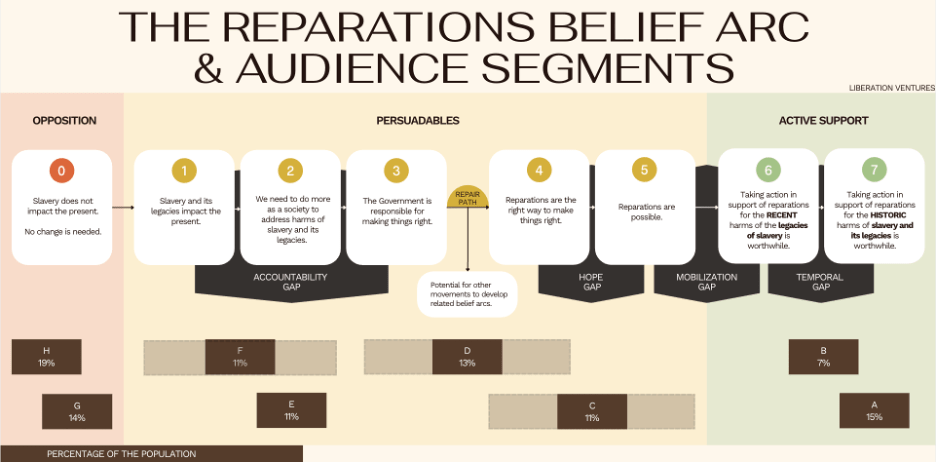
This arc shows the range of uses of belief arcs more generally:
- Tying social justice movements together
- Audience and message targeting
- Goal setting and success tracking
- Broader narrative strategy development
First, the foundational beliefs in a belief arc inherently lend themselves to narrative collaboration between social justice movements. If climate justice, immigrant rights, and reparations movements all need to instill the belief that “history impacts the present,” then one movement’s narrative success should positively impact the other’s. In a time when solidarity is essential, identifying our overlapping foundational beliefs offers us a chance to stay issue-focused while intertwining our liberation journeys.
The following defines the active beliefs that audiences adopt along the arc, and the application of each belief within the Reparations Belief Arc.
- No change is needed (“Slavery does not impact the present.”)
- Identifying the problem (“Slavery and its legacies impact the present.”)
- Caring about the problem (“We need to do more as a society to address the harms of slavery and its legacies.”)
- Identification of a target (“The Government is responsible for making things right.”)
- Support for the solution (“Reparations are the right way to make things right.”)
- Tactical confidence (“Reparations are possible.”)
- Public support for recent harms (“Taking action in support of reparations for the recent harms of the legacies of slavery is worthwhile.”)
- Public support for historic harms (“Taking action in support of reparations for the historic harms of slavery and its legacies is worthwhile.”)
Belief arcs can also be used to target messaging to specific people based on their beliefs. For example, someone who believes reparations are the right solution and are possible responds to messaging very differently from someone who believes slavery does not impact the present. We can therefore focus on moving people one step up the belief arc, increasing support incrementally.
By expanding traditional audience segmentation beyond opposition, persuadable ideas, and base support, the intermediate beliefs identified in a belief arc move us away from all-or-nothing campaigning that looks for full support after a single engagement. This can also increase trust within a movement ecosystem, which must rely on others to make subsequent touchpoints to move a person all the way up the belief arc over time.
Belief arcs also help challenge the traditional notion that narrative work is hard to track. They allow practitioners to set trackable goals, such as moving 60 percent of engaged audiences one step up the arc. Paired with annual polling or engagement surveys, the belief arc offers tracking for performance indicators. Instead of trying to track all the beliefs and themes that were changed, practitioners can track a single belief within a specific project. It takes just seven questions to track and look at the change in response over the duration of a project or campaign. This convenient indicator in audience response can point to narrative success, or lack thereof.
Today, the country is the most politically polarized it has been in decades. Belief arcs put these disparate perspectives into focus by catering messaging to different groups along the spectrum.
Finally, this kind of incremental engagement also allows us to prioritize our narrative work and set SMART—Strategic, Measurable, Ambitious, Realistic, Time-bound—narrative goals. By focusing funding or campaigning on a single stage of the belief arc and then surveying the general public annually, advocates can see if their campaign is changing the mass narrative connected to that specific belief stage.
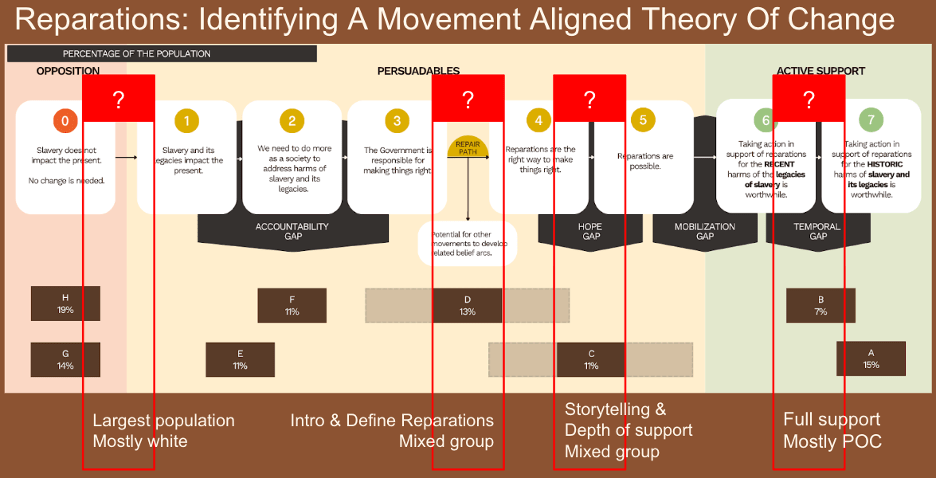
For the Reparations Belief Arc, there are a couple of theories of change that the movement is currently deliberating before prioritizing specific stages of their arc. Will reparations organizers garner enough active support to win by moving 11 percent of the public out of the hope gap? Or maybe advocates need to prioritize moving the 33 percent of the US public that doesn’t think slavery impacts the present. The movement is weighing its options. Similar processes could help inform strategy development for any other controversial issue, with a wide range of supportive and oppositional beliefs.
Today, the country is the most politically polarized it has been in decades. Belief arcs put these disparate perspectives into focus by catering messaging to different groups along the spectrum. In addition to being able to use it in day-to-day reparations advocacy and communication, belief arcs are now being developed in campaigns for transit infrastructure, 2026 Get Out the Vote initiatives, and housing and climate advocacy.
As the narrative industry continues to grow and establish its importance across social advocacy fields, I hope the belief arc meets the call for narrative infrastructure to make this work more impactful than ever. Our country needs it.