logo logo
giving banner
Donate
    • Membership
    • Donate
  • Social Justice
    • Racial Justice
    • Climate Justice
    • Disability Justice
    • Economic Justice
    • Food Justice
    • Health Justice
    • Immigration
    • LGBTQ+
  • Civic News
  • Nonprofit Leadership
    • Board Governance
    • Equity-Centered Management
    • Finances
    • Fundraising
    • Human Resources
    • Organizational Culture
    • Philanthropy
    • Power Dynamics
    • Strategic Planning
    • Technology
  • Columns
    • Ask Rhea!
    • Ask a Nonprofit Expert
    • Economy Remix
    • Gathering in Support of Democracy
    • Humans of Nonprofits
    • The Impact Algorithm
    • Living the Question
    • Nonprofit Hiring Trends & Tactics
    • Notes from the Frontlines
    • Parables of Earth
    • Re-imagining Philanthropy
    • State of the Movements
    • We Stood Up
    • The Unexpected Value of Volunteers
  • CONTENT TYPES
  • Leading Edge Membership
  • Newsletters
  • Webinars

The Red Line Crossed: Chinese Artists Arrested for Pro-Democracy Support

Susan Raab
October 21, 2014


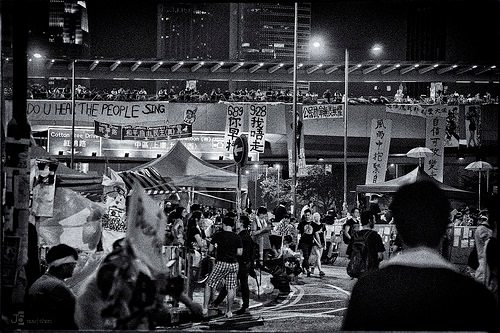
Umbrella Revolution
Occupy Central with Love and Peace by Empa3y@Jeff5

October 17, 2014; San Francisco Chronicle and The Daily Telegraph

Pigs and umbrellas would hardly seem to pose much of a direct threat to China’s government, but officials trying to quell support for the growing Occupy Central movement in Hong Kong have decided otherwise. As the Associated Press reports, a number of the most respected artists in eastern Beijing’s Songzhuang art district have been detained or taken from their homes for going public with their views, particularly via the Internet.

The artists of Songzhuang, a popular tourist destination, had recently seemed to enjoy “a rarely seen degree of creative and political freedom,” according to AP’s Jack Chang who reported on the police actions Thursday. In fact, not long ago, artist Li Dapeng “couldn’t wait to show off his series of oil paintings depicting Chinese families, leaders and aristocrats—all topped off with grotesque pig faces.” Now, all that has changed. Police roam the streets, and artists who only a few weeks ago were inviting foreign journalists in to see their new works now warn visitors away from their studios.

The first signs of trouble came on October 1st when poet Wang Zang was arrested after posting a picture of himself on Twitter holding a blue umbrella with one finger raised, showing solidarity with student pro-Democracy protesters of the “Umbrella Revolution” in Hong Kong. As readers know, the umbrella has become a powerful symbol in that movement.

【大陸淪陷區區民王藏黑衣光頭打傘撐香港:眼前黑暗,抗命的中指和拳頭不黑暗】#香港#占中#公民抗命#伞花革命pic.twitter.com/mU80dfRfz1

— 王藏 (@wang_zang) September 30, 2014

Sign up for our free newsletters

Subscribe to NPQ's newsletters to have our top stories delivered directly to your inbox.

By signing up, you agree to our privacy policy and terms of use, and to receive messages from NPQ and our partners.

“The ubiquitous umbrella symbol of Hong Kong’s protests emerged out of necessity,” says the Daily Telegraph’s chief foreign correspondent, David Blair, “due to weather and as a form of defense against police tactics” spraying tear gas. Ironically, this is the opposite of how the umbrella symbol has been used traditionally. According to Edward H. Miller, an academic at Northeastern University in Boston, from the days of Neville Chamberlain in pre-WWII England through the Kennedy and Nixon years, an umbrella was the emblem of appeasement. “If you are compromising, you are umbrella man,” he said, but now, “the umbrella is being used for the opposite purpose (in Hong Kong)…It’s a symbol of strength, a symbol of defiance.”

The world of the artists of Songzhuang has been flipped on end, too, from a time of staying safe by, as Chang says, “avoiding official harassment by following a few tacit rules: If they produced provocative work, they showed it only to each other, and if they sold it, they did so privately. Most importantly, they kept a low profile.” But now, as he quotes painter Tang Jianying as saying, “If you’re in public, you have to watch what you do. If you’re on the Web and you speak too freely, they’ll get you.”

Numbers vary, but according to Radio Free Asia, “a total of 33 activists across China have been detained since September 22nd for publicly supporting the Occupy Central movement in Hong Kong, which is calling for public nomination of candidates for the 2017 elections for the territory’s chief executive…Of those, 21 are in Beijing, and seven are from the Songzhuang Artists’ Village, according to the Weiquanwang rights website.” The Chinese Human Rights Defenders (CHRD) group, which collates reports from rights groups inside China, says 23 people are being held under criminal detention. Three have received administrative sentences, while 35 have been held under some other form of police custody.

Chang also reports that watchdog groups, including Amnesty International, are saying, “Free speech restrictions have tightened during the nearly two-year-old government of President Xi Jinping with police detaining dozens of lawyers, journalists and activists and closely monitoring non-political groups such as Christian churches and community libraries.”

On Wednesday, Xi went further, telling “the country’s most well-known directors, writers and artists gathered in Beijing that their art should be patriotic and reflect socialist values, according to the official Xinhua News Agency. That message was prominently displayed across state media and dominated that evening’s main newscast,” according to Chang.

This represents another example of what Si Han, curator of Chinese Collections at the Museum of Far Eastern Antiquities in Stockholm, has called crossing “the invisible red line” of arts censorship in China. But, as events have shown, it’s increasingly difficult to keep freedom under wraps.—Susan Raab


Our Voices Are Our Power.

Journalism, nonprofits, and multiracial democracy are under attack. At NPQ, we fight back by sharing stories and essential insights from nonprofit leaders and workers—and we pay every contributor.

Can you help us protect nonprofit voices?

Your support keeps truth alive when it matters most.
Every single dollar makes a difference.

Donate now
logo logo logo logo logo
About the author
Susan Raab

Susan Raab is a journalist, speaker and marketer whose passion is helping artists, businesses and non-profits promote their work in an authentic, meaningful way. She has, for more than twenty-five years, consulted in the literary, arts and education fields and has worked with corporations and associations from around the world. Her company, Raab Associates, is recognized as a source for marketing advice and innovative solutions to meet the challenges of balancing creative work with the need to stay competitive in an ever-changing business environment. She has a regular following as the To Market columnist for the Society of Children’s Book Writers and Illustrators and hosts the blog, ArtstoMarket. Susan’s written for many business publications and has done international interviews for Recess! Radio, a program broadcasted nationally via 500 public radio stations. She’s also the featured host of literary podcasts for the University of Connecticut’s Teacher’s for a New Era program.

More about: ActivismNonprofit NewsPolicySocial Media
See comments

You might also like
Social Enterprise: Lessons from Down Under
Vicki Pozzebon
A National Network of Activists Pursuing “People’s Budgets” Gains Prominence
Celina Su
How People’s Budgets Advance Local Democracy: A Conversation with Celina Su
Steve Dubb and Celina Su
Organizers at Global Teach-ins Seek Solutions and Envision What Comes Next
April Doner and Deissy Perilla
Real Problems Deserve Real Solutions
Eli Moore
Equitable Intermediaries: Power, Protection, Partnership
Frank Gargione and Andrea Granda

Upcoming Webinars

Group Created with Sketch.
January 29th, 2:00 pm ET

Participatory Decision-making

When & How to Apply Inclusive Decision-making Methods

Register
Group Created with Sketch.
February 26th, 2:00 pm ET

Understanding Reduction in Force (RIF) Law

Clear Guidance for Values-centered Nonprofits

Register

    
You might also like
A protest sign reading, “No Business on a dead planet”, emphasizing how the wellbeing of our planet is more important than profit.
Social Enterprise: Lessons from Down Under
Vicki Pozzebon
Budget Justice: On Building Grassroots Politics and Solidarities
A National Network of Activists Pursuing “People’s...
Celina Su
Budget Justice: On Building Grassroots Politics and Solidarities
How People’s Budgets Advance Local Democracy: A...
Steve Dubb and Celina Su

Like what you see?

Subscribe to the NPQ newsletter to have our top stories delivered directly to your inbox.

See our newsletters

By signing up, you agree to our privacy policy and terms of use, and to receive messages from NPQ and our partners.

  • About
  • Advertise
  • Careers
  • Contact
  • Copyright
  • Donate
  • Editorial Policy
  • Funders
  • Submissions

We are using cookies to give you the best experience on our website.


Nonprofit Quarterly | Civic News. Empowering Nonprofits. Advancing Justice.
Powered by  GDPR Cookie Compliance
Privacy Overview

This website uses cookies so that we can provide you with the best user experience possible. Cookie information is stored in your browser and performs functions such as recognising you when you return to our website and helping our team to understand which sections of the website you find most interesting and useful.

Strictly Necessary Cookies

Strictly Necessary Cookie should be enabled at all times so that we can save your preferences for cookie settings.