As the United States of America marks 250 years of existence this summer, the country will soon find itself in a celebratory mood, with flags, fireworks, and fanfare for a nation that has long told itself a story of expanding freedom. But anniversaries are not just occasions for celebration. They also serve as opportunities to reckon with the full truth of what has been built, at what cost, and to whom.
That reckoning must include America’s relationship with guns: how violence became normalized across generations and embedded into the fabric of the American life we’ve inherited today.
For those engaged in the work of social change, understanding this history is essential. The struggles we confront today did not emerge in a vacuum, but from generations of decisions about whose rights would be protected, and whose could be denied through force.
Violence as a Tool of Expansion and Control
Firearms have been part of the American story from the very beginning, but not only in the ways we are often taught. Yes, the musket-carrying minuteman—the colonial militia member who answered the call to resist British rule—remains an enduring symbol of American freedom and self-determination. But in that same founding era, guns were also instruments of enslavement and forced displacement. Armed slave patrols enforced bondage across the South. Militias and settlers drove Native communities from their ancestral lands at gunpoint. From the nation’s earliest days, a culture that celebrated armed resistance to tyranny also normalized armed violence against those it deemed unworthy of humanity and freedom. This was not simply a contradiction the founders failed to notice. It was a foundation they chose to lay to build this country into what it is today.
Yes, the musket-carrying minuteman—the colonial militia member who answered the call to resist British rule—remains an enduring symbol of American freedom and self-determination. But in that same founding era, guns were also instruments of enslavement and forced displacement.
As the young republic pushed westward, the gun traveled with it. The mythology of the frontier as rugged, romantic, and deeply American was written over the graves of those who stood in the way of expansion. The Trail of Tears. The massacre at Wounded Knee. These were not accidents of history or isolated excesses. They were the violent enforcement of policy, carried out by armed federal troops and settlers who believed that profit and power were worth more than human life. That belief did not die at the frontier. It was folded into the culture and passed down.
After the Civil War, as formerly enslaved people briefly glimpsed the promise of citizenship and self-determination during Reconstruction, the gun became a tool of terror to roll it back. The Colfax Massacre in Louisiana. The Rosewood massacre in Florida. Black towns and Black lives were destroyed by armed mobs, while the law looked away or pulled the trigger alongside them. Lynchings were carried out and enforced at gunpoint. The message was clear: the Second Amendment was never meant for everyone. The gun was a guarantor of White supremacy, not liberty, and the violence was not incidental to the social order; it was the social order. That logic did not end with Reconstruction. It carried forward into the twentieth century, where the assassinations of Medgar Evers and Martin Luther King Jr., along with the violent intimidation of Freedom Riders and civil rights marchers, made plain that the gun remained a weapon of political and racial suppression. The targets changed decade by decade. The weapon and the intent did not.
The Legacy We Inherited
This is not ancient history. It is the direct ancestor of what we see today: armed intimidation at polling places and protests, the disparate policing of Black gun owners, and the ease with which weapons designed for war find their way into American communities.
The United States now faces a sustained gun violence crisis on multiple fronts: mass shootings in schools and grocery stores, daily community violence, firearm suicides, children accidentally killed by guns left within reach. More than 40,000 Americans are killed by guns every year. Children and teenagers in the United States are now more likely to die from gunfire than from any other cause. Shootings in Buffalo, El Paso, Uvalde, and hundreds of other communities that never make national headlines have become so routine that the cycle of grief and inaction has its own grim rhythm of tragedy, vigil, statement, then silence. The normalization of this violence mirrors every prior era when violence against the vulnerable was tolerated, justified, and ultimately institutionalized.
It is an uncomfortable truth to confront in the middle of a national celebration. But a 250th anniversary demands more than nostalgia. It demands honesty and the courage to look at the truth unflinchingly.
Sign up for our free newsletters
Subscribe to NPQ's newsletters to have our top stories delivered directly to your inbox.
By signing up, you agree to our privacy policy and terms of use, and to receive messages from NPQ and our partners.
A Different Future Is Possible
The first two and a half centuries of American history must be a warning, not a template. We are not bound by the choices of those who came before us. The fact that gun violence has been normalized, against the enslaved, the displaced, the marginalized, and the simply unlucky, does not mean it must remain normal. History is not destiny. Policy can change. Culture can change. A generation can decide that it will not inherit what it has not consented to carry.
The next chapter of American history does not have to be written in gunfire. But it won’t write itself.
I came to this work because I saw that choice firsthand. On February 14, 2018, a gunman murdered 17 people at my high school in Parkland, Florida. In the days that followed, my classmates and I were told, once again, that this was a tragedy, that thoughts and prayers would be offered, and that meaningful change was unlikely. We refused to accept that answer.
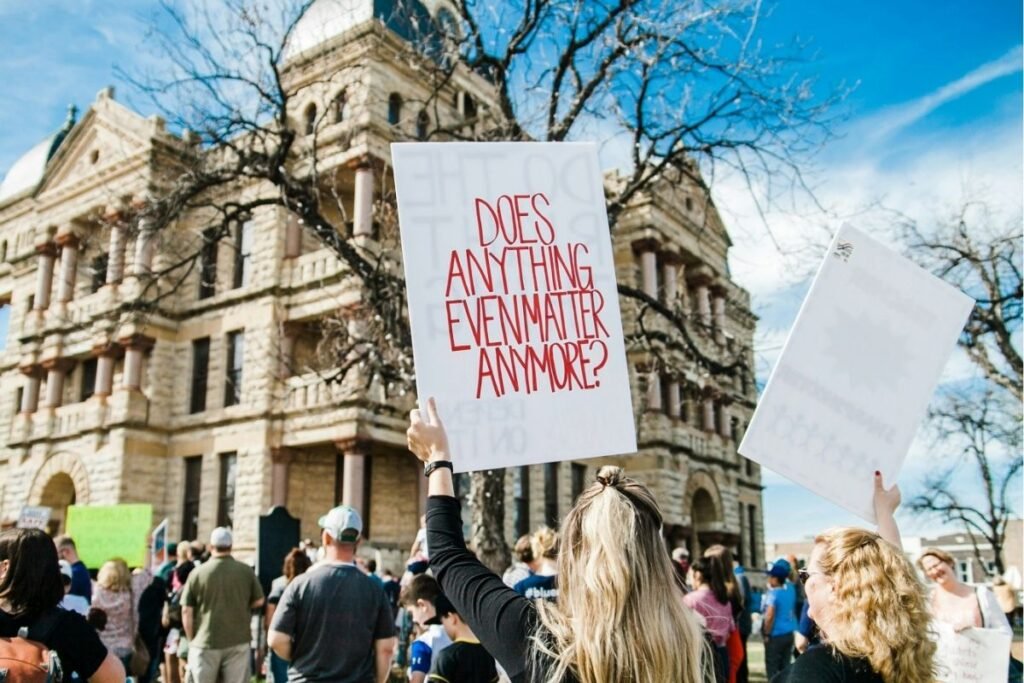
March For Our Lives exists because a generation made the same decision. Young people who grew up conducting active shooter drills, who lost friends to weapons of war, and who watched their government offer condolences and inaction in equal measure refused. They took to the streets, to the ballot box, to the halls of Congress.
Since the original March For Our Lives protest one month after the shooting in Washington, DC, the movement has helped pass hundreds of state and local gun safety laws, registered millions of young voters, and built a generation of civic leaders who treat gun violence not as an inevitability but as a policy choice. They are part of a long tradition of Americans who looked at the gap between the nation’s stated ideals and its lived reality and chose to close it.
To be sure, many Americans view firearms through a different historical lens. For them, guns represent self-defense, personal autonomy, protection against government overreach, family tradition, and constitutional rights. Those concerns are neither unfounded nor easily dismissed. The right to bear arms is formally part of the American constitutional tradition, and any conversation about reducing gun violence must grapple with tradition and constitutional rights.
But rights are not absolute, and every society draws lines when the exercise of one person’s freedom puts others at risk. The question is not whether Americans should have rights. It is how we balance those rights with the equally fundamental right of every person to live free from preventable violence.
The next chapter of American history does not have to be written in gunfire. But it won’t write itself. It will be written in the choices we make—in legislatures and living rooms, in elections and in the streets—about what kind of country we are willing to become. That means demanding universal background checks, removing weapons of war from civilian streets, and electing leaders who treat gun violence with the urgency it deserves. This is not the work of one movement or one election. It is the work of a country deciding, collectively and at last, what it actually values. The anniversary of a nation is a good time to start choosing.