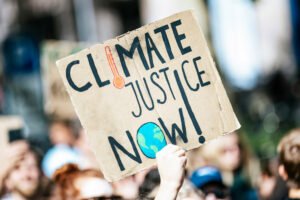

In 2025, corporate broadcast networks aired just eight hours of climate coverage across an entire year—a 35 percent drop from the year before—according to a new analysis by Media Matters for America. The decline came even as climate disasters intensified across the United States and federal climate policy entered a period of aggressive rollbacks. Climate justice appeared in only 2 percent of segments, fossil fuels in 8 percent, and White men accounted for more than half of all guests featured in climate coverage. The result is a public narrative that treats climate largely as a lifestyle segment or a one-off disaster story rather than the defining political and economic issue of our time, all while sidelining the expertise of women and frontline communities.
Climate coverage remains overwhelmingly event-driven, with extreme weather accounting for a significant share of segments, while the systems driving those events…are rarely examined.
Broadcast television still reaches millions of viewers each night. When that platform shrinks its climate coverage, the implications extend far beyond journalism. They shape how the public understands risk, policy, and responsibility. If climate appears only when a wildfire spreads across the screen or a hurricane makes landfall, audiences are left without the context needed to connect those events to fossil fuel systems and the corporations benefiting from them, the political decisions that enable their expansion, and the communities living with the consequences long before disaster footage makes the evening news.
Intentional Changes in Climate Coverage
The contraction in coverage is not occurring in a vacuum. It is unfolding alongside structural changes inside major newsrooms that are reshaping editorial priorities. CBS—historically the leader in broadcast climate reporting—dismantled much of its climate reporting capacity in late 2025 after installing Bari Weiss as editor in chief. Weiss rose to prominence as a columnist at The New York Times before founding The Free Press, a subscription-based media platform that positions itself as a corrective to what it describes as ideological bias in mainstream journalism.
Women remain underrepresented, despite playing leading roles across climate science…And frontline communities…are almost entirely absent, even as they experience the most immediate and sustained impacts of environmental harm.
Under Weiss’s leadership, The Free Press has frequently elevated climate-contrarian perspectives, questioned the urgency of climate action, and framed the crisis through cultural and ideological debate rather than scientific consensus or systemic analysis. When that editorial approach is introduced into a major broadcast newsroom, it does not simply diversify viewpoints—it reshapes what is considered credible, urgent, and worthy of sustained coverage. At CBS, those shifts coincided with the dismantling of much of the network’s climate reporting infrastructure, signaling a move away from climate as a core beat.
The effects are already visible. Climate coverage remains overwhelmingly event-driven, with extreme weather accounting for a significant share of segments, while the systems driving those events: fossil fuel expansion, regulatory decisions, and long-term emissions trajectories are rarely examined. Federal climate actions appear only intermittently in coverage, leaving viewers without a clear understanding of how policy choices shape climate risk, public health, and economic vulnerability.
Who gets to speak about climate further narrows the story. White men dominate as expert voices, shaping how the issue is framed and understood. Women remain underrepresented, despite playing leading roles across climate science, organizing, and policy. And frontline communities—those living near refineries, petrochemical corridors, and sites of fossil fuel extraction—are almost entirely absent, even as they experience the most immediate and sustained impacts of environmental harm. The result is not just a lack of diversity; it is a distortion of expertise itself.
Taken together, these trends point to a deeper structural problem within the US media ecosystem. Climate reporting in corporate outlets expands during moments of visible crisis and contracts once the immediate spectacle fades. What remains is episodic coverage that documents impact without interrogating the cause.
In practice, across the country, independent and movement-rooted media platforms are stepping in to fill the gaps left by corporate outlets.
Independent Media and the Gaps in Climate Coverage
For nonprofit and movement-rooted media, this contraction creates both a challenge and an opening.
Sign up for our free newsletters
Subscribe to NPQ's newsletters to have our top stories delivered directly to your inbox.
By signing up, you agree to our privacy policy and terms of use, and to receive messages from NPQ and our partners.
Often described as “movement journalism”—an approach advanced by organizations like Press On—this model treats journalism in service to liberation, fostering collaboration between reporters and grassroots movements and supporting storytelling led by communities most impacted.
In practice, across the country, independent and movement-rooted media platforms are stepping in to fill the gaps left by corporate outlets. Publications like Prism, Capital B, Scalawag, Convergence, and NPQ continue to report on climate from a justice lens—often sustaining coverage of systemic drivers and community impact even as corporate broadcast outlets scale it back. These outlets operate with far fewer resources, yet they consistently center frontline communities, investigate structural causes, and track the political and economic forces shaping climate risk.
At Counterstream Media, the organization I lead, this approach has meant reporting on the fight against petrochemical expansion in Louisiana’s “Cancer Alley,” where organizers are challenging the legacy of plantation land use and the fossil fuel-to-plastic pipeline that continues to shape environmental exposure. It has meant covering the rapid expansion of AI-driven infrastructure in Memphis, where communities are confronting the intersection of energy demand and environmental health risks. And it has meant documenting how Indigenous organizers are linking land rights, climate policy, and sovereignty, reframing climate not as an isolated environmental issue but as part of a broader political and economic system.
This is not simply a matter of representation. It is a question of narrative infrastructure: who defines the problem, who names its causes, and which connections are made visible.
The Need for Sustained Investments in Climate Coverage
What often gets lost in philanthropic conversations is the distinction between communications and journalism. Climate philanthropy invests heavily in communications strategies designed to advance specific campaigns or policy goals. But communications is not a substitute for independent reporting. Journalism—especially when rooted in communities—has the ability to surface inconvenient truths, follow emerging storylines, and connect systems in ways that are not always aligned with existing funding priorities.
This work is often collaborative rather than siloed. For its recent Earth Day issue on the build-out of AI data centers, Counterstream Media’s Peace & Riot magazine worked in partnership with Capital B to republish reporting, Floodlight to support visual assets, and MediaJustice for their organizing expertise. These kinds of collaborations point to a growing ecosystem, where movement-rooted outlets are not only producing journalism but also building pathways for that work to circulate more widely.
The rise of movement-rooted media does not eliminate the need for robust climate reporting by major news institutions. Broadcast networks still have reach, influence, and multibillion-dollar budgets that independent outlets cannot easily replicate. But as corporate media narrows its climate coverage, the responsibility of explaining the crisis increasingly shifts elsewhere.
For the nonprofit sector, that shift should prompt a reassessment of priorities. Climate work is often framed in terms of policy wins, technological solutions, or corporate-sponsored community programs. Without sustained investment in independent journalism, the public narrative that underpins those efforts remains fragmented and incomplete.
Broadcast television remains one of the most powerful agenda-setting forces in the United States, reaching millions of viewers each day. But as the 2025 Media Matters data make clear, its climate coverage is shrinking in both volume and depth, even as the stakes grow more immediate. In that gap, independent and movement-rooted media are not simply adding new voices—they are taking on the work of connecting the systems, political realities, and lived experiences that broadcast news is increasingly leaving out.