

Inside the States provides a clear-eyed look at the policy dynamics unfolding under state capitol domes. Blending emerging trends, behind-the-scenes context, and stories of cross-sector collaboration, this column equips nonprofit leaders to engage strategically in the state-level arena where so much of our civic future is being decided.
State politics is often treated as local by definition: bounded by district lines, committee calendars, and the practical pressures of governing close to home. But the forces shaping what happens in our statehouses are rarely so contained, as we’ve seen with the chaotic and harmful back-and-forth of mifepristone’s legal status. The policy fights unfolding under state Capitol domes are increasingly influenced by federal legal strategies, political narratives, funding streams, and movement tactics that travel across states and across borders.
That is especially true in the fight over reproductive freedom.
For nonprofit leaders trying to understand where civic power is shifting, this is one of the clearest lessons of the moment: state legislators need more than strong bill language and smart communications. They need relationships that stretch across sectors, across levels of government, and across national boundaries. They need places to compare notes with local officials, federal partners, advocates, researchers, and lawmakers in other countries confronting related attacks on bodily autonomy and democratic governance.
Arguments About Power
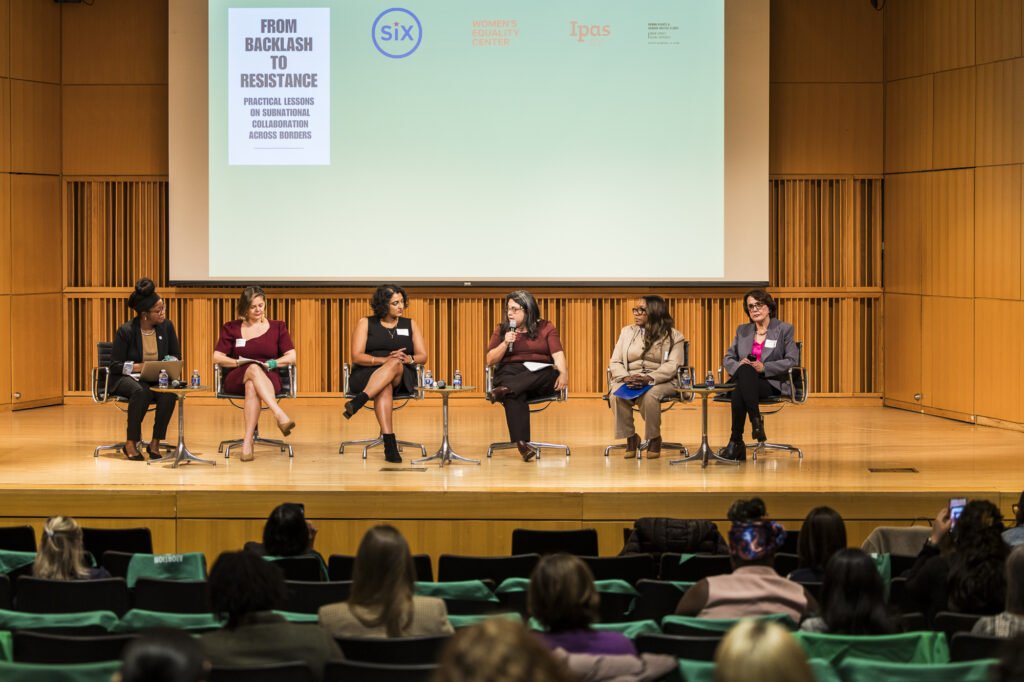
That was the animating idea behind a recent gathering SiX convened during the 70th session of the United Nations Commission on the Status of Women in New York City. In partnership with the Women’s Equality Center (WEC), Ipas, and the CUNY School of Law Human Rights and Gender Justice Clinic, SiX hosted “From Backlash to Resistance: Practical Lessons on Subnational Collaboration Across Borders”—our first United Nations side event.
The convening brought together a striking mix of leaders: Diputada Patricia Mercado from Mexico’s Congress, former state senator and current Georgia Congresswoman Nikema Williams, New York Assemblymember Amanda Septimo, Iowa State Representative Megan Srinivas, and Philadelphia Councilmember Kendra Brooks.
What emerged from that conversation was not a milquetoast call for solidarity for solidarity’s sake. It was a practical argument about power.
The panelists spoke from very different governing contexts, but they returned again and again to a common reality: anti-rights movements learn from one another. They borrow language, tactics, legal frameworks, and political infrastructure. They test arguments in one place and refine them in another. They use national institutions, local institutions, and international forums when it serves them.
Anyone committed to reproductive freedom, democratic inclusion, and human rights has to be equally serious about learning, coordination, and scale.
There is also a narrative benefit that nonprofit leaders should not underestimate. In the United States, especially since Dobbs, international attention to reproductive rights often centers on rollback and crisis. That attention is warranted, but it can obscure another part of the story: state and local leaders across the country are still organizing, legislating, and building new forms of power and resistance. Giving those efforts global visibility does more than improve morale. It broadens the field of possible allies, signals that backlash is being contested in real time, and reminds lawmakers in hostile environments that they are not working in isolation.
We must refuse the fiction that state legislators’ work begins and ends within state lines.
New York Assemblymember Amanda Septimo grounded that idea in policy, lived experience, and intentional strategizing. Reflecting on her delegation trip with SiX and WEC to the Dominican Republic, she described how she comes from a Dominican family, is steeped in Dominican culture, has traveled there countless times, and yet, until this delegation, she never realized that abortion was criminalized in the Dominican Republic.
As she recounted this to a friend, the friend reflected back to her: “People who have rights never realize when other people don’t.”
Sign up for our free newsletters
Subscribe to NPQ's newsletters to have our top stories delivered directly to your inbox.
By signing up, you agree to our privacy policy and terms of use, and to receive messages from NPQ and our partners.
The lesson here is twofold: we must look beyond our own experience and fight for reproductive justice that is truly universal. And it’s also a lesson about ambition; in moments of pressure, lawmakers and advocates are often trained to ask only for what feels immediately attainable. But in a period of escalating attacks, defensive stances can become their own kind of trap.
Across the country, state legislators are taking expansive views and advancing bold pieces of legislation that assert reproductive rights as human rights.
- Shielding Access
Shield laws are legal protections for patients, healthcare providers, and people assisting in the provision of certain healthcare, primarily reproductive and gender-affirming care, in states where that care is legal from the reach of states with civil, criminal, and professional consequences related to that care.
In 2026, New Mexico, New York, and Washington passed enhancements to their existing shield laws, and Washington state also strengthened privacy protections by restricting license plate reader data from being shared with ICE and others seeking to prosecute pregnancy outcomes. Virginia’s bill barring law enforcement from investigating or extraditing anyone for protected healthcare activity was signed by the governor in April.
- Pushing Back on Criminalization
The criminalization of people for their pregnancy outcomes continues to rise post-Dobbs decision. This year, SiX network members in states like Wisconsin, Kentucky, and New York have introduced decriminalization measures to ensure people are not investigated, prosecuted, or punished for pregnancy outcomes, or for helping someone access abortion care.
- Affirming Reproductive Health Is Healthcare
Hawaii enacted a resolution affirming the requirement that hospitals provide life-saving emergency care to pregnant people, including reproductive and abortion services, when such care is medically necessary under the Emergency Medical Treatment and Active Labor Act (EMTALA). Tennessee moved a bill that would ensure protections for healthcare professionals when providing emergency care for pregnant people, and a similar bill also advanced in Maryland.
Addressing the Maternal Health Crisis
State legislators in SiX’s network are meeting the moment by introducing evidence-based policy solutions to resolve the maternal health crisis. Mississippi legislators introduced the Maternal Health Momnibus, and Illinois introduced a bill to expand access to reproductive health care while significantly strengthening and supporting midwifery care. In South Carolina, legislation was introduced to enhance maternal healthcare options for people who are incarcerated.
Current attacks on reproductive autonomy are not isolated disputes, but part of a larger pattern of coordinated political and ideological backlash. When national governments fail to meet their obligations, subnational actors—states, cities, counties, local agencies—are left to absorb the fallout and improvise solutions.
This is where SiX comes in. We work at scale across the country, connecting leaders who are facing similar attacks and helping them move together with clarity, urgency, and purpose. State legislators are among the people deciding whether rights are protected, hollowed out, or rebuilt in new ways.
One of the promises of state-level policymaking is that it can remain close to conditions on the ground. But proximity alone is not enough. Legislators also need wider horizons, an ability to see how local harms are connected to national abandonment, how national failures echo international trends, and how strategies developed elsewhere might sharpen their own. Cross-border exchange does not dilute state leadership; it can deepen it.
The most important policy questions are rarely entirely contained within the states. They are part of a bigger conversation about the larger democratic infrastructure we need to meet the moment.
For nonprofit leaders, that is the state-level arena worth watching: not just where bills move, but where governing becomes more collaborative, more strategic, and more alive to the wider forces shaping our civic future.