
To learn more about how the authors mapped racial wealth gap in Minnesota, read the companion article that broadly show how to conduct the mapping.
In Garrison Keillor’s fictional Lake Wobegon, “all the women are strong, all the men are good-looking, and all the children are above average.” It’s been Minnesota’s favorite joke about itself for fifty years because it comes uncomfortably close to how the state’s real statistics read—if you are White.
By nearly every conventional measure, Minnesota ranks among the best in the country: the lowest poverty rate of any state, near-top rankings in educational attainment and employment, and one of the least regressive tax codes outside Washington, DC. But break those same rankings down by race, and the picture does more than weaken. It reverses.
Minnesota wants to close this gap, and real effort is underway, but the people doing that work haven’t coalesced around a shared strategy to change the system producing it.
Economist Samuel Myers Jr., who has studied this contradiction for decades, named it the Minnesota Paradox: a state that ranks near the top of national quality-of-life measures in the aggregate and near the bottom when measured by racial gaps in unemployment, wages, incarceration, homeownership, mortgage lending, and school discipline. The Twin Cities’ Black-White homeownership gap is the widest of any comparable metro area in the country. The state’s overall racial wealth gap ranks among the sixth worst in the nation, and its progress in narrowing that gap ranks in the bottom third. As Myers said, “African Americans are worse off in Minnesota than they are in virtually every other state in the nation.”
None of this reflects an absence of effort. Minnesota has one of the country’s most generous earned income tax credits, decades of homeownership assistance programs, and a philanthropic sector that has directed hundreds of millions of dollars toward economic opportunity. One of the authors has worked inside this field for four decades, watching Black homeownership in the Twin Cities move from roughly 25 percent in the 1980s to 29 percent today—stagnation that’s harder to explain than neglect would be.
This spring, working with the Institute on Race, Power, and Political Economy and the African American Leadership Forum, we set out to map the system producing Minnesota’s stagnation, rather than measure the disparities again—tracing how the issues interconnect, who holds power to act, and what policy tools already exist. What we found was both a contradiction and an opportunity: Minnesota wants to close this gap, and real effort is underway, but the people doing that work haven’t coalesced around a shared strategy to change the system producing it.
The nonprofit sector has built strong organizations and achieved real programmatic excellence. Yet the gap persists, because a third capability is missing: the collective capacity to change the system those organizations operate within.
Stakeholders on Minnesota’s racial wealth gap are currently ‘all over the place on the topic of income and wealth inequality’…that’s a collection of stakeholders. It is not a coalition.
One System, Not Six Problems
Statistical study of Minnesota’s wealth gap isn’t new—state and regional agencies, including the Twin Cities Metropolitan Council, have run rigorous analyses for years. But that work hasn’t clarified how the issues connect to, reinforce, or undermine one another.
In February, we identified roughly 150 organizations working on asset and wealth-building for Black Minnesotans, including both US-born and immigrant communities. A group of 20 people, curated from nonprofit organizations, philanthropy, government, and education, met twice to map the issues using a technique called issue mapping: drawing the presumed causal connections among hundreds of issues to trace which influence which. Most identified as US-born African American; the remaining participants were White or from immigrant communities.
Our sessions generated 187 distinct issues, which participants grouped into six priority areas: structural racism, the absence of intergenerational wealth, a lack of financial freedom, unequal access to labor markets and education, inadequate health care, and an unjust public safety system. The more important result sat underneath those six. They did not behave as six separate problems. They resolved into one interconnected system, held together by five hub issues that reappeared across nearly every cluster: an unfair tax code, zero wealth to transfer, no access to capital, disproportionate incarceration, and structural racism itself.
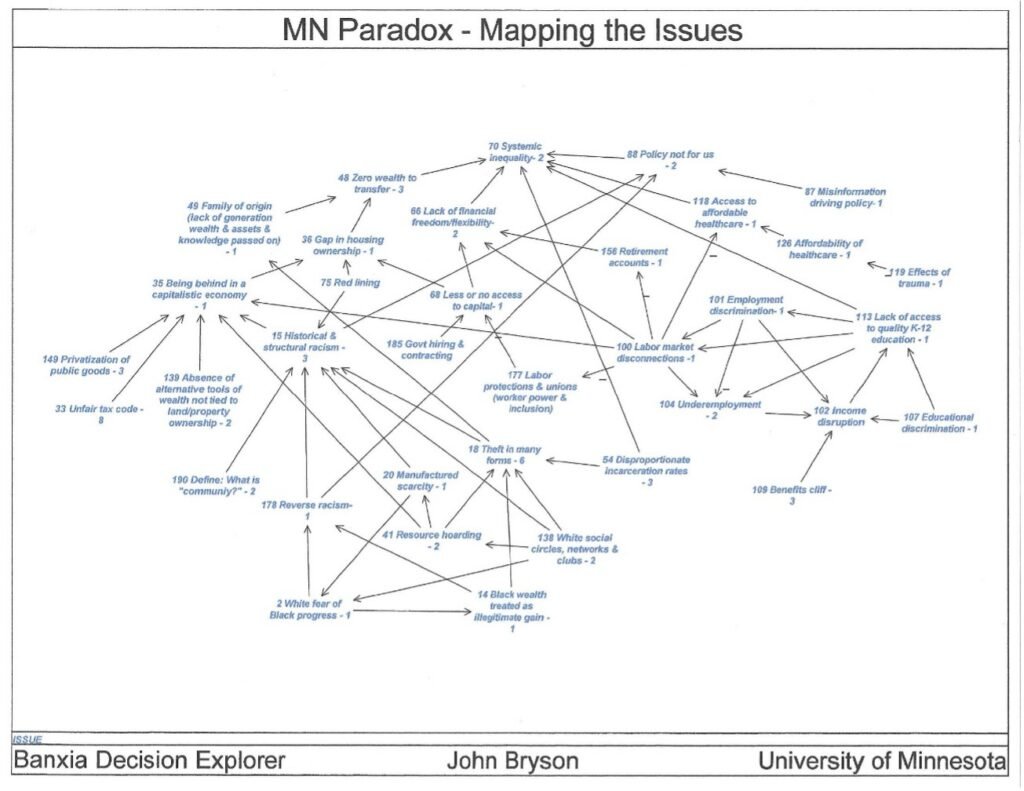
Public management scholars call problems shaped like these “wicked problems”: no agreed-on definition, tangled causes, and stakeholders holding conflicting values that resist linear analysis. Our mapping makes those interdependencies visible, showing how the tax code, wealth transfer, access to capital, incarceration, and structural racism operate as one reinforcing system rather than a collection of independent issues.
This dynamic reaches well beyond Minnesota. Economist Gunnar Myrdal described the same cumulative causation in 1944: discrimination depresses Black living standards, which are then used to justify further discrimination, each round feeding the next.
Minnesota’s version shows up in its history of redlining: banks and insurers marked Black neighborhoods as poor risks, which starved those neighborhoods of investment, which depressed property values and credit access that then justified marking them as poor risks all over again. A system whose parts reinforce each other will absorb and undermine an intervention aimed at any single part of it—as researchers Stephen Menendian and Caitlin Watt argued in a 2008 systems-thinking primer, a system’s structure shapes outcomes as much as its parts do. That’s why single-point interventions prove insufficient: they move one part of the loop while the rest keep reinforcing each other.
Down-payment assistance is the clearest example on our map: it raises homeownership at the margin, but the absence of inherited wealth and the undervaluation of homes in Black neighborhoods pull the other way. However well designed, issue-by-issue programming rarely moves a gap this size.
Income, Wealth, and Mobility Are Not the Same Problem
Policy silos show up in how income, wealth, and mobility are each reported as if it were the whole picture. Income is what a household earns yearly. Black households in Minnesota earn roughly 40 percent less than White households in median terms. Wealth is what a household owns and passes down, and it’s where the gap is starkest: nationally, homes in Black neighborhoods are valued roughly 23 percent below comparable homes in White neighborhoods and taxed 10 to 13 percent higher relative to that value. Minnesota runs the same pattern: in the seven-county Twin Cities region, the higher a census tract’s share of residents of color, the lower its median estimated market value.
Mobility should worry the field most. Minnesota has among the highest rates of income persistence in the country, meaning workers who stay in the same earnings quartile over five years, and American Indian and Black workers are the most likely to stay stuck in the bottom quartile.
This rules out the simplest explanations for the other two. The problem is not where people start, but rather it is the unequal opportunity to move regardless of where they start. This is exactly what our map found: a system whose issues reinforce each other.
A Collection of Stakeholders, Rather Than a Coalition
If the structure perpetuates these disparities, who has the power to change it? A second set of sessions sorted more than 190 stakeholders on a power-versus-interest grid:
- Players, with both power and interest
- Context Setters, with power but not interest
- Subjects, with interest but not power
- Crowd, with neither
The pattern that emerged was blunt: very few were Players. As one participant summarized it, stakeholders on Minnesota’s racial wealth gap are currently “all over the place on the topic of income and wealth inequality…that’s a collection of stakeholders. It is not a coalition.”
Participants then mapped support and opposition for one specific proposal that had emerged from their own dot-voting: baby bonds. They placed more than 140 stakeholder groups in the potential-support column, spanning labor unions, faith organizations, regional banks, major corporations, and a substantial share of the White working class. Only 13 stakeholders were placed in opposition, concentrated among developers, private equity housing interests, and a small number of elected officials.
Sign up for our free newsletters
Subscribe to NPQ's newsletters to have our top stories delivered directly to your inbox.
By signing up, you agree to our privacy policy and terms of use, and to receive messages from NPQ and our partners.
That asymmetry doesn’t, by itself, mean anyone is organized around a shared purpose—but it means no single racial or class constituency must carry the argument alone. Closing this gap will still require, in one participant’s words, “a large number of White votes.”
A strategy built around a single organization can optimize that organization’s contribution, but it cannot, by itself, transform the larger system.
The data points toward how a coalition organized around changing the system’s architecture, rather than around any single program, might work. The “Players” quadrant is the natural core to build around, since stakeholder theory holds that this group’s engagement most reliably determines whether change happens. Such a coalition doesn’t require members to agree on everything. “Clumsy solutions,” the practice of reaching agreement issue by issue under a shared purpose, lets it grow even where disagreements persist. The difference from single-issue organizing is what the agreements are aimed at: the rules that produce the gap, not more funding inside them.

Why Coordination Doesn’t Change the System
Philanthropy already funds programs. It funds institutions, and it even funds coalitions. What’s missing isn’t coalition-building. Rather, it’s what the coalition is built to do.
Every organization’s board holds it accountable to its own mission and its own outcomes, so even a funded coalition tends to organize for wins inside the existing structure: the tax code, the lending rules, the system as it stands. In turn, the structure, itself, remains unchanged. The real opportunity is different: build the capacity, and the accountability, to organize collectively around changing the system’s architecture rather than outcomes.
That dynamic plays out at ground level, too. If you have ever sat in a room where two nonprofits working on the same root cause described each other as competitors for the same grants, you have seen it firsthand. Most progressive nonprofits have thoughtful strategic plans and dedicated staff. The problem is scope. A strategy built around a single organization can optimize that organization’s contribution, but it cannot, by itself, transform the larger system. Multiply that dynamic across dozens of organizations, each rationally pursuing its own mission, and the result is a field that is weakly coordinated with itself, and an unchanging system.
Other research supports this: Bridgespan Group found that across 14 years, only about 7 percent of big-bet grants of $10 million or more went, by dollar value, to field building rather than to single organizations, and Ann Goggins Gregory and Don Howard call the related pattern the nonprofit starvation cycle, where funders’ expectations push nonprofits to underinvest in coordination capacity.
Philanthropy’s funding structure rewards a nonprofit for executing its own plan well but does not require aligning that plan with anyone else’s. Even voluntary partnerships often do not survive because there is rarely enough funding on the table to make the institutional risk worth it.
The field of collaborative governance has a name for the piece that’s usually missing: a structure and capability resourced specifically to coordinate, rather than to deliver its own program. The roughly 150 Minnesota organizations working on asset and wealth building have a shared sense of the problem, real relationships, and now a shared map—but no funded, accountable structure to coordinate action across them.
One effort is trying. The GroundBreak Coalition, launched in 2022 with McKnight Foundation support and now operating as its own entity with more than 40 member institutions, has mobilized close to a billion dollars in committed capital for Black homeownership and business lending. It is too early to call it a success: commitments are not outcomes, and its scope is capital, one of the five hub issues, not the system as a whole.
Generation Next is the longer and more sobering data point. Founded in 2012 on the StriveTogether collective-impact model, it has run as a funded, staffed backbone organization coordinating Twin Cities education partners for more than a decade. The Black-White graduation gap narrowed substantially over that period, from roughly 23 percentage points in 2017 to about 14 in 2025. That is real progress, and Minnesota’s gap is still wider than the national gap of about 9 points. A well-designed, well-funded backbone was necessary but not sufficient. It worked inside the school funding formula rather than changing it.
Our stakeholder mapping points toward the need for a coalition able to influence the political economy that produced the gap, not another initiative inside the current system. Philanthropy’s real role is specific: seed the coordinating structure and analytic tools a coalition needs, while knowing that alone cannot close a gap this large.
Economists Darrick Hamilton and William Darity Jr. have argued that structural wealth gaps are intergroup phenomena that individual-level and philanthropic interventions cannot resolve—closing them requires redistribution at a scale only government can execute. Darren Walker, then-president of the Ford Foundation, made the same point from inside philanthropy itself: “I don’t believe that the Ford Foundation or philanthropy writ large can achieve the solutions at scale. We have to believe in public policy…government and public policy together are the pathway.”
Treating philanthropy as a substitute lets government off the hook. And there are what we call the “Five C’s” to help identify where the gaps might be:
- Coordination: The constituency isn’t missing. What’s missing is the coordinating function: nobody’s job is to organize that support into a coalition for structural change.
- Connection: This is one system, not six separate problems, held together by five hub issues: an unfair tax code, zero wealth to transfer, no access to capital, disproportionate incarceration, and structural racism. Single-point programs get absorbed instead of closing the gap.
- Convergence: Where coordination has been tried, it has been narrow—real and well-funded, but aimed at one hub issue at a time, and none closed the gap alone. The hub issues have to move together.
- Capital: Only government has the taxation authority and regulatory reach to close a gap this size. Philanthropy can seed the coordinating structure; it can’t substitute for policy.
- Coalition: The winning coalition is broader than race or geography: labor unions, faith communities, regional banks, and a substantial share of the White working class. Confined to the Twin Cities or to Black communities alone, it isn’t big enough to win.
What Should Happen Now
Read together, those five C’s point to one place, but they describe only phase one. The map shows that the system’s parts reinforce each other. Phase two converts it into a formal system dynamics model: a simulation of how the hub issues push on each other over time, so combinations of intervention can be tested before capital and political will are spent on them.
That work should organize around a universal goal, not a racial one: shared prosperity for all Minnesotans, with racial data used to target strategy rather than define it. A wholly untargeted program risks missing the families the gap affects most—Connecticut’s baby bonds program solves that by tying eligibility to Medicaid enrollment rather than race and reaching Black and Latino families disproportionately anyway. Minnesota could use the same proxy logic.
What’s missing isn’t another coalition—Minnesota already has coalitions organized around individual pieces of the system, as GroundBreak and Generation Next both show—but what the Bridgespan Group calls a field catalyst: an entity built not to deliver its own program, but to align a field’s existing actors around a shared, model-tested agenda. The nearest structural model is the Civil Marriage Collaborative, which pooled $153 million over 11 years behind one explicit numeric strategy, funding existing state advocacy groups rather than building a new organization. What Minnesota could borrow is the funding structure, not the size of the target. The system dynamics model would identify which policies to put behind it.
Lake Wobegon is a metaphor that only holds if effort and good intentions are always enough. Minnesota’s 50 years of real, well-funded effort against this gap prove they aren’t—not because the effort was wasted, but because effort inside a system is not the same as changing the system itself. What this phase adds is the capability this project set out looking for: not another program, but the collective capacity, a map, a model, and a field catalyst built to act on both. Minnesota had every conventional advantage and still learned this the hard way. Other places don’t have to.
This work was supported by a grant from the McKnight Foundation, which is also a founding member of the GroundBreak Coalition discussed in this piece.