
The article “Beyond Lake Wobegon” describes what mapping found in Minnesota around the racial wealth gap. It does not describe how to do the mapping. That is worth fixing, because the tools we used for the MN Paradox project were not custom-built for Minnesota. Issue mapping and stakeholder mapping are established methods, and any region can use them with a working group, two or three sessions, and a facilitator willing to resist the pull toward solutions before the picture is complete.
The two exercises answer different questions. Issue mapping asks what is producing the outcome you are trying to change. Stakeholder mapping asks who already has the power, the interest, or reason to act on what the issue map reveals. Skipping either one leaves you with half a diagnosis: a system you understand but cannot move, or a coalition you can convene but do not know where to lead.
Map the System, Not the Symptoms
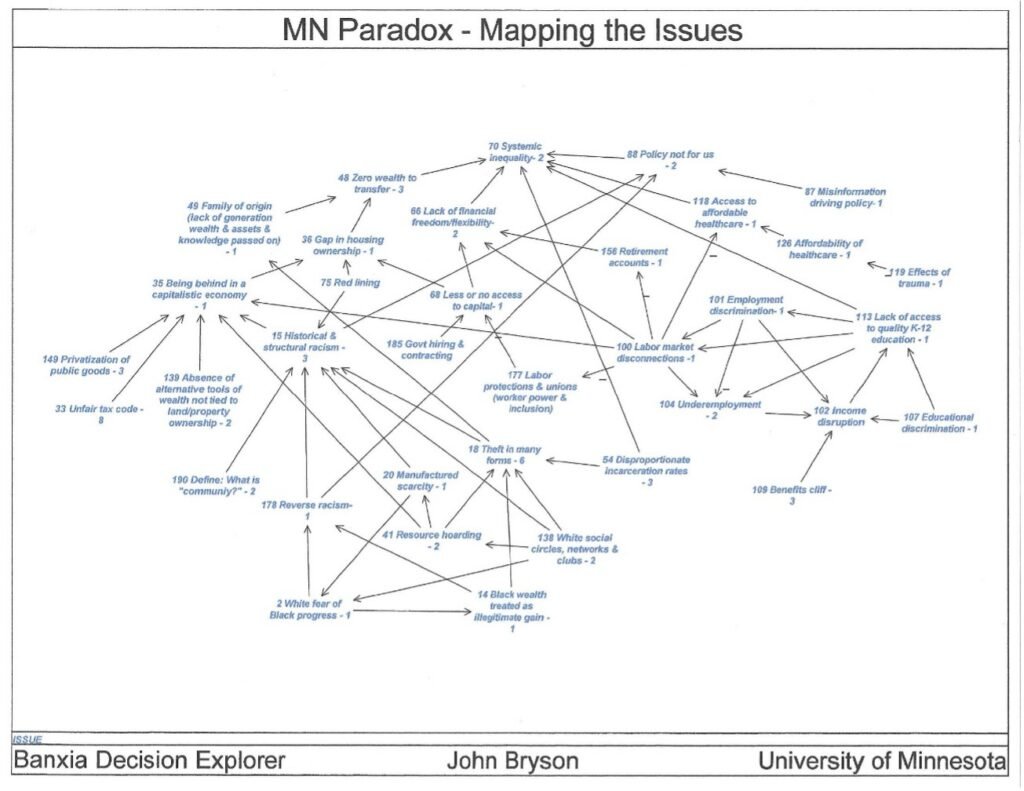
- Assemble a small cross-sector working group of 15 to 25 people, including nonprofit staff, philanthropy program officers, government representatives, knowledgeable researchers, and people with direct experience of the gap you are studying.
- Run at least two sessions. In the first, generate issues without editing them: include everything anyone believes is connected to the outcome you care about. Our first session alone produced 187 distinct issues.
- In the second session, connect the issues. For each issue pair, ask whether one causes, worsens, or offsets the other. This is slower and more uncomfortable than listing problems down a column, and that discomfort is the point. Exploring cause and effect is where hidden structure shows up.
- Look for hub issues: the handful of items that reappear across nearly every cluster of issues. In our case, that was an unfair tax code, zero wealth to transfer, no access to capital, disproportionate incarceration, and structural racism itself. Hub issues are where leverage concentrates.
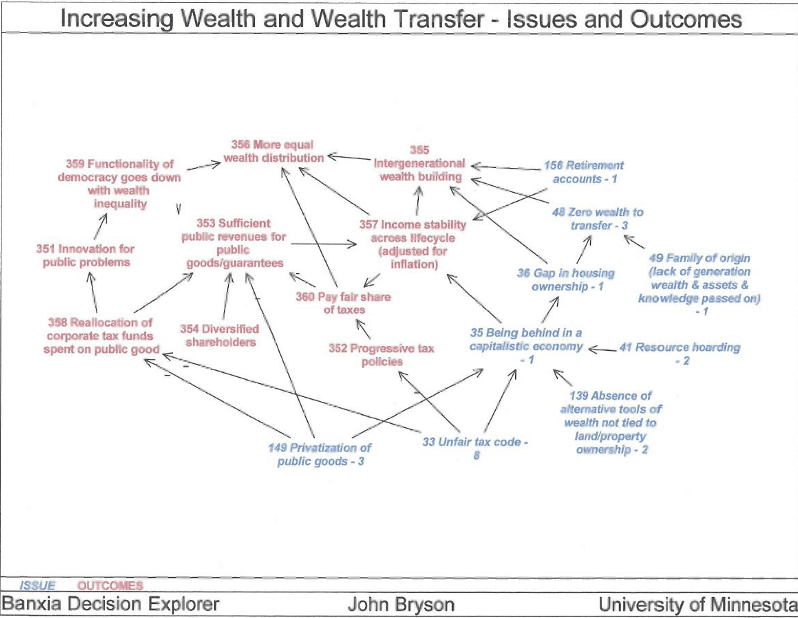
- Software helps but is not required. We used Banxia Decision Explorer, the tool John Bryson and Barbara Crosby have applied to this kind of work for decades. Free tools like Kumu.io do a similar job for a smaller group, and a whiteboard, sticky notes, and markers, or a wall, sticky notes, and string, will do for a first pass.
Map the Stakeholders, Not Just the Issues
- Once you understand the system’s structure, ask a different question: who has the power to change it. Brainstorm a long list. Ours grew past 190 names across two sessions. Resist shortening the list too early.

- Sort every name on a power-versus-interest grid: Players (both power and interest), Context Setters (power, not interest), Subjects (interest, not power), and the Crowd (neither). Most fields discover what we did: almost nobody sits in the Players quadrant. That is diagnostic, not a flaw to fix before starting.

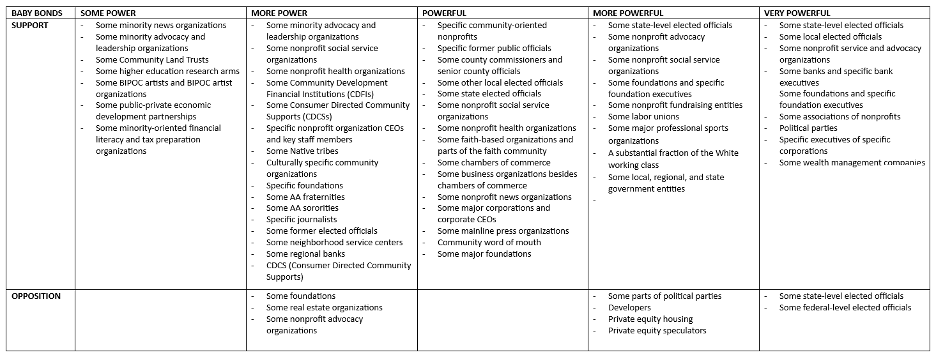
- Test one specific, real proposal, not an abstract goal. We used baby bonds, a publicly funded trust account established for every child at birth, with deposits scaled to family wealth. Ask each stakeholder group whether it would support or oppose the proposal, and count. The ratio of supporters to opposers tells you whether the raw material for a coalition exists, even before anyone has agreed to anything.
Going Deeper
The two exercises above will get a working group most of the way to a real diagnosis. Groups with more time can add three more techniques from the original methodology this approach is built on: a stakeholder influence diagram, which maps how stakeholders affect one another rather than just where they sit on the grid; a bases-of-power and directions-of-interest diagram for each key stakeholder, which spells out where a specific actor’s leverage actually comes from and what it would take to move them to act on their interests; and a map for finding the common good, which searches across all of those individual interests for the handful of shared goals that could unite an otherwise unlikely coalition. None of these require significant new data. They require going back through the same map a second time, asking a sharper question of it.
Sign up for our free newsletters
Subscribe to NPQ's newsletters to have our top stories delivered directly to your inbox.
By signing up, you agree to our privacy policy and terms of use, and to receive messages from NPQ and our partners.
From Map to Coalition
- A map is diagnostic, not a plan. The temptation after two productive sessions is to start drafting strategy. Resist doing so until the map is done. A system this tangled will punish an ill-informed strategy the same way it punishes any single-issue fix.
- Full agreement is not a precondition to start. Political scientists call this the pursuit of clumsy solutions: assembling agreements issue by issue and coalition by coalition, under a shared purpose, rather than waiting for consensus on everything.
- The mapping process does not fund itself. Someone has to pay for the backbone function: the staff and structure that coordinate rather than deliver a single program. That is a funding decision, not a mapping one, and it is worth raising with funders early rather than after the map is finished.
What It Takes
None of this requires a large budget or a research department. It requires a facilitator, a room or a video call, and participants willing to give up two or three sessions of substantial time rather than a single meeting. Most of the cost is staff and participant time, not technology or consulting fees. The harder resource to secure is patience: the discipline to avoid shortcutting straight to a plan, since the method only works if you resist that pull long enough for the map to tell you something you did not already know.
A region that runs both exercises will not necessarily like what it finds. Ours did not. But the region will know, for the first time, whether it has a purpose-driven coalition, and where the handful of hub issues are that any real strategy has to address together. That is worth more than another single-issue program, however well designed.
Further Reading
- John M. Bryson, Gary L. Cunningham, and Karen J. Lokkesmoe, “What to Do When Stakeholders Matter: The Case of Problem Formulation for the African American Men Project of Hennepin County, Minnesota,” Public Administration Review 62, no. 5 (2002): 568–584.
- Bryson, John M., et al., “Addressing Complex and Cross-Boundary Challenges in Government: The Value of Strategy Mapping,” IBM Center for The Business of Government, 2023.
- Marco Verweij, Clumsy Solutions for a Wicked World (Palgrave Macmillan, 2011).
- Stephen Menendian and Caitlin Watt, Systems Primer, Kirwan Institute for the Study of Race and Ethnicity, 2008.