
Technology, financing, and policy changes haven’t been enough to solve the global food crisis, but perhaps a mindset transformation could.
That possible missing piece of the puzzle was discussed at the first Global Conscious Food Systems Summit, held in late August through September in Bhutan. There, philanthropists, food and agriculture nonprofits, and policymakers discussed how to integrate mindfulness inside food systems policy.
Andrew Bovarnick, global head of food systems work at United Nations Development Programme (UNDP), which co-hosted the summit, said
current food systems are too disconnected from farmers, nature, and human wellbeing. They are entrenched in extractive systems, focussed on mass production, exports, and processing.
This model means that in the US alone 48 million people don’t always have enough food. Food systems are responsible for a third of the world’s carbon emissions. And the recent conflict in the Middle East has exposed supply-chain vulnerabilities that are creating even bigger pockets of food insecurity globally.
Despite hundreds of food and agriculture-related projects, run by the U.N. and nonprofits, these challenges persist. “They’re not working adequately to shift the system. Something’s missing,” said Bovarnick.
Consciousness, as defined by UNDP’s Conscious Food Systems Alliance (CoFSA), is an “awareness of inner and outer phenomena that influences how we see and relate to ourselves, other people, nature, and future generations.”
“We’ve lost connection to the earth. We’ve lost connection to each other.”
In practice, consciousness might look like regenerative farming, agroecology, integration of Indigenous practices, rewilding, or biodiversity conservation—acts that protect the earth and nourish people. Consciousness might also mean a policymaker approaching a decision from a place of care, compassion, equity, justice, and reverence for nature, said Bovarnick. “If they do that, those policies will look different and hopefully be more fit for people and climate,” he added.
The problem is that the current market, made up of food conglomerates and agricultural giants, doesn’t reward a conscious food system, according to Martin Ping, executive director of the Hawthorne Valley Association, a Hudson Valley-based biodynamic farm.
Instead, industrial farming remains the dominant model alongside the use of harmful pesticides and practices that destroy biodiversity. “We’ve lost connection to the earth. We’ve lost connection to each other,” said Ping.
Consciousness in practice
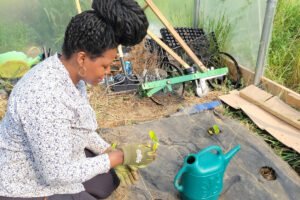
Several organizations are already trying to change this. CoFSA has more than 800 members subscribed to the consciousness approach, while in New York, ReBORN Farms tackles food insecurity in the Bronx through hyper-local models of harvesting and educating residents on growing food.
“It’s extending the idea of sovereignty of choice and embedding that into culture and heritage, which is often not engaged,” according to ReBORN founder Henry Obispo.
Ping said the Hawthorne Valley Association was founded 55 years ago with a question around consciousness of food and land stewardship, and the role of small and mid-sized farms amidst an industrialized agribusiness model. Hawthorne became one of the first community-supported agriculture farms in the country.
Today part of its work is bringing urban youth to the farm to see how food is grown. This helps young people reflect about their food purchases and whether those choices impact somebody else’s life. As Ping said, “You can begin to see a shift in their perception, a shift in their awareness.”
Consciousness means taking a longer-term view.
Sign up for our free newsletters
Subscribe to NPQ's newsletters to have our top stories delivered directly to your inbox.
By signing up, you agree to our privacy policy and terms of use, and to receive messages from NPQ and our partners.
For land restoration nonprofit Commonland, consciousness means taking a longer-term view, said Pénélope Choussat, landscape finance associate at Commonland. The nonprofit has a 20-year vision and looks at “return on inspiration” rather than return on investment, which might mean offering financial incentives to not cut down trees and to build environmental stewardship.
The question isn’t whether the idea of consciousness is realistic or not. “It’s just what it is,” according to Obispo, who added that many cultures have long understood and practiced being more conscious of the earth and humanity’s role on it.
The scaling quandary
The challenge lies in scaling one-off approaches across the whole sector. “How do you go from the individual to the group to the institution? We just can’t do it. Even if we went from 800 members to 8,000, we need eight billion,” said Bovarnick.
Still, it’s a starting point, he said, explaining that as more people learn about the consciousness approach it has the potential to effect change. “Serious people see the importance of it,” he pointed out, “and therefore it’s something that others in development, food, nature, and climate should be considering.”
For example, the former president of Ireland, Mary Robinson, who attended the summit in Bhutan, said that although she believes her nonprofit Project Dandelion is already conscious, she hadn’t used that language before. “The more I learn, the more I like the concept because the problem in countries like Ireland is we’ve forgotten our past, and we’ve become too remote from how food is produced and frankly, too remote from nature itself,” she said.
Ireland currently imports 80 percent of its food. Reconnecting to the traditional Irish concept of meitheal—which is based on helping one another in a community, including when it comes to harvesting crops—could help not only agricultural systems but also help improve mental health, Robinson said. “I actually think that’s acutely important and relevant to where we are now in our modern world. We have to be careful of our minds, our mental security,” she added.
How to be more conscious
Those NPQ spoke to hope that increasingly more people will opt to bring their inner values into their work.
“It will require doing the inner work to produce outer change in the world. We can’t just rearrange the deck chairs on the Titanic. We are required to change our own consciousness,” said Ping.
The future of consciousness is collaboration.
As a starting point, Bovarnick said consciousness is about shedding the idea of having a work self and a personal self, and merging the two. “There is a culture about what professionalism means, and the idea of writing a project that promotes care and compassion has, over time, faded into the background,” he explained. He added that writing a project from a place of compassion instead could have longer-term gains.
He recommended asking yourself: “How are we connecting with our stakeholders?” and “How are we bringing ourselves into these projects?”
Ping also believes the future of consciousness is collaboration. “Nothing ends up being a mistake unless we don’t learn from it, and if we can take all of our shared learning and advance our understanding, then hopefully we’ll meet the poly crisis that we seem to be in the midst of in a way that’s coming from a place of greater understanding and greater strength,” he said.
Obispo is often contacted by other organizations around the United States, and says even those that may not be traditional partners should be engaged with. “It’s not about ostracizing anyone in the building of a new system,” he stressed.
The increasing threats farmers are facing is prompting donors to discuss changes in the way they give money, which could allow for a more conscious approach, according to Choussat. For example, Commonland has been talking to South African banks about funding more resilient agricultural practices. The banks were willing to do that because they had been able to quantify the cost of not acting through unpaid loans as a result of droughts and floods.
“This is a way that I’ve seen the consciousness of individuals shape what’s possible,” said Choussat. “Ultimately, you realize it all comes down to people.”