Sarcoidosis is a rare but serious inflammatory disease….It disproportionately affects Black Americans, particularly Black women, who experience some of the highest rates of the disease.
When the Milken Institute and the Ann Theodore Foundation launched a grant program to fund a clinical trial for a promising therapeutic in sarcoidosis, the team learned that coordinating such a trial would be challenging for two reasons: the complexity of the disease and the underlying systemic inequities that shape access, participation, and care.
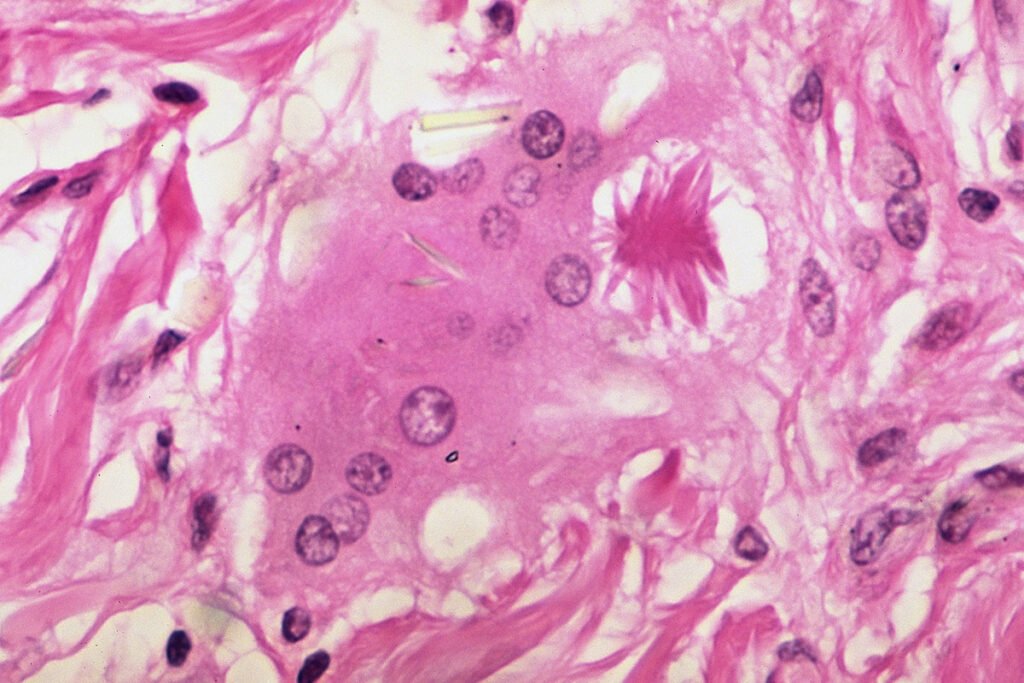
Sarcoidosis is a rare but serious inflammatory disease of unknown origin, affecting approximately 150,000 to 200,000 people in the United States. It disproportionately affects Black Americans, particularly Black women, who experience some of the highest rates of the disease. It can cause pain, fatigue, aching joints, and brain fog. Depending on the organs affected, it can cause chest tightness, blurred vision, skin scarring, or heart rhythm disturbances. It looks very different from person to person. While it might go away on its own with few to no symptoms, for some, it may come and go intermittently, or even impact vital organs, causing irreversible damage or death.
Due to historically underfunded research on the disease, scientists and clinicians have a limited understanding of sarcoidosis. That, in turn, leaves many people misdiagnosed, dismissed, or untreated. Generalized symptoms associated with the disease, such as fatigue, can lead many people with sarcoidosis to endure a journey over several years before reaching a diagnosis. Once diagnosed, only a few treatment options are available—and those available merely mitigate symptoms rather than reverse the disease. Such treatments like corticosteroids and chemotherapeutics come with significant side effects, necessitating the development of safer, more effective options for patients.
What makes the research gap especially troubling is who bears the burden. Black Americans live with sarcoidosis 2.2 to 5.6 times more frequently than White, Hispanic, and Asian Americans. Black women have the highest prevalence of any group, double that of Black men, and three to six times that of White, Asian, and Hispanic women. Black Americans also tend to experience more severe cases. Yet despite this disproportionate impact, Black people make up as little as 5 percent of clinical trial participants across interstitial lung diseases, which refer to diseases that can cause inflammation and scarring in the lungs, including sarcoidosis.
Closing that gap is not only a matter of equity. It is a matter of getting the science right. And while philanthropy can help facilitate change by accelerating groundbreaking research, it can be even more effective if systemic change happens alongside it.
Scientists and clinicians have a limited understanding of sarcoidosis. That in turn leaves many people misdiagnosed, dismissed, or untreated.
Systemic Inequities Shaping Sarcoidosis Research, Diagnosis, and Care
When the Foundation for Sarcoidosis Research surveyed Black patients to better understand the barriers that contribute to underrepresentation in clinical trial participation, the answers were painfully familiar. Surveyed individuals shared that they weren’t told about trial opportunities, there was understandable distrust that the opportunities would be safe, and the logistical costs such as missed work, childcare, and transportation were prohibitive.
These barriers are symptoms of structural failures that pervade the entire biomedical ecosystem, with roots that stretch back decades. Past and present discriminatory practices have led to broad health disparities between Black and other Americans. Black children are 60 percent more likely than the general population to develop asthma. Black women are 54 percent more likely than the general population to be diagnosed with stomach cancer. Black adults are 26 percent more likely to be diagnosed with hypertension. Black people are more likely to experience understandable reluctance to receive medical care due to historical malpractice against and racist beliefs about Black people.
This is where philanthropy can intervene in ways that government funding, bound by bureaucracy and political headwinds, often cannot.
Moreover, Black Americans are excluded from the biomedical ecosystem as professionals, not only as patients. As of 2018, only 5 percent of all practicing physicians in the United States were Black, and this proportion has remained largely unchanged in recent years, with Black physicians representing 5.3 percent of active physicians nationwide. These structural inequities limit our ability to improve health outcomes for all.
Sign up for our free newsletters
Subscribe to NPQ's newsletters to have our top stories delivered directly to your inbox.
By signing up, you agree to our privacy policy and terms of use, and to receive messages from NPQ and our partners.
Building trust in the biomedical system will demand philanthropic and structural change in who funds the research, who builds career pipelines for Black physicians, and who invests in the community health infrastructure that might actually close these gaps. Without representation in the biomedical research and medical enterprise, the conditions that most affect Black communities remain understudied, underfunded, and undertreated.
This is where philanthropy can intervene in ways that government funding, bound by bureaucracy and political headwinds, often cannot.
A Promising Leverage Point: Investing in HBCUs
Historically, Black Colleges and Universities (HBCUs) offer one of the most promising leverage points. HBCUs provide disproportionate and enduring contributions to diversifying the healthcare workforce. Representing just 2.3 percent of US medical schools, they’ve produced nearly 10 percent of all Black physicians in 2019. And according to a report by the Robert Wood Johnson Foundation, HBCUs have historically educated nearly 70 percent of Black physicians and dentists in the US—an extraordinary return from institutions that represent only a small fraction of institutions of higher education.
HBCUs are also geographically and culturally closest to the communities most affected by diseases like sarcoidosis and their graduates overwhelmingly choose to practice in communities that lack healthcare. Yet, they are chronically underfunded. All HBCUs combined receive less than one-fifth of the research funding that Johns Hopkins alone received in 2023. Sixteen states have underfunded their HBCUs for decades, resulting in over $12 billion in withheld resources. Only one HBCU, Howard University, has achieved R1 research status, the designation for institutions with the highest levels of research activity.
Historically, Black Colleges and Universities offer one of the most promising leverage points.
The infrastructure gap is real, and it has consequences for how many Black researchers enter the pipeline and how many conditions affecting Black communities get the scientific attention they deserve. The Association of HBCU Research Institutions, recently formed to help institutions overcome these barriers, offering a powerful platform for advancing discovery, innovation, health equity—and increasing funding stability—but there is still much work to be done.
The Milken Institute’s work with the Ann Theodore Foundation points toward what targeted philanthropic investment can accomplish. Their collaboration will direct over half a million dollars toward a clinical study on a promising therapeutic—one that is FDA-approved for other inflammatory diseases but additional data is needed for sarcoidosis approval. These efforts provide a model for designing the kinds of specific, flexible, fast-moving investments that philanthropy is uniquely positioned to make. Federal research funding, particularly through the National Institutes of Health, faces significant structural and political constraints; any meaningful reform will take years to materialize. Philanthropy can move now.
But the Milken-ATF partnership also points to the limits of what any single funding source can accomplish in the absence of broader systems change. Transforming systemic inequity requires coordinated investment in HBCU research infrastructure, sustained advocacy for equitable federal funding, and a medical establishment willing to reckon with the trust it has spent generations eroding.
Whether you are a funder, an advocate, or a nonprofit leader, the lesson from sarcoidosis is transferable: when research excludes the communities most affected by a disease, it produces incomplete science and inadequate solutions. Addressing a longstanding lack of funding for sarcoidosis research—or any disease for that matter—requires contending with deeper structural challenges and inequities while investing in promising leverage opportunities, such as HBCUs, that can build a more inclusive research ecosystem and accelerate breakthroughs for all patients.