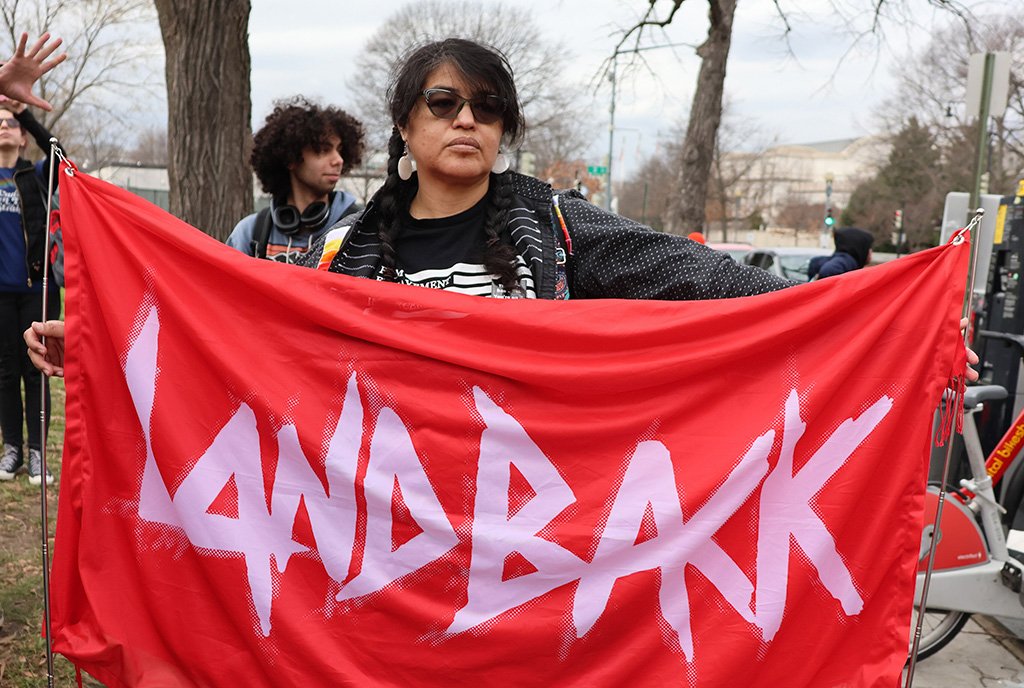
In this column with NPQ, LandBack for the People, NDN Collective builds on their podcast of the same name, sharing stories from Turtle Island and beyond about Indigenous people organizing in community, advocating for social justice, and fighting for the return of Indigenous lands.
While the Donald Trump administration, billionaires, oil executives, and Elon Musk are busy finding new ways to extract from the Earth and exploit communities of color even quicker, Indigenous Peoples continue resisting assimilation and colonization, holding keys and solutions and building alternatives to the status quo.
One of those alternatives is the LANDBACK Action Network (LAN), an Indigenous-led network of Indigenous people, organizations, grassroots groups, Tribal Nations, multiracial movement organizations, community members, organizers, and accomplices working together to strengthen the LANDBACK movement and towards the collective liberation for all people and Mother Earth. And we hope to grow the network to include Indigenous peoples across the Canada, United States, and Mexico.
On April 20, NDN Collective’s LANDBACK for the People podcast released an episode about the launch of the LAN. As the director of membership for LAN at NDN Collective, a major portion of my role is dedicated to expanding the network, so I was honored to be a guest on that show.
With my fellow guests, Cy Wagoner and Eva Cardenas, and our host Nick Tilsen, I shared what I learned about mutual aid and organizing as a child growing up along the border of the United States and Mexico. I learned by watching how the community took care of each other out of necessity—and how we do have the power to change things when we mobilize strategically.
This is a common way people find themselves in organizing spaces—through necessity, through the need to survive, in solidarity, and with community. Cy shared how his start to organizing came through water. He grew up having to haul water in the absence of plumbing at his home on the Navajo Nation and found himself organizing in his home community because of this fundamental basic human right.
Sign up for our free newsletters
Subscribe to NPQ's newsletters to have our top stories delivered directly to your inbox.
By signing up, you agree to our privacy policy and terms of use, and to receive messages from NPQ and our partners.
Eva also found herself organizing at a young age, through the lens of her parents being immigrants and having to take on a huge amount of responsibility at a young age. She joined the Georgia Latino Alliance for Human Rights, her first political home, as ICE and Homeland Security were just being started during the George W. Bush administration.
One of the things Eva said that really struck me, as we talked about the need for humility in this work, is that “sometimes with that disconnection that’s driven by ego, we tend to think that somehow we, as ‘two-leggeds’, know everything and have the answers for everything—when in reality we are part of something larger that must be respected and must be defended. And so, I think LANDBACK is a larger call. It’s a bigger framework. It shifts sort of how people are positioning themselves in this current situation, and it gives people the opportunity for hope to continue to light that fire for struggle.”
A common theme throughout our conversation was about how LANDBACK is an Indigenous call, yet it includes everyone. It includes Black reparations. It means protected resources for all. It means that our national parks and public lands would be better stewarded, if they were under Indigenous Peoples care and jurisdiction. It means the end to colonial borders that cause unimaginable death and the destruction of communities. It means reclaiming all that colonization took from us.
And as for LAN, it’s important to emphasize that it’s not a new organization. It is a political formation of human beings, organizations, and Tribal Nations all connected with one another to build our collective power. It’s a way to break down siloes and isolation between our people, organizations, and movements. It’s an alternative to the Instagrams and Facebooks of the world that have not benefitted us, have not provided the framework we need to continue building power on a large scale, and in fact have harmed our movements in many ways.
To apply to become a member or follow along for LANDBACK updates, stories, victories, strategies, and more, on landback.org.