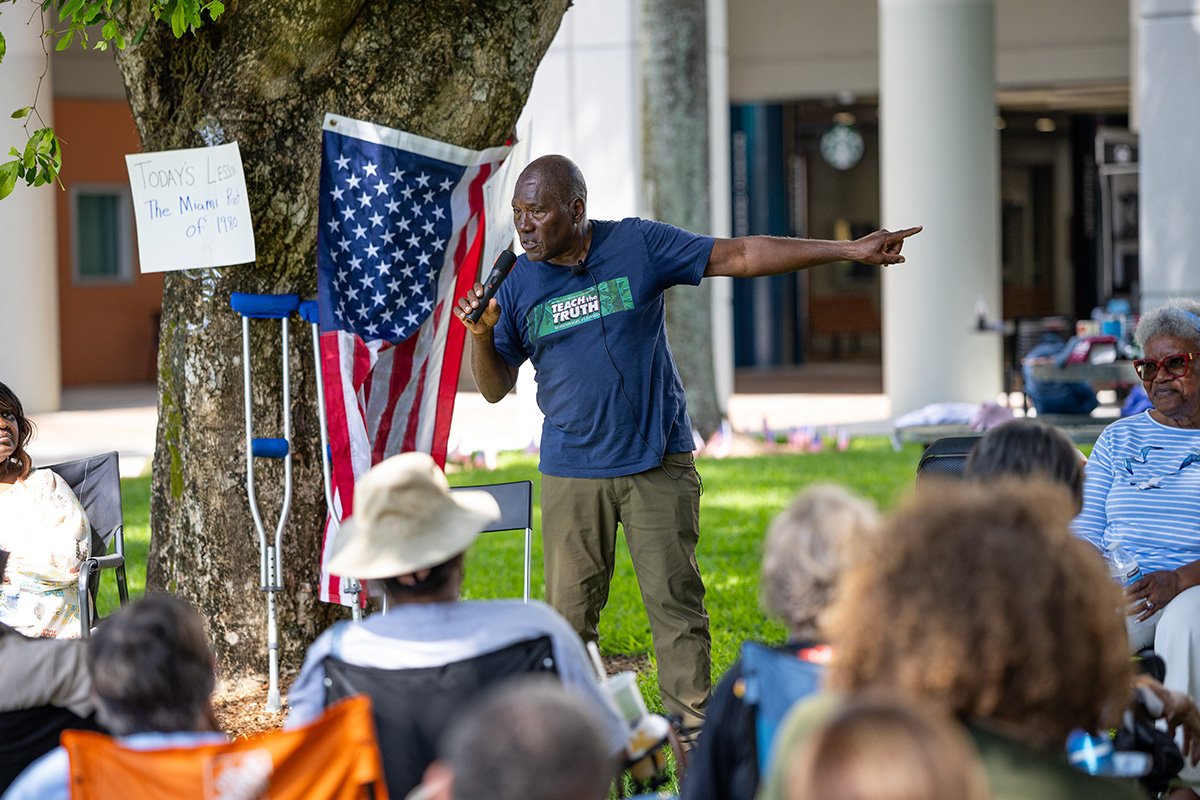
Even wearing a T-shirt and jeans, Marvin Dunn still has the military bearing of the naval officer he once was. Dunn grew up in the 1940s under Jim Crow. Now, at the age of 86, he’s anything but retired.
In 2020, following the murder of George Floyd, he founded the nonprofit Miami Center for Racial Justice with the mission to tell the stories of Florida’s Black community. A grant from the Mellon Foundation allowed Dunn to expand his Teach the Truth Tours, bringing diverse groups to towns like Ocoee and Rosewood.
Never heard of the Rosewood massacre? That, and more Black history, has been suppressed by design, thanks to Florida Governor Ron DeSantis’ 2022 Stop WOKE Act, which banned discussion of race and gender issues in the classroom. That legislation is now being ruled unconstitutional.
In 1923, a mob of white outsiders burned down every Black home in Rosewood and shot and lynched many of the townspeople. The rest of the Black community fled by rail, never to return. No white person was ever charged.
“Young students are the ones for whom our history is being denied,” Dunn said. “They need to learn these stories the most. It’s not too early to know these stories. The state is aiming to keep them in the dark.” That’s also why Dunn wrote his new textbook, The History of African Americans in Florida, for middle school and high school students. The book was released earlier this year.
Concern about young students is why Dunn is suing Miami-Dade College, which has granted public land use for the proposed Trump Library. “I was insulted this was being done to the future generations of Miami-Dade County,” Dunn said. “They gave this land away. They did it in secret. It should not have been given away to a politician, any politician. No politician should rob children.”
When he’s not leading a Teach the Truth Tour or on social media, Dunn spends time in Teach the Truth Garden.
Once an abandoned lot in Miami’s urban Overtown neighborhood, Dunn turned it into a community garden and welcoming green space for all where volunteers grow callaloo, collards, tomatoes—and hope. In fact, I first met Dunn in the garden, where I still like to volunteer.
“Our garden is where the police take breaks,” said Dunn. It’s where he goes to recharge, as well. “It’s peaceful and it’s beautiful and it’s positive,” he said. “I can go and find a few moments to reflect and come out of the garden re-energized. It’s the kind of environment where mental health can be sustained.”
Uncovering Florida’s Painful Past
Dunn demands that the truth be taught about our past because he was denied it. “No one taught me history,” he said. “I taught myself. The only Black history I learned as a student in the State of Florida was Mary McCleod Bethune, George Washington Carver, Booker T. Washington—the most innocent of our heroes, the most nonthreatening heroes.” Missing were many heroes, like Crispus Attucks, a Black man and the first American killed in the Boston Massacre.
“I really did not get into history until the riot of 1980,” he said, referring to the Arthur McDuffie Riots. “I had become increasingly concerned that race and ethnic relations in Miami were deteriorating well before then, but I experienced the riot directly. I was, like most of the country, outraged, hurt. As I tried to write about it, I realized there was almost nothing about Miami’s Black history.
“Our stories are getting lost under current administration at an alarming rate. That propelled me into writing Black history and Black local history. I was trying to save Black history for the benefit of future generations.”
Using Social Media to Shine a Light on Injustice
Can storytelling be advocacy? Dunn is sure of it. “You can sit back and tell stories and not do anything,” he said. “Stories that change things are quite different.”
“You build community by getting people who are not in agreement to come together and work things out. I’m trying to keep that going.”
Sign up for our free newsletters
Subscribe to NPQ's newsletters to have our top stories delivered directly to your inbox.
By signing up, you agree to our privacy policy and terms of use, and to receive messages from NPQ and our partners.
Anyone who’s attended a Teach the Truth tour can tell you that. “People are shocked and outraged that the truth of our past, about Rosewood and Mims and Ocoee and all over the state, has been buried, whitewashed. The most common response is: ‘Why didn’t they teach us this?’
“I tell them carefully what I want. I tell them, ‘Go to your social media friends, TikTok, share the photos, the videos you took on this tour.’ I insist they communicate what they’ve learned to other people. Given the connectedness this generation has, it’s the best way to keep these stories alive.”
Dunn recalls the first time he visited Rosewood. He came alone, at dusk, as evening fell. “I remember the way I felt when I walked on that railroad track, how much it brought back the story, just being in that physical space where that had happened. It made me attuned to the importance of walking the ground where these stories have taken place.”
“I see my role now as an elder. I can teach these children a lot if they’ll listen…You don’t need a school. Go online and teach what you know.
And yet he feels the biggest impact isn’t made by bringing groups on Teach the Truth Tours: “It’s online,” he said. “At best I can take a few thousand people to Rosewood. I’m training guides to do this so it doesn’t all depend on me. But even so, only so many people can make that trip. How do we have others experience it? By sharing with people who are close to us, sharing it on social media for folks who can benefit from knowing what they did, that’s how to keep these stories alive—online. I’m reaching people in Africa, Thailand and England. The reach is so much more extensive.”
Building Community Through Difference
Dunn has plans for Rosewood, though, seeing it as a place and an opportunity to bridge differences. “I’m building a house in Rosewood for that purpose, to bring people together to work out conflict, to build stories together,” he said. “You build community by getting people who are not in agreement to come together and work things out. I’m trying to keep that going.”
Dunn calls it Rosewood Peace House and it’s built to look like the Black homes burned down in the massacre. “We’ve got to get folks who disagree to come together in a common space, a sacred space, in the physical space where [the massacre] happened, and talk and figure out the many ways we’re alike as opposed to different.
“In our country, there are more people who want us to live together in peace than there are people who want to divide us. I truly believe that. That’s how I can sleep at night.”
Fighting for Future Generations
“Burnout? What is that?” Daily walks and strong coffee keep Dunn going. So does spending time in Teach the Truth Garden with younger people. “They are not yet tarnished. There, you find hope,” he said.
“I see my role now as an elder. I can teach these children a lot if they’ll listen,” he said, and he urges others to do the same. “Never stop teaching. You don’t need a school. Go online and teach what you know.
“My motivation is based upon what I see happening in the state—trying to suppress Black history, to keep our stories hidden. That’s my motivation, keeping those stories alive. “I believe American democracy will be saved. It’s just taking so damn long. It feels like we’ve lost so much ground so fast. We’re going backwards, we’re moving back to old Jim Crow, back to where I lived 60 years ago. The rules are different but the impact is the same—more isolation, more suppression of minorities.
“In our country, there are more people who want us to live together in peace than there are people who want to divide us. I truly believe that. That’s how I can sleep at night. That’s why we need to commit to writing our history, our impressions, our knowledge,” Dunn said. “Getting families, a child, a parent, a grandparent, to have these stories kept alive through dialogue around a table—that’s the future as I see it.”