Black voters know they are the backbone of American democracy. They have delivered elections, sustained movements, and kept the promise and possibility of this country’s stated ideals alive through every era that tried to bury both the ideals and Black people. What they are still waiting for—what they have always been waiting for—is to be respected not as a voting bloc to be managed, but as a power base with the capacity to lead.
You cannot frighten people into action by describing a bottom they have already lived and overcome. What moves Black voters is hope, joy, and evidence that the needle is actually moving.
The gap between what Black voters have given this democracy and what this democracy has given them back is not a messaging problem. It is not an enthusiasm gap. It is a rational conclusion drawn from centuries of evidence. I have facilitated enough focus groups, conducted enough voter interviews, and analyzed enough data to share with confidence: Black voters by and large are not low information. They are not apathetic, in the traditional sense of the word. They are making a very clear-eyed assessment of whether their material conditions will change, and too often, the honest answer is that they will not. Not enough. Not fast enough. Whether they show up to the polls or choose to opt out is rarely accidental. It is a verdict.
What I have also learned is this: Fear and negativity alone do not move Black voters. This is not because the threats aren’t real. It is because Black communities have never had the luxury of believing things couldn’t get worse, and have built survival, solidarity, and forward motion anyway. You cannot frighten people into action by describing a bottom they have already lived and overcome. What moves Black voters is hope, joy, and evidence that the needle is actually moving. That is not a vulnerability. That is wisdom earned through generations of watching this country make and break its promises in the same breath.
The Playbook Is Old
Now, 250 years after its inception, we know that what is happening to Black political power in America is not unprecedented. It is not a glitch. It is a pattern that is well-documented, named, and old enough to have grandchildren. My team at Georgia Alliance for Progress has built a Reconstruction Parallels framework that makes this plain: slide by slide, decade by decade. What is clear is that the tactics repeat with eerie precision. For those of us working in the nonprofit sector, especially organizations led by and for Black communities, understanding that pattern is not just intellectually interesting. It is operationally essential.
Someone has to explain why life feels this hard and who is responsible. That makes narrative itself a form of political power.
In 1847, Southern states passed anti-literacy laws to prevent formerly enslaved people from learning to read. In 2021, conservatives passed legislation banning the teaching of Critical Race Theory in K-8 schools, a policy that, in practice, outlawed honest instruction about racial discrimination by the US government. The tools changed. The goal didn’t.
In 1866, former Confederate generals manufactured the “Lost Cause” mythology to reframe a war fought to preserve slavery as a noble struggle against Northern aggression. It was disseminated through books, films, and public school curricula for over a century. Today, a right-wing nonprofit called PragerU partners with states to teach a version of American history where White identity is framed as under existential threat. Different century. Same architecture.
In 1868, White supremacy was deliberately weaponized to prevent poor White people from recognizing their shared economic interests with formerly enslaved Black people. By falsely attributing the hardships of Reconstruction to Black political power, wealthy White Southerners ensured that poor White people voted along racial lines rather than economic ones. Today, the Republican Party runs that same play, using immigration and race to fracture the multiracial working-class coalition that might otherwise challenge concentrated wealth. The script hasn’t changed. They’ve just updated the casting.
Our research with Georgia voters of all races, ethnicities, ages, and areas of the state suggests why that strategy remains potent. Across focus groups and statewide surveys, people consistently return to the same material pressures: the cost of housing, groceries, healthcare, wages, and simply making it from one month to the next. However, economic anxiety does not arrive with its own political interpretation. Someone has to explain why life feels this hard and who is responsible. That makes narrative itself a form of political power. When people experiencing the same economic precarity are taught to see one another as the source of the problem rather than potential partners in solving it, coalition becomes nearly impossible. Reconstruction teaches us that this fracture is not incidental to the strategy. It is the strategy.
Combating disinformation is less about winning arguments and more about staying connected long enough to tell each other the truth with love.
Disinformation Is Not New
In 1898, White supremacists used newspapers to spread fabrications about Black men: most prevalently the myth that Black men were sexually assaulting White women. One incident laid the groundwork for a White mob to overthrow a Black-majority government in Wilmington, North Carolina. It was not a riot. It was a coup, seeded by lies.
In 2021, Republicans used social media to amplify disinformation about voter fraud in a free and fair election. That campaign seeded an insurrection.
The medium evolved. The mechanism of using manufactured fear of Black power to radicalize White voters toward violence did not.
At Georgia Alliance, we have seen just how persistent that architecture is. In tracking disinformation targeting Georgia voters, we have repeatedly encountered narratives that exploit racial anxieties, stereotypes, and existing divisions to shape how people understand everything from elections and public policy to who belongs and who can be trusted. That work led us to launch The Grapevine, a monthly narrative intelligence product that tracks emerging disinformation and, importantly, examines the narratives underneath it: who is being targeted, what existing fears or grievances are being activated, and what organizations as well as individuals can do to shift the narrative. The particulars change. The underlying strategy of using information to manufacture threat, deepen division, and constrain Black political power is remarkably durable.
We’ve also drawn on research showing that 75 percent of Georgians trust their family members more than any other messengers. People believe people they love. Our We the People intergenerational civic engagement series is built on that understanding. We are not fact-checking people into truth. We are helping communities build the relational trust that makes truth-telling possible in the first place. Combating disinformation is less about winning arguments and more about staying connected long enough to tell each other the truth with love.
Black Votes Have Always Been the Target
During Reconstruction, more than 1,500 Black men held public office across the South. Mississippi sent two Black men to the U.S. Senate. Georgia sent Black men to Congress. Then federal troops withdrew in 1877, and states methodically dismantled what Black voters had built through poll taxes, literacy tests, grandfather clauses, KKK violence, rewritten state constitutions.
Mississippi has never sent another Black senator to Washington since Blanche Bruce left office in 1881. Georgia didn’t send another until Raphael Warnock won in 2021, 140 years later. That gap is the point, not a footnote.
The Voting Rights Act of 1965 (VRA) was the most direct federal answer to nearly a century of that suppression. It worked. Because it worked, it became a target. The Supreme Court gutted preclearance in Shelby County v. Holder in 2013. Georgia passed SB 202 within hours of that decision’s logic taking hold, cutting drop boxes, reducing voting hours, criminalizing handing water to voters standing in lines that were longest in majority-Black precincts.
Now the court has diluted Section 2 of the VRA, and Southern states are chomping at the bit. A wave of mid-decade gerrymandering is already underway in Texas, North Carolina, Missouri, and Florida, specifically engineered to eliminate majority-Black districts and erase Black representation before the 2028 cycle. Georgia and Mississippi are next in line. Texas is 40 percent White, but White voters control more than 73 percent of its congressional seats. This is not partisan politics. This is the post-Reconstruction playbook, running on schedule.
Sign up for our free newsletters
Subscribe to NPQ's newsletters to have our top stories delivered directly to your inbox.
By signing up, you agree to our privacy policy and terms of use, and to receive messages from NPQ and our partners.
If the historical project has been to limit Black political power, then our counterstrategy cannot merely be maximizing Black voter participation. Participation and power are not the same thing.
In our research, I watch Black voters navigate this with a clarity that rarely makes it into mainstream political analysis. Fatigue routinely sits beside hope. People can believe deeply that voting matters and simultaneously question whether their vote translates into meaningful power. They can understand exactly what is at stake and still be exhausted by a political system that becomes intensely interested in their votes every two or four years and considerably less interested in their agency, input, or leadership afterward. What they are deciding—rationally, not apathetically—is whether the system can be trusted enough to be worth engaging.
That is not political ignorance. It is an assessment of return on investment.
Some of the voters our field is quickest to describe as “disengaged” are actually asking some of democracy’s most sophisticated questions: What happens after I vote? Who follows through? Who represents me as expected? Who reports back? Who helps me understand what the person I elected actually did? Where do I go if I want to influence that decision? How does my vote become power?
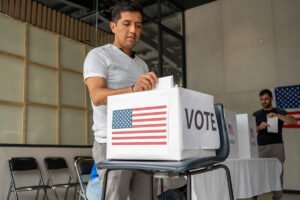
Civic engagement infrastructure still too often treats casting a ballot as the culmination of engagement rather than one point along a much longer continuum of civic and political power. We have invested far less in what comes next: how voters deepen their engagement, influence governance, hold elected officials accountable, and build power beyond Election Day. If the historical project has been to limit Black political power, then our counterstrategy cannot merely be maximizing Black voter participation. Participation and power are not the same thing.
That is the question our civic engagement work must answer honestly—not with false optimism or another transactional appeal to save democracy, but with evidence, relationships, pathways to power, and a commitment that outlasts any single election cycle.
Black Institutions Have Always Filled the Gap
When federal protection collapsed during Reconstruction, Black institutions stepped in. Black churches organized. Black fraternal orders established mutual aid networks. Black women’s clubs built schools, hospitals, and civic infrastructure. Black political organizations from local Union Leagues to statewide conventions to student groups registered voters, trained candidates, and built the kind of grassroots infrastructure that turned constitutional amendments into actual governing power. The state had abandoned them, so they built their own.
This is still true. It is both a testament to Black community resilience and an indictment of every era that made that resilience necessary.
In 1865, Black Christian ministers organized the Convention of the Colored People of Virginia to demand voting rights. In 2025, Historically Black Colleges and Universities (HBCUs) have become organizing anchors that mobilize students around voting rights, produce the next generation of Black political leadership, and hold institutional memory that mainstream universities are actively trying to erase. Black institutions endure against all odds. The mission endures within continued assaults. What keeps shifting is how much energy Black communities are expected to spend rebuilding what should never have been dismantled in the first place.
For Black-led, Black-serving organizations, this is not just historical context. It is an organizational genealogy. The organizations doing this work today are, in many cases, the direct descendants of those Reconstruction-era institutions, carrying their methods, their urgency, and their exhaustion across generations.
That lineage is not nostalgia. It is organizational identity, and it is precisely what makes these organizations irreplaceable. Philanthropic institutions largely do not share that genealogy. They arrive and depart according to funding cycles, strategic pivots, and the political temperature of their donor base.
Black-led organizations don’t get to leave when the moment gets hard because the moment is their community. How philanthropy resources and sustains Black-led institutions over the long arc, not just during crisis cycles, is not a diversity question. It is a movement infrastructure question.
Our research reinforces why this institutional continuity matters. Black voters repeatedly tell us that trust is built through relationships, consistency, and presence across political cycles, not election-season outreach that disappears in November. Our intergenerational work also shows how differently experiences with power, progress, and political disappointment can shape political engagement within Black communities. Black institutions create spaces where those differences can be navigated, relationships sustained, and political memory carried forward.
The Ending Is Not Written
The pattern that opened this piece does not end with Reconstruction. On Christmas Day 1868, President Andrew Johnson issued a sweeping pardon to former Confederate insurrectionists, including Jefferson Davis, the man who led a war against the US government to preserve slavery. Reconstruction, the closest this country has ever come to multiracial democracy, was already dying.
On January 20, 2025, Donald Trump granted clemency to more than 1,500 people convicted in connection with the January 6 Capitol attack. Then his Department of Justice announced a nearly $1.8 billion fund to compensate those same insurrectionists for their alleged suffering. Meanwhile, Congress has never passed HR 40, the bill that would simply study reparations for the descendants of people who built this country for free.
The opposition is not reacting to our failure. They are reacting to our potential.
Our job as researchers, organizers, and nonprofit leaders is not to shame people for a rational response to generations of broken promises. It is to create the conditions where something different becomes possible, where hope is not naive but earned, where joy is not distraction but strategy, and where Black voters are treated not as a transaction but as the leaders they have always been.
Reconstruction was dismantled violently, systematically, and with great deliberateness because it was working. What this teaches us is that the demand for freedom must be sustained through coalition, institution building, disinformation resistance, and the kind of intergenerational truth-telling that helps communities understand not just what is happening, but why, and what it has looked like before.
We have been here. We have built through it before. The work ahead is not to avoid the parallels. It is to learn from them well enough to write a different ending.