Public art signals what a democracy chooses to remember and, just as importantly, who it overlooks.
Walk through many US cities, and Vietnamese American life is visible in certain ways. You can find us in restaurants, markets, nail salons, temples, churches, community centers, festival banners, and small business corridors. We share this with many refugee communities––from Cambodian, Lao, and Hmong families displaced by wars in Southeast Asia––to Somali, Afghan, Iraqi, Haitian, Bosnian, and other communities who have rebuilt homes after rupture. Our labor, food, rituals, languages, and family histories are woven into the everyday life of neighborhoods, even when our stories of displacement and survival remain harder to encounter in public memory.
Compared with the scale of public memorials dedicated to war, military service, and other established civic narratives, Vietnamese American refugee stories remain much harder to encounter, particularly in the Northeastern states. Public art matters because it gives displaced communities a visible place to remember, and it gives the wider public a way to encounter histories of war, refuge, survival and belonging.
That absence matters.
The Vietnam War is one of the most publicly remembered wars in the United States, and Maya Lin’s Vietnam Veterans Memorial in Washington, D.C., remains one of the most recognized public artworks of that memory. Its history also reminds us that memorials are never simple. Even this now-beloved landmark was once highly controversial, revealing how difficult it can be for a nation to decide how grief, responsibility, service, and loss should be held in public. US veterans’ losses deserve honor, yet at the same time, if public memory of the war stops with American military loss, the story remains unfinished.
The war also produced mass displacement, family separation, reeducation camps, dangerous sea journeys, refugee camps, resettlement, silence, grief, and rebuilding across generations. Vietnamese Americans carry these histories not only as trauma but also as wisdom about survival, mutual aid, civic courage––and what it means to rebuild a life after upheaval.
A Permanent Installation to Remember Vietnamese Refugee Communities in Boston
I write this as a 1.5–generation Vietnamese American artist and cultural organizer, the daughter of a Vietnamese refugee mother and a South Vietnamese veteran. My family arrived in Boston in 1992 through the U.S. Humanitarian Operation Program, which resettled former South Vietnamese military personnel, including my father, and others who had been detained in post-1975 reeducation camps, often for three years or more. We first resettled in Dorchester and eventually made our way to Fields Corner, the heart of Boston’s Vietnamese community, which was officially designated as the Boston Little Saigon Cultural District by the Massachusetts Cultural Council in 2021. Its cultural events and community programs are run by a nonprofit organization.
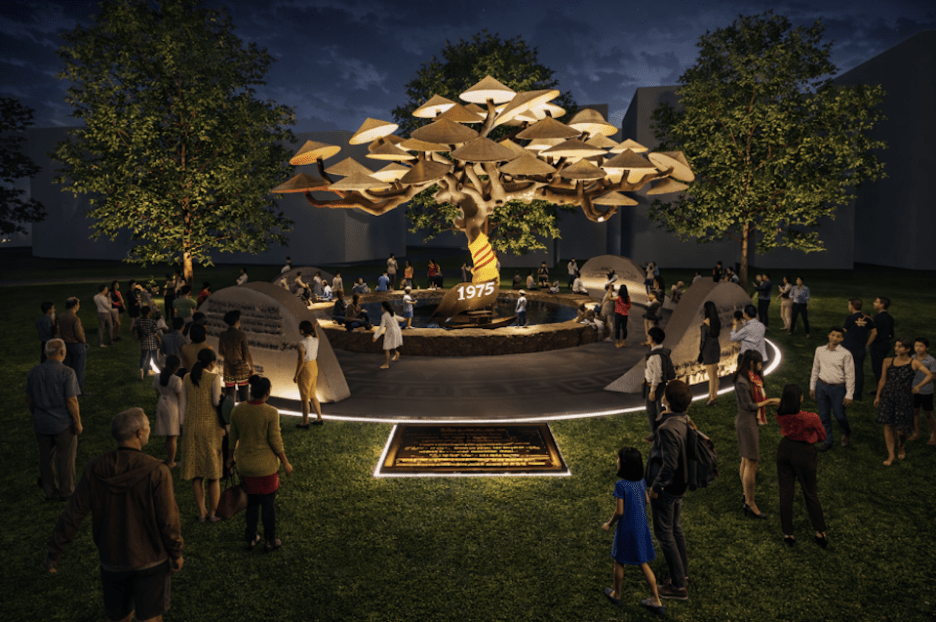
As the lead artist and project director of “1975: A Vietnamese Diaspora Memorial”—an intergenerational public art installation at the Boston Little Saigon Cultural District—I have been thinking deeply about what public land holds. The project began not as a traditional commission, but as part of an intentional grassroots community effort to mark 50 years since the end of the Vietnam War and the beginning of mass Vietnamese displacement, refugee resettlement, and diaspora life, without centering military narratives or militaristic figures. We wanted to shift the focus from the war itself to its lasting impact and legacy on families and communities.
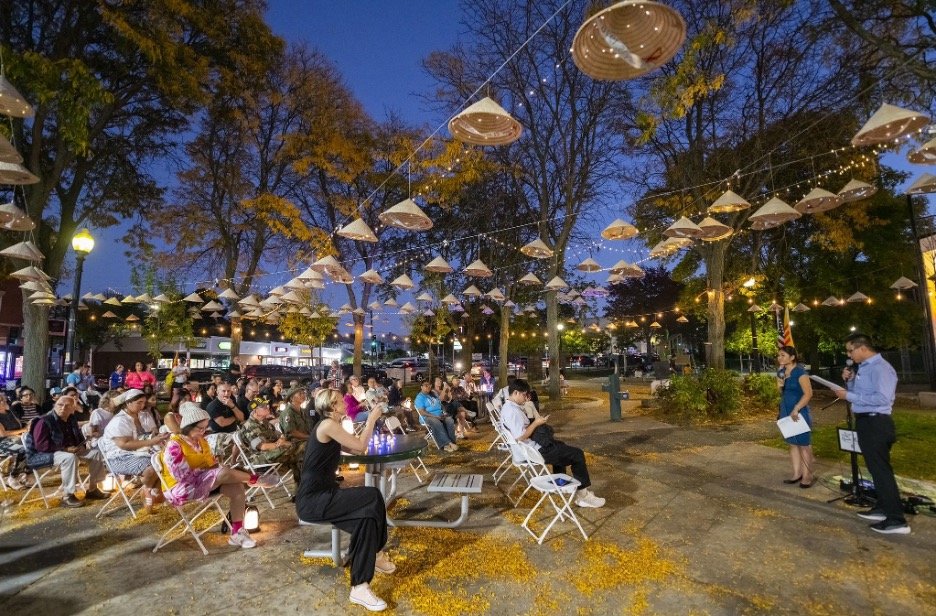
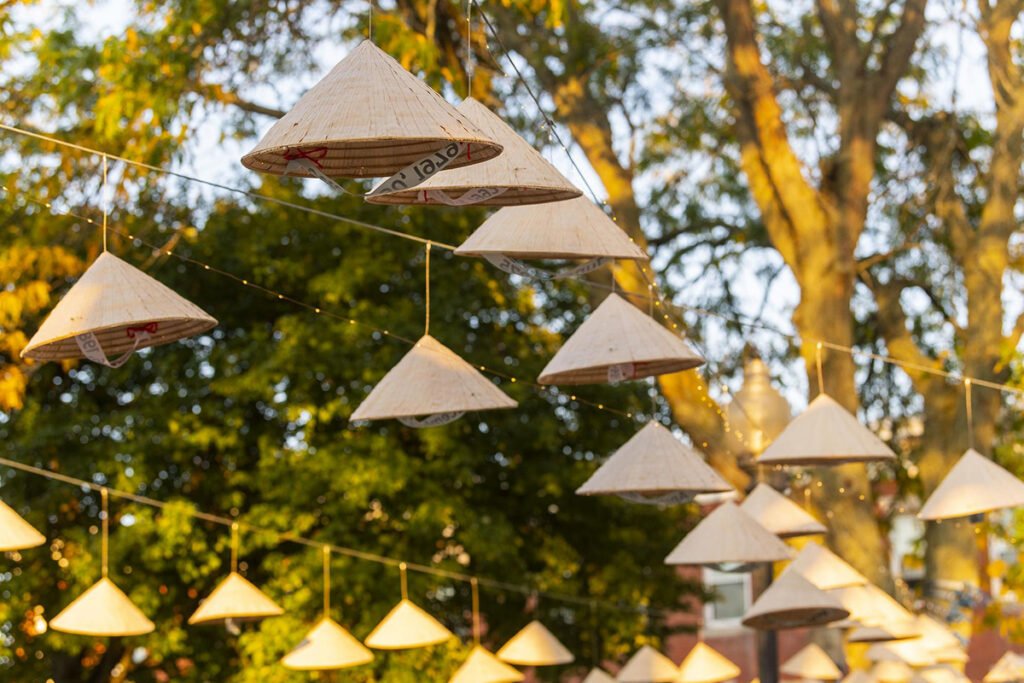
For over three years, the 1975 Memorial team and I have built partnerships, shaped the artistic vision, and advocated for more public resources and civic space in Boston. Our temporary installation, “Journey of Light: A 1975 Memory Field” in Town Field Park in 2025 was a first public step toward a permanent Vietnamese diaspora memorial in Dorchester’s Little Saigon.
With illuminated nón lá (a traditional Vietnamese hat), lanterns, projections, bilingual storytelling, and community gathering, the artwork remembered those changed by April 30, 1975: refugees, reeducation camp survivors, separated families, veterans, elders, and later generations carrying inherited memory.
It was temporary because long-term public artwork requires a longer civic process, including securing funding, site approval, design review, maintenance, and shared political will, which is why we launched a call to action to give it a permanent home. Visitors shared that they had never seen Vietnamese refugee histories held so visibly in Boston public space.
Beyond Boston: Public Art for Vietnamese Americans
This question of who gets remembered in public space and whose histories are allowed to shape civic memory, extends far beyond Boston.
In Clarendon, VA, the need for public memory is clear. Former residents of Little Saigon remembered their community not only as a business district but as a place where refugees learned how to survive, find one another, and feel at home again. One former community member described it as a place where people exchanged advice on “how to survive in America” and “how to learn to be American.” Another remembered Vietnamese coffee, music, and food as making him feel “back in Saigon again.” Khánh H. Lê’s “Voices from Little Saigon of Clarendon” responded to that layered memory by bringing oral histories, tiny building structures to resemble past businesses, photographs, a sculptural apricot blossom tree, and folded paper boats into public view. The work mattered because it marked a community whose presence had shaped Clarendon, even after redevelopment and rising rents made much of that presence disappear. Public art cannot undo the loss of being priced out of your community, but it can say: We were here, we built here, we loved here, we made meaning here.
Sign up for our free newsletters
Subscribe to NPQ's newsletters to have our top stories delivered directly to your inbox.
By signing up, you agree to our privacy policy and terms of use, and to receive messages from NPQ and our partners.
The Vietnamese refugee story is part of the country’s civil inheritance.
Santa Clara County, in California, offers similar important examples. At the nonprofit Vietnamese American Service Center, the public artwork “Home” by Kyungmi Shin draws from Vietnamese landscapes, including Hạ Long Bay and terraced rice fields, to welcome community members into a space designed around culturally competent care. Nearby, San Jose’s Vietnamese Heritage Garden has become a vital public site for Vietnamese elders, veterans, families, and community ceremonies. The site includes community garden plots, flag-raising gatherings, and “Thank You America,” a public monument by Tuan Nguyen depicting an American soldier and a South Vietnamese soldier standing side-by-side. More than a garden, it functions as a place where refugee memory, cultural survival, gratitude, grief, and civic belonging are made visible in a public space.
In East San Jose, a recent mural on Alum Rock Avenue, painted by artists who came together through the 1Culture Collective, honors Vietnamese American history, migration, cultural dress, and the beauty of Vietnam. The mural shows how public art can make refugee history visible not only as trauma, but as culture, resilience, and home.
Public art matters. It is not decoration. It is one of the ways democracy learns to see itself more honestly.
A Space for Public Memory
The Vietnamese refugee story is part of the country’s civil inheritance. About 125,000 Vietnamese people were evacuated to the United States in 1975, and more refugees followed in later waves. Today, about 2.2 million people in the United States identify as Vietnamese alone or in combination with other backgrounds. More than 1.3 million Vietnamese American adults are eligible to vote.
The work before us is not only to add Vietnamese American stories to civic landscapes—it is to ask who gets space, who shapes it, and who gets to reframe public memory.
When Vietnamese American refugee stories are not given lasting, visible space in public art, the public loses more than one community’s history. It loses a fuller understanding of what war does to families, what refuge makes possible, and how displaced people help rebuild the civic life of this country.
This is why I continue to build “1975: A Vietnamese Diaspora Memorial” in Dorchester’s Little Saigon. Vietnamese refugee histories belong not only in private memory, but also in the public spaces where a city tells the stories of the immigrant communities that helped shape it. We are currently advocating for public land access, civic partnership, and financial support to make the memorial a reality.
Public art matters. It is not decoration. It is one of the ways democracy learns to see itself more honestly.
When Vietnamese American refugee stories are not given lasting, visible space in public art, the public loses more than one community’s history. It loses a fuller understanding of what war does to families, what refuge makes possible, and how displaced people help rebuild the civic life of this country.
A democracy worthy of its name must make room for the communities that have kept memory alive even when public institutions did not. Public art can help make that visible. It can help our communities share past and present knowledge and experiences in that public space. And when we do it with care, trust, and community leadership, it can help make that room and public space truly last for all.