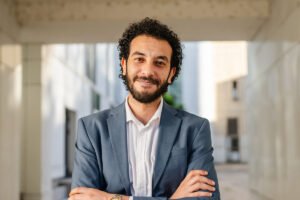
Azadeh Shahshahani is the legal and advocacy director for Project South. A human rights attorney based in Atlanta, she previously served as president of the National Lawyers Guild and director of the National Security/Immigrants’ Rights Project for the American Civil Liberties Union of Georgia.
Rebekah Barber: You have a unique vantage point because a lot of your work is focused in the US South, but you’re also an Iranian American who is deeply invested in speaking out against military violence and the war economy. How has this lens shaped your work in recent months?
Azadeh Shahshahani: For one thing, we cannot separate US imperialism and militarism and attacks against Black and brown people in the Global South from US government repression against Black and brown communities and Muslim communities in the US South. The two are very much interconnected. US government violence is not okay if it’s being [committed] elsewhere against brown and Black bodies.
It’s obviously been a deeply distressing time to witness US bombs dropped on my country of birth. I should mention I was born in Iran four days after the Iranian revolution. My name actually means “free-spirited,” signifying the hope that my parents had for what the revolution would bring.
“We’re seeing that old playbook again before our eyes, so we just need to put a stop to this.”
Unfortunately, what they had hoped for didn’t materialize because a theocracy ended up taking over and US government intervention pretty soon after the revolution led to a devastating result for Iran, which was basically providing support for the Iraqi dictator, Saddam Hussein, who at the time was a great friend of the US. The US provided support to him for the invasion of Iran, which then got Iran entangled in the eight-year Iran-Iraq war.
More than a million people lost their lives on both sides. I was in Iran during that time and distinctly remember the days that we were being bombed. Basically, Hussein was attacking our neighborhoods and it was a really traumatizing time, especially for a young child. Just to know that another generation of Iranian children are now experiencing the same and having to live through that trauma—and so many children have already been killed with US and Israeli bombs—is deeply painful.
RB: As you point out in a recent article, in some ways, Americans have been far removed from the violence taking place in other countries, but in recent months we have also seen extremist violence here, particularly as it relates to immigrant raids and detention. Can you talk about this connection?
AS: As somebody who lives here in the US, I feel a deep responsibility to try to counter US imperialism and the bombing of Iran, as well as US militarism against other countries in the Global South because, obviously Iran is not the only country that’s being attacked by the US or its allies.
It’s a pattern that keeps repeating. And once the US government finds that it can capture resources that a country has, which in this case is oil—the same as Venezuela, it tries all sorts of military and economic repression. Sanctions have been devastating for the people of Iran.
We’re seeing that old playbook again before our eyes, so we just need to put a stop to this.
“Once you normalize the deep-seated racism against one group, it becomes so much easier for the establishment to use that same rhetoric and action against people in this country also.”
We have all these deaths in ICE prisons. Here in Georgia, we have one of the largest immigrant detention centers in the country: the Stewart Detention Center. There have been fourteen deaths there that we know of: at least four by suicide, at least three where people were place in solitary confinement for prolonged periods of time. The most recent suicide was a 33-year-old man. The level of repression and violence implicated in this situation is massive.
The aim of the US government is to make violence and repression normal, whether it is violence toward migrants and Black and brown people and Muslim people in our communities, or Black and brown people abroad. It’s glorifying violence—the way that Trump was speaking of the Iranian people—the disgusting language of bombing them so that this whole civilization is lost as if they are playing a video game. You see that same type of mindset, rhetoric, and actions when it comes to people here in the US South—the rhetoric that we have seen against Haitian migrants for example and people from Central America. Muslims are always a big target.
Once you normalize the deep-seated racism against one group, it becomes so much easier for the establishment to use that same rhetoric and action against people in this country also.
Sign up for our free newsletters
Subscribe to NPQ's newsletters to have our top stories delivered directly to your inbox.
By signing up, you agree to our privacy policy and terms of use, and to receive messages from NPQ and our partners.
“The state and White supremacist forces of repression thrive on our isolation. We need to be connected to movement organizations and each other.”
RB: Alongside this type of violence and repression, there have also been recent attacks against democracy in the US South in recent months. For instance, many view actions like the Supreme Court’s decision to weaken the Voting Rights Act as a form of political violence. How is this connected to the attacks against democracy we’ve seen in other places in the Global South?
AS: The issue of erosion of democracy is pretty significant in what they’re learning from autocrats and dictators in different parts of the world. They are taking steps toward eroding any type of system of democracy and checks and balances that we have in this country.
At Project South, one of the ways we are trying to counter state repression by connecting our struggles is through various types of exchanges with our comrades in the Global South in terms of delegations and regular exchanges so we can learn about their struggles. A lot of it is very much connected to US intervention and destabilization that goes back decades.
For example, groups in the Philippines have shared how they’re surviving and the strategies they have used. We have a quarterly webinar series where we bring together voices from the Global South and US South to talk about what people are facing, how they are resisting, and how we can learn from each other so we don’t reinvent the wheel and support each other in this moment.
We need to be very much in coalition and understand that we are in a joint struggle, especially in this current moment. The state and White supremacist forces of repression thrive on our isolation. We need to be connected to movement organizations and each other. We need to have each other’s back.
RB: This year marks the 25th anniversary of the September 11th attacks. One thing that came in the wake of the attacks was mass surveillance of Muslim communities and other communities of color. There were also attempts to divide marginalized groups. What lessons does this moment of history in particular teach us about how to remain in coalition, especially in the wake of tragedies?
AS: The US government basically used that moment to scapegoat Muslims, and put into place a system of laws and infrastructure to systematically attack our communities. That was also a continuation of other systems of repression and surveillance that they had already used, like COINTELPRO. It wasn’t novel, but it did advance these systems of repression that they keep trying to modify with the aim of better attacking our communities. The lessons that we need to keep in mind is not to allow moments of crisis when we’re in collective trauma to scapegoat one group of people with the aim of putting forward laws that lead to deep repression and attacks on that particular community and all of us.
Once you create an infrastructure of repression, that is going to affect all of us who do any type of organizing and any type of movement building, so we need to speak up, resist, and try to reverse the repressive laws.
RB: Can you talk about any successful organizing strategies you’ve seen that those in the US can learn from the Global South and vice versa?
AS: One that I’ve been involved in is the People’s Tribunal. I’ve been involved in several as a member of the jury that has been organized by comrades in the Philippines. There’s a National Union of People’s Lawyers.
The aim is that when there is no justice possible through a formal judicial system, community members and movements create a People’s Tribunal where evidence of human rights violations is documented, and community members testify. In the case of the Philippines, after the People’s Tribunal in Brussels in 2018, lawyers with the National Union of People’s Lawyers went to Geneva to present evidence to the various human rights bodies there. Some of them went to The Hague to present the evidence in International Criminal Court.
We now see Duterte (the former President of the Philippines from 2016-2022) facing charges at the International Criminal Court. I believe that is in part a direct result of that organizing. Of course, it was not only the Philippine government that was under scrutiny through the tribunal; it was also the US government, given that the Philippines used to be a colony of the US and a lot of the repression continues to happen with the direct support of the US government.
Hopefully a day will come that we can also hold US government officials accountable for the various war crimes in Iran and the various contexts in which they have been complicit in war crimes and crimes against humanity such as in Palestine and in Lebanon.