NPQ publishes this letter as part of our ongoing #WeTheCivic: America 250 series. At its foundation, #WeTheCivic reflects our broader editorial conviction that multiracial democracy’s meaning is tested not by what we celebrate, but by whose voices we allow ourselves to hear. Inside borders, and outside them.
Palestinian resident Mohammed Abu Lebda’s letter comes to us through poet Yahia Lababidi, whose work NPQ has published as part of our coverage of the Gaza crisis and the role that American philanthropy and policy play in shaping—or silencing—Palestinian lives. We have also published perspectives from Funders 4Palestine and allied organizations working at the intersection of funding, narrative power, and accountability in this moment.
However, we share Mohammed’s words here not as testimony to tragedy alone, but as a reminder that democratic values are not self-executing. They require us to name what is being done in our name, with our tax dollars, by our government—and to insist that the people most directly harmed by those decisions have the right to be heard, recorded, and remembered.
Mohammed asked only to leave a trace of his existence before silence closes over it. Nonprofit Quarterly—and I—believes that bearing witness is not a passive act. It is one of the foundational responsibilities of a free press, and of a civic life worth the name.
You could say this is not a “traditional” NPQ publication. But I, and we, feel it’s a vital one to share. Because here and always, we remain committed to all forms of witness.
— Dr. Sara Hudson, Editor-in-Chief, Nonprofit Quarterly
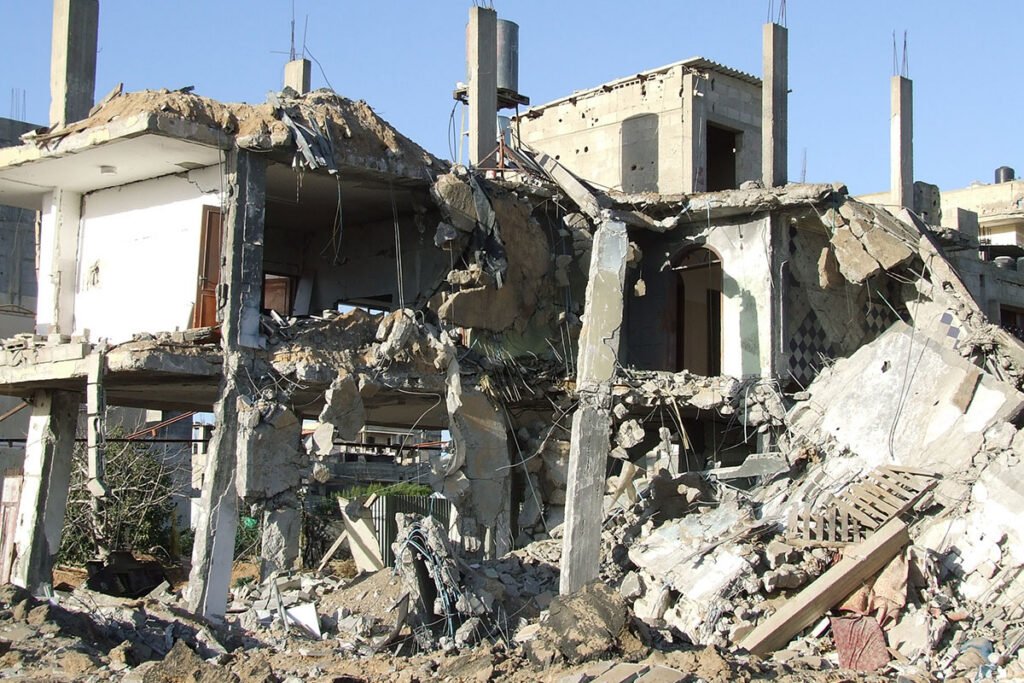
I have known Mohammed Abu Lebda for around two and a half years now, a gifted young Palestinian poet and translator from Rafah, in his twenties, who first reached out to me and has not stopped reaching since. He has sent me videos of the ruins where his home once stood, after a bomb destroyed the house beside his family’s and forced them to flee, and voice notes recorded in the dark. He has inspired my poetry and prose, directly and indirectly, and where possible I have helped publish some of what he has shared with me before.
Earlier, fearing something might happen to him, Mohammed entrusted me with his full unpublished poetry manuscript, Pillow for a Severed Head, one hundred and nine pages of devastating poems that move between prayer and grief, dreams and the silence of God. But today’s cry from the heart was of another order entirely.
A few hours ago, he wrote to tell me he was working on something new. “I am actually writing a letter to the world,” he said. “About myself. Because it really might be my last one.” His mental health, he told me plainly, was poor. “I want to write again, because I stopped long time ago.”
When the letter came, he told me he was sending it to his friends, despite everything, because he felt genuinely compelled to. He said it was because I had always believed in him. I told him I was grateful for his trust and his friendship, and that I would read it carefully. I have tried to honor that since.
What follows is his letter, presented with only light editing for clarity. I have removed only the emphasis he added to certain lines, in the hope that his sentences might stand on their own, without need for underlining. I do not introduce them to ask for your pity, though pity may come. I introduce them because Mohammed asked, in his own words, only to leave a trace of his existence before silence closes over it. The least I can do is pass his words along.
Sign up for our free newsletters
Subscribe to NPQ's newsletters to have our top stories delivered directly to your inbox.
By signing up, you agree to our privacy policy and terms of use, and to receive messages from NPQ and our partners.
— Yahia Lababidi
A Letter to the World
Hello World,
I am Mohammed, a young Palestinian man from a city that used to be called Rafah. I truly do not know where to begin, for I do not know how to define myself, nor do I know with what I should introduce myself… Should I say that I work in translation and write literature? It is a superficial, deceptive definition—one that fits a government bureaucrat or a monotonous character. Yet, it is the truth, because all my life, I have dreamed of nothing more than living a normal life: a simple existence untouched by fear, where I own my choices.
Since my childhood, I have chosen nothing—absolutely nothing. I have spent my entire life at the mercy of others’ choices, growing up without ever knowing what it means to choose something by myself and for myself. Whenever I tried to take control of something personal or chart a path for my future, I found someone else holding the reins, wresting it away from me. Even at the moment of writing this letter, I am driven to write from the very depths of my pain, from wounds that reopen with the passage of time. They grow deeper and darker every time the everyday spaces and streets that formed my identity vanish, as if the disappearance of these places is a final confiscation of what remains of my soul.
And now, in these long and bloody days, I live under the crushing weight of this horrific war that ravages everything. Pain here is not just a word; it is a physical ache that fills the heart until it nearly suffocates under its sheer mass. I am entirely consumed by agonies shared between my body and my soul: the physical pain that exhausts me, making my limbs heavy and my body so drained it feels as though it carries tons of rubble; and the psychological pain that gnaws at my consciousness day and night, leaving me without a single minute of peace.
The cruelest part of this torment is the suffocating realization that I am dying in slow motion, and I am watching it happen. I am not dead so that my soul may rest, nor am I truly alive; I am merely a helpless spectator, standing frozen, watching my own gradual erosion. I witness this slow death with absolute clarity, and I have no control over it whatsoever. I have been stripped of every recourse, standing naked and powerless before my fate.
This pain extends into a terrifying, constant fear of losing the people I love—the ones who anchor me to this life. This fear creeps in with every breath I take. I look around every second, tracing the faces of my family and loved ones, my heart tightening with a suffocating terror at the thought that I might wake up one moment to find them gone, or that their warm features might be reduced to distant memories lost in the void. This dread of forced absence makes me mourn the loss before it even happens, robbing my eyes of sleep.
What truly tears me apart inside is this absolute paralysis. To see this inevitable danger closing in on my loved ones, to see the terror reflecting in their eyes, and yet I can do absolutely nothing right now to protect or save them. This utter helplessness devours the remnants of my composure, leaving me with a bitter, hollow conviction that I am worth nothing. How can a person feel their human value when they stand as a helpless witness to their own tragedy and the tragedy of those they love? How can I feel my existence when I am just a delayed number in the ledger of a merciless war? This helplessness has made me feel small and nonexistent, like a muffled scream in a deep valley—a scream that carries no weight in the scales of an indifferent world.
And here, at this narrow edge of existence, I stand alone. I am dying slowly, dying every second, and the entire world sits in the spectator seats, watching the extinguishing of my city and the fading of my soul, without a single hand reaching out to break this suffocating siege. Facing this terrifying silence, I stand before my own bewilderment and ask: Will I just keep watching? Am I destined to remain standing, helplessly watching the erosion of my body and the fading of the eyes of those I love, a frozen witness to my own end? And do I deserve this? Does a human being who dreamed of nothing but a normal, simple life deserve to be left to be torn apart and forgotten? I do not write to mourn myself, but to leave a trace that points to my existence before the silence swallows me completely. I write because I am still breathing, hoping that in this vast world, someone will hear the pulse of fear in my words; hoping that someone will realize—before it is too late—that I am here, fighting against the drowning, that time is running out, and this slow death is about to drop the curtain.