

July 19, 2015; Columbus Dispatch
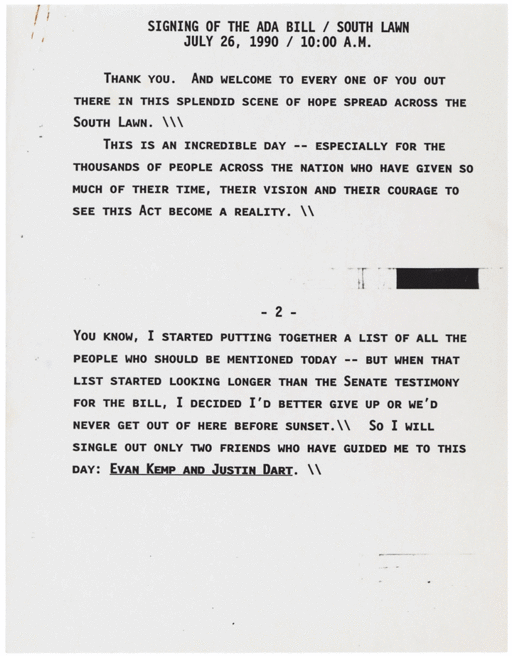
Among the many different perspectives you will hear about how much the Americans with Disabilities Act has or has not achieved, one thing is clear: The ADA, signed into law 25 years ago by President George H.W. Bush, altered the public’s perception of the civil rights of persons with disabilities. Writing for the Columbus Dispatch, Rita Price tells the story of Elizabeth Sammons, whose parents struggled with the public school system in Knox County, Ohio, so that their blind daughter could be mainstreamed rather than sent to a special school for blind students. Now 49, Sammons remembers that to demonstrate her qualifications for mainstreaming, she was required to show that she was “not a community hazard,” demonstrating for a police officer her facility with her white cane at avoiding tree root swells, sidewalk cracks, and other obstacles. Today, Sammons is an employee with Opportunities for Ohioans with Disabilities, where she helps persons with disabilities find jobs and live independently.
Sammons looks back on her family’s efforts to get her mainstreamed in public schools as a civil rights issue, and that’s one dimension of the importance of the ADA. According to Price, the ADA, passed in 1990, along with amendments to the Act added in 2008, “gives civil-rights protections to people with disabilities similar to those based on race, sex, ethnicity, age and religion.” Leading up to the ADA, activist organizations used civil disobedience techniques to push for protections for persons with disabilities. One group called ADAPT was known for blocking buses that lacked wheelchair access, forming wheelchair caravans, and even crawling up the steps of the Capitol. “There are a number of people—some with very severe disabilities—who really took risks,” said Mark Johnson, paralyzed in a diving accident and an activist with ADAPT in that era. “You get a sense of pride about that stuff.”
Sign up for our free newsletters
Subscribe to NPQ's newsletters to have our top stories delivered directly to your inbox.
By signing up, you agree to our privacy policy and terms of use, and to receive messages from NPQ and our partners.
The salient point of Price’s story is that the ADA, like much of the nation’s civil rights legislation, established for persons with disabilities and the public at large parameters of what was wrong and ultimately illegal with the way persons with disabilities were treated. But passing a law doesn’t mean that full civil rights are automatically achieved. Developers complain that making buildings ADA compliant will drive costs through the roof, but Derek Mortland of the Center for Disability Empowerment says that “for a new build, it only adds about one percent (to the cost).” Price notes that the labor force participation (that is, people working or looking for work) of persons with disabilities is about 20 percent, compared to 68 percent for persons without disabilities. Both Mortland and Michael Kirkman, executive director of Disability Rights Ohio, suggest that employers are fearful about the possibility of increased costs of accommodating workers with disabilities and of reductions in productivity, both of which Kirkman says are “based on mythology.”
The minimal costs of accommodating persons with disabilities in the workplace or in access to transportation or with regard to ingress and egress to buildings are not dismissible as discretionary choices. As Mortland told Price, “The backbone of the ADA is not what you have to do to make a building accessible—it’s civil rights…. Before it, there was no law that said, ‘You can’t discriminate against me.’”
This week, the disability rights community will be celebrating the achievements of the past quarter-century. The challenge, however, is to pivot from celebrating the past to figuring out a strategy for moving forward, particularly in the realm of labor force participation and employment where the statistics haven’t budged hugely for persons with disabilities since the enactment of the ADA. In a manner of speaking, disability is the one civil rights cause that crosses all ethnic, racial, gender, and age differences. We anticipate much discussion during this week of the 25th anniversary of the ADA to focus on strategies for moving forward and making progress against seemingly intractable obstacles.—Rick Cohen
Correction: This article has been changed from its original form. A quote for which Mr. Mortland was actually the source was misattributed to Mr. Kirkman. We regret the error.