logo logo
giving banner
Donate
    • Membership
    • Donate
  • Social Justice
    • Racial Justice
    • Climate Justice
    • Disability Justice
    • Economic Justice
    • Food Justice
    • Health Justice
    • Immigration
    • LGBTQ+
  • Civic News
  • Nonprofit Leadership
    • Board Governance
    • Equity-Centered Management
    • Finances
    • Fundraising
    • Human Resources
    • Organizational Culture
    • Philanthropy
    • Power Dynamics
    • Strategic Planning
    • Technology
  • Columns
    • Ask Rhea!
    • Ask a Nonprofit Expert
    • Economy Remix
    • Gathering in Support of Democracy
    • Humans of Nonprofits
    • The Impact Algorithm
    • Living the Question
    • Nonprofit Hiring Trends & Tactics
    • Notes from the Frontlines
    • Parables of Earth
    • Re-imagining Philanthropy
    • State of the Movements
    • We Stood Up
    • The Unexpected Value of Volunteers
  • CONTENT TYPES
  • Leading Edge Membership
  • Newsletters
  • Webinars

American Indians Address Health Disparities by Restoring Cultural Practices

Steve Dubb
January 30, 2018

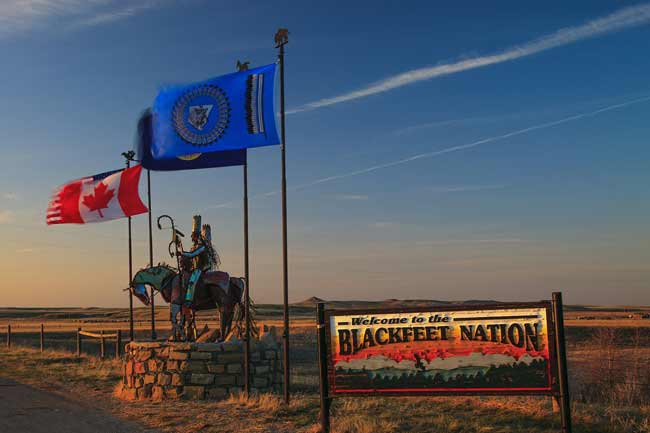
By Murray Foubister [CC BY-SA 2.0], via Wikimedia Commons
January 25, 2018; The Conversation

As Annie Belcourt, an associate professor in public health at the University of Montana, notes, the differences between public health in the US and in the American Indian nations first became clear to her while she was pursuing her doctoral degree in clinical psychology in the 1990s.

Belcourt, a member of the Blackfeet Nation who grew up on the reservation in Montana, writes,

As each year of school unfolded, I lost family members due to early causes of death, including homicide, suicide, motor vehicle accidents, cancer and pneumonia. I had to drive over four hours to the nearest Indian Health Service [IHS] provider for prenatal visits for my children and nearly lost one child due to lack of access to proper medical care.

The IHS, a federal agency that, like many, has faced recent threats of cutbacks, documents the gap in health outcomes. Though outcomes in some areas of American Indian health have improved—for example, infant mortality fell by two-thirds between 1974 and 2009—health disparities remain high. According to the Journal of the American Medical Association, American Indians in the 637 counties where the Indian Health Service works (and where 64 percent of all American Indians live) can expect to have a “6.4- to 8-year decrease in life expectancy compared with whites” in the same service areas. The same report found that “all-cause mortality” was 46 percent higher for American Indians than among whites.

In the state of Montana, where Belcourt lives and where American Indians make up about six percent of residents, the numbers are even more dramatic. A 2013 state public health department report found that on average, American Indians live nearly 20 fewer years than whites. According to the report, the average age at death for white men is 75 years and for white women is 82 years; in contrast, for American Indians, the average age at death for men is 56 years and for women, 62 years.

Sign up for our free newsletters

Subscribe to NPQ's newsletters to have our top stories delivered directly to your inbox.

By signing up, you agree to our privacy policy and terms of use, and to receive messages from NPQ and our partners.

The IHS has historically been inadequately funded. As Michelle Sarche and Paul Spicer, researchers at the University of Colorado–Denver, wrote in a 2009 journal article, “The IHS is so severely underfunded that it spends just $1,914 per patient per year compared with twice that amount ($3,803) that is spent on a federal prisoner in a year.” The result, as noted in a 2016 report issued by the Office of the Inspector General, is, as Belcourt writes, that “many American Indian patients receive health care that may be inadequate or of minimal quality.”

In response to federal shortfalls, American Indian communities are increasingly taking on more health equity work themselves. At the national level, leading actors include the National Council of Urban Indian Health, the National Indian Health Board, and the National Congress of American Indians. Belcourt adds, “The National Indian Health Board has a number of public health initiatives working to inform tribes on best practices in obesity, violence, suicide, and substance abuse prevention. The National Congress of American Indians advocates policies to improve health by engaging elected tribal leadership.”

At the local level, Belcourt notes, “Many tribal communities have even taken over the health care provision structure.” Measures taken including bringing back traditional healing methods, languages, and foods, and launching Native health initiatives around issues like tobacco use. “This revitalization is showing promise to improve health the entire family and community,” Belcourt says.

One example Belcourt cites is the Piegan Institute, a nonprofit that has promoted education that teaches the Blackfeet language and culture since 1987. More recently, in South Dakota, the Lakota-based Thunder Valley Community Development Corporation has developed similar programs. These efforts are important for public health, Belcourt says, because rebuilding culture is an important pathway to improving community resiliency and because tapping into indigenous healing helps address a shortfall of American Indian healthcare workers.

Some educational programs, Belcourt notes, are working to increase the number of American Indian health professionals, researchers, and educators. Belcourt herself is among the growing group of those working “in public health to help [American Indian] communities explore potential solutions to the many challenges [they] collectively face.”—Steve Dubb


Our Voices Are Our Power.

Journalism, nonprofits, and multiracial democracy are under attack. At NPQ, we fight back by sharing stories and essential insights from nonprofit leaders and workers—and we pay every contributor.

Can you help us protect nonprofit voices?

Your support keeps truth alive when it matters most.
Every single dollar makes a difference.

Donate now
logo logo logo logo logo
About the author
Steve Dubb

Steve Dubb is senior editor of economic justice at NPQ, where he writes articles (including NPQ’s Economy Remix column), moderates Remaking the Economy webinars, and works to cultivate voices from the field and help them reach a broader audience. In particular, he is always looking for stories that illustrate ways to build a more just economy—whether from the labor movement or from cooperatives and other forms of solidarity economy organizing—as well as articles that offer thoughtful and incisive critiques of capitalism. Prior to coming to NPQ in 2017, Steve worked with cooperatives and nonprofits for over two decades, including twelve years at The Democracy Collaborative and three years as executive director of NASCO (North American Students of Cooperation). In his work, Steve has authored, co-authored, and edited numerous reports; participated in and facilitated learning cohorts; designed community building strategies; and helped build the field of community wealth building. Most recently, Steve coedited (with Raymond Foxworth) Invisible No More: Voices from Native America (Island Press, 2023). Steve is also the lead author of Building Wealth: The Asset-Based Approach to Solving Social and Economic Problems (Aspen 2005) and coauthor (with Rita Hodges) of The Road Half Traveled: University Engagement at a Crossroads, published by MSU Press in 2012. In 2016, Steve curated and authored Conversations on Community Wealth Building, a collection of interviews of community builders that Steve had conducted over the previous decade.

More about: Health JusticeIndigenous CommunitiesNonprofit NewsPolicy
See comments

You might also like
How MediaJustice Is Leading Communities to Push Back Against AI Data Centers
Myaisha Hayes
Reclaiming the Spaces that Once Confined Women Against Their Will
Michelle Browder
Standing Up for Food Justice in a Time of Fear: Pandemic Reflections
Chase Louden
If Farm School NYC Closes, What Will the City Lose?
Farm School NYC and Iris M. Crawford
A Lakota Matriarch Offers Perspective on the Long Struggle for LandBack
Martell Hesketh
The Fight for Gender Recognition for Trans People in Southeast Asia
Trang Vũ

Upcoming Webinars

Group Created with Sketch.
December 9th, 2:00 pm ET

Nonprofit Safety & Security: Protecting Our People, Data, and Organizations in a Time of Unprecedented Threat

Register
Group Created with Sketch.
January 29th, 2:00 pm ET

Future is Collective

Register

    
You might also like
Protestors and Organizers march in Memphis to protest Big Tech’s rapid data center expansion across the country.
How MediaJustice Is Leading Communities to Push Back Against...
Myaisha Hayes
Illustration of three Black women wearing delicate crowns, sitting together in a verdant bush, wearing patterned dresses. A golden sun sets behind them.
Reclaiming the Spaces that Once Confined Women Against Their...
Michelle Browder
A purple tinted fist is raised against a brick wall background.
Standing Up for Food Justice in a Time of Fear: Pandemic...
Chase Louden

Like what you see?

Subscribe to the NPQ newsletter to have our top stories delivered directly to your inbox.

See our newsletters

By signing up, you agree to our privacy policy and terms of use, and to receive messages from NPQ and our partners.

  • About
  • Advertise
  • Careers
  • Contact
  • Copyright
  • Donate
  • Editorial Policy
  • Funders
  • Submissions

We are using cookies to give you the best experience on our website.


Nonprofit Quarterly | Civic News. Empowering Nonprofits. Advancing Justice.
Powered by  GDPR Cookie Compliance
Privacy Overview

This website uses cookies so that we can provide you with the best user experience possible. Cookie information is stored in your browser and performs functions such as recognising you when you return to our website and helping our team to understand which sections of the website you find most interesting and useful.

Strictly Necessary Cookies

Strictly Necessary Cookie should be enabled at all times so that we can save your preferences for cookie settings.