With the upcoming 250th anniversary of the founding of the United States, I am reminded of the two communities I am part of that long predate this country and have profoundly shaped its history. As an Indigenous trans person, I share a history with people who have faced torture, murder, and efforts at eradication solely based on their identities. Today, we are witnessing some of the darkest parts of this history repeating themselves and playing out in new ways. ICE agents mirror slave patrols while detention centers function as concentration camps. The state is suppressing dissent and enacting violence on civil rights and anti-war protestors. Black people are once again fighting for their right to vote. And the federal government is trying to force trans people underground by denying their existence.
Despite the many ways this country feels like it’s slipping backwards, it is imperative to remember that Indigenous and trans histories have always been rooted in resistance and rebellion. Over time, we have built networks of care that have shaped this country into a place of belonging and opportunity; a place that can begin to live up to the democratic ideals in the founding principles being celebrated this July.
The founding documents being touted this 250th anniversary mark when the United States of America was given its name—a name that erased Indigenous people’s long-held understanding of the earth we inhabit. Turtle Island is what many North American Indigenous communities use to describe the continent, but it also signifies the deep relationship we have with the natural world. Many of the freedoms we are fighting for today—such as the ability to migrate across borders, age with dignity, live in a clean environment, and celebrate gender diversity—existed before settlers and colonizers arrived.
A strict gender binary is also a colonial idea, imposed upon Indigenous communities by Western European colonizers. Before White people landed on Turtle Island, many native cultures in the United States, such as the Diné, Ojibwe, and Sioux people, recognized gender identities that weren’t determined by a person’s physiology, but rather their own individual sense of who they were. Indigenous communities had different names and customs around this practice but adopted “Two-Spirit” is an English language umbrella word to describe a variety of traditional approaches to embracing people who would be considered gender non-conforming in colonial terms.
The founding documents being touted this 250th anniversary mark when The United States of America was given its name—a name that erased Indigenous people’s long-held understanding of the earth we inhabit.
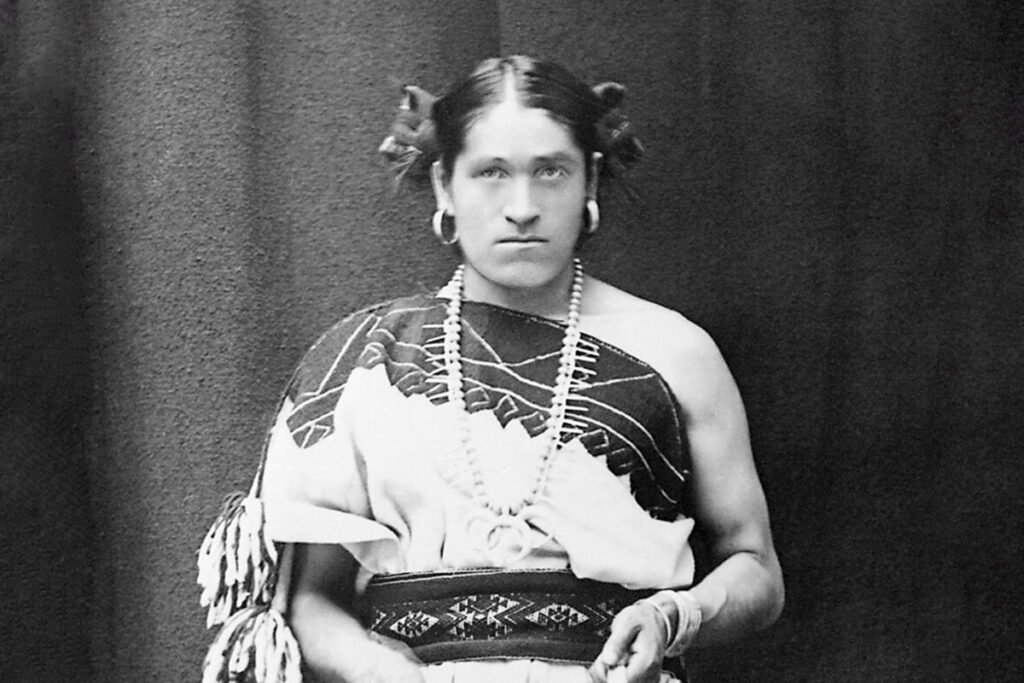
Native cultures not only accepted Two-Spirit people but also celebrated them. Their ability to access both feminine and masculine spirits was respected and revered. For example, We’wha was a celebrated Two-Spirit Zuni weaver and potter who went to Washington DC as an ambassador for Zuni culture to President Grover Cleveland in 1885. We’wha was received as a renowned female artist, which was groundbreaking because Indigenous women were a rare sight in the halls of power. We’wha hoped to leverage this attention to improve the relationship between the Zuni and the U.S. government, which exerted so much control over the health and wellbeing of their people.
Despite the efforts of Two-Spirit people like We’wha, the relationship between the government and our communities has continued to be strained, tested, and broken. The federal government has a long track record of violently stealing Indigenous land and isolating native children from their families and culture. Forced assimilation touched all aspects of life, from the food we ate, to our understanding of gender, to our relationship with the land and each other. In fact, what this milestone year evokes for me is how the government enacted violence against many for the freedom of a few.
Often, people speak of the founding of the United States as a time where White men came together and created a novel form of civil freedom. Yet, as is well known, what they forged was a form of freedom that worked for them on the condition that it kept others—Indigenous people, Black people, women, people with disabilities, and people in poverty—exploited. Our communities were unable to directly benefit from the fruits of our labor, were stripped of our freedom to make decisions for ourselves and our families, and left without representation or power to change the status quo.
Yet, from this country’s beginnings, people excluded from its founding definition of freedom—including trans people—have been speaking out and stepping up for their communities. This is the history that I want to celebrate.
These histories underlie how trans communities end up being at the forefront of cross-movement work.
Trans people have long advocated for laws and protections that recognize the civil rights of all marginalized communities. An early example is Frances Thompson, a formerly enslaved Black transgender woman who testified before Congress to protect the rights of Black people who were recently emancipated. Her testimony propelled political action during Reconstruction to give Black Americans rights to citizenship and political representation.
Sign up for our free newsletters
Subscribe to NPQ's newsletters to have our top stories delivered directly to your inbox.
By signing up, you agree to our privacy policy and terms of use, and to receive messages from NPQ and our partners.
Thompson’s work is an example of how trans identity does not preclude us from participating in other movements for social justice. Trans people are deeply familiar with the systemic exclusion and violence faced by many communities—including disabled, incarcerated, immigrant, Black, and Indigenous communities. We’ve had our bodies scrutinized and policed over how we look. We’ve had our movements and communications tracked and surveilled by the state. And we’ve been denied access to basic needs like food, housing, and healthcare.
These histories underlie how trans communities end up being at the forefront of cross-movement work. And there are many historical examples of trans leaders who did just that. They broke through movement silos to demonstrate the ways our liberation is intertwined. Lorena Borjas and Cecilia Gentili are two of those leaders. As immigrants themselves, both Lorena and Cecilia dedicated their lives to supporting trans migrants through their own political advocacy and providing material, medical, and legal support. Their work demonstrated their own deep and personal understanding of how the rights of immigrants, sex workers, and trans people are intertwined.
Marsha P. Johnson is another example of a cross-movement leader. While perhaps most famously known for her role in the Stonewall riots, she was also a fierce advocate for the disability community. Her vision of the future was one in which trans and disabled people would no longer be wrongly subjected to forced hospitalization and nonconsensual psychiatric treatment. Her advocacy for bodily autonomy and self-determination is still incredibly relevant today.
Every day I am inspired by these legends of our movement, and how they navigated life, often before legal rights and protections. Their legacies are how I hold onto hope for the future, knowing that the communities I come from have long been building spaces and cultures where every person can receive the care and belonging they deserve.
Even though, as an Indigenous trans person, this 250th anniversary feels to me more a memorial than a celebration—a reminder that we lost so much and so many as the result of colonization—there is much to be proud of.
Trans leaders today are carrying the legacy of our ancestors forward. This includes leaders across the South who, despite living in politically hostile states, are supporting trans communities where they are. Wendi Cooper provides direct services to women in New Orleans, particularly women who are Black, Brown, transgender, and who have been impacted by the carceral system. BIPOC trans leaders are spearheading organizations like the Transgender Education Network of Texas and Intransitive in Arkansas, which are building the infrastructure for trans communities to be resourced, engage in advocacy, and access spaces of collective care.
Reflecting on this legacy being carried forward, I believe our ancestors would be proud to see how we are returning to our roots. In this time of rising fascism, we are returning to a way of being in relation with one another that centers our shared humanity and material needs. I have visited states across the country where trans people are leading mutual aid efforts to keep their communities nourished and housed. I have seen neighbors out on every block protecting our immigrant siblings from being disappeared by ICE, organizers leading protests outside of detention centers, and entire communities rallying to stop war and genocide. We are fighting for freedom for those who were excluded from it during the founding of this country.
Even though, as an Indigenous trans person, this 250th anniversary feels to me more a memorial than a celebration—a reminder that we lost so much and so many as the result of colonization—there is much to be proud of. Every day I am reminded of my history. Of the people who refused to deny who they were, people who made a way out of no way, and who devoted their lives to making it better for those of us who came after them, no matter our identity.
Indigenous and trans people, and Indigenous trans people, are here. We are here caring for ourselves, each other, and everyone caught in the crosshairs of fascism. We are protecting immigrants, feeding the hungry, running for office, and so much more. As we celebrate what this country could be, let’s remember who has been leading the way.