

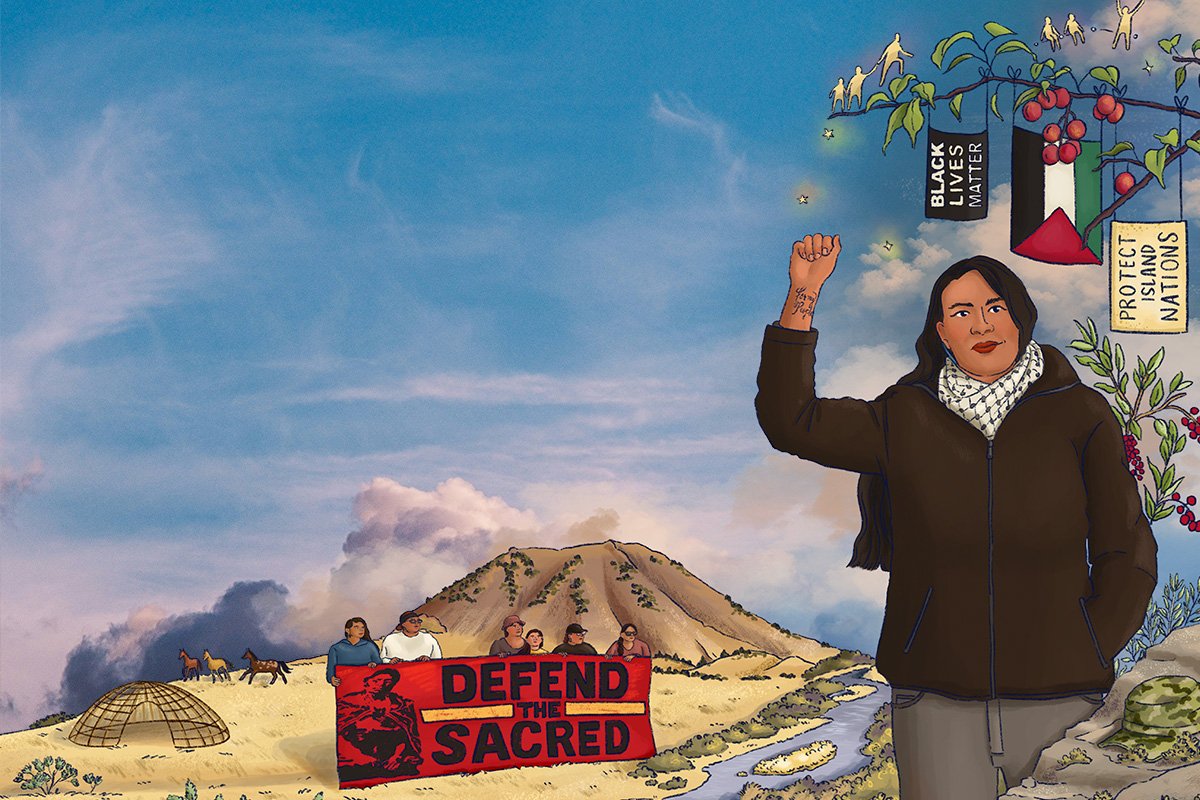
Whose Movement Is It, a series co-produced by NPQ and the Environmental Justice Oral History Project, is a call to action for those at the forefront of environmental justice decision-making, drawing on insights, hopes, and visions for the future from some of the foundational women organizers of the environmental justice movement.
What are the defining characteristics of islands? At their core, they are pieces of land surrounded by water—bounded, set apart, often isolated. The Northern Cheyenne reservation of southeastern Montana is sometimes described the same way, though it isn’t surrounded by water. For the Northern Cheyenne, isolation is not geographic; it is structural, built on decades of uneven access to resources, governance, and political power.
The reservation sits surrounded by strip mines, a coal-fired power plant, haulage railroads, and transmission lines. Krystal Two Bulls, Oglala Lakota and Northern Cheyenne, executive director of Honor the Earth and an organizer who grew up on the reservation, has described her frustration with industries capitalizing on the area’s coal reserves at the expense of its water supply. It’s an ongoing fight—one now complicated further by proposals to build a nuclear power plant that could contaminate the clean spring water the tribe’s way of life depends on.
When it comes to siting interstate pipelines and coal mines, most public attention goes to the federal government, understating the role states actually play. Federal decisions set the frame, but state decisions determine whether energy infrastructure siting amplifies distributional benefits or deepens existing harms. States have the power to tailor federal law—adapting its enforcement or exceeding what it requires. California, for instance, has mandated a 100 percent clean electricity grid by 2045, a standard well beyond anything the federal government requires. Standards like that demonstrate what states can do with authority they already have: shield their communities from destructive energy infrastructure and assert a degree of autonomy federal preemption doesn’t erase.
The power—and the choice not to use it
Section 401 of the Clean Water Act is one of the clearest examples: it lets states and authorized tribes block a federal permit that would worsen water quality through “discharge,” the release of hazardous or synthetic substances into the environment. Pipelines can leak drilling fluid, introduce sediment into waterways, and degrade water quality for years afterward. With EPA oversight, states or tribes can use Section 401 to restrict those pollutants before they enter the water supply. The federal government sets minimum standards for “Waters of the United States,” but states and tribes hold the authority to enforce their own, often stricter, standards—they can grant certification, deny it outright, or waive their right to review entirely.
Tribes like the Northern Cheyenne have secured Treatment as a State status, authorizing them to receive federal grants and manage water quality standards through their own environmental protection departments.
That authority matters more than ever as national energy policy swings back toward fossil fuel investment, and pressure mounts to fast-track oil and gas infrastructure. Tribes like the Northern Cheyenne have secured Treatment as a State status, authorizing them to receive federal grants and manage water quality standards through their own environmental protection departments. But even after that baseline is established, the decisions that follow—what gets approved, what gets built—fall to local governments and private developers, often producing prolonged legal fights over which frontline communities will absorb the consequences.
“Water is a necessity for all life. Water is life. Now is the time for all people from all walks of life to join together to stop the desecration and destruction of water, land and life!”—Red Warrior Camp and Camp of Sacred Stones Call to Action
Two pipelines, two outcomes
State and tribal governments are regularly forced to decide whether to challenge or approve major energy projects under intense political and economic pressure. Two case studies, the Dakota Access Pipeline and the Atlantic Coast Pipeline, show how differently that decision can play out.
Sign up for our free newsletters
Subscribe to NPQ's newsletters to have our top stories delivered directly to your inbox.
By signing up, you agree to our privacy policy and terms of use, and to receive messages from NPQ and our partners.
The Dakota Access Pipeline became one of the defining fights of the #NoDAPL movement after the Standing Rock Sioux Tribe challenged its construction near the Missouri River, the tribe’s main source of drinking water. Thousands gathered at the construction site in protest, among them Krystal Two Bulls, who traveled to Standing Rock as a water protector before her work with Honor the Earth and has spoken about how that fight shaped her understanding of what tribes are up against when a state and a pipeline company both decide a project is going forward regardless of tribal objection. State regulators approved a key section of the pipeline’s path in 2016, and construction proceeded; the pipeline began operating in June 2017. In the end, state and federal approval overrode the tribe’s claims under the Clean Water Act, and the community’s ability to protect its own water resources gave way to the project moving forward.
“Water is a necessity for all life. Water is life. Now is the time for all people from all walks of life to join together to stop the desecration and destruction of water, land and life!”
The Atlantic Coast Pipeline tells a different story. Originally proposed to run through West Virginia, Virginia, and North Carolina, the project would have cut through Robeson County, home to the Lumbee Tribe, the largest tribe in North Carolina. Donna Chavis, a Lumbee elder who led the campaign against the pipeline as senior fossil fuels campaigner for Friends of the Earth, spent years organizing alongside the Lumbee and Tuscarora communities and building the sustained local opposition that ultimately gave state regulators the political cover—and the evidentiary record—to act. The project ran into Section 401 water quality certification requirements in both Virginia and North Carolina; state agencies flagged the project’s impact on water quality, and on July 5, 2020, Dominion Energy and Duke Energy cancelled the pipeline outright. It’s an often-overlooked precedent, and one Chavis’s own organizing helped write: The Clean Water Act gave two state governments the power to stop a multibillion-dollar project before it broke ground, when years of community pressure gave them a reason to use it.
That’s the catch: Section 401 only works if states and tribes actually use it, and often they don’t. Some waive certification because they lack the staff to review the volume of nationwide permits the Army Corps of Engineers processes for pipelines and infrastructure projects, an administrative bottleneck that ultimately lands on the communities in the pipeline’s path. Others decline to invoke it because fighting a pipeline company feels like a fight they’ll lose regardless. But Section 401 is not symbolic. Treating it as a procedural rubber stamp rather than a substantive safeguard is itself a form of exclusionary governance—one that produces the same outcome as never having the authority in the first place.
What needs to happen
The Dakota Access Pipeline shows what happens when state deference outweighs scrutiny. The Atlantic Coast Pipeline shows what happens when states take their authority seriously enough to use it. There are three important lessons here. First, state environmental agencies need to stop defaulting to waived review. If a pipeline seeks to cross a state’s waters, the burden should be on the company to prove it won’t cause harm, not on residents to prove that it will. Second, Tribal nations with Treatment as a State status need the funding and political backing to actually exercise it. State governments should consult tribal governments and support their decisions; communities like the Northern Cheyenne shouldn’t have to fight alone. And third, individuals need to show up. Public opinion moves state legislators, and pipeline companies are counting on residents being too exhausted, too busy, or too discouraged to organize.
The Atlantic Coast Pipeline proves that assumption wrong: When states use their authority, they can stop projects backed by billions of dollars, for the benefit of the people who would have paid the price.
These avenues matter more now than they have in years. The country is leaning further into fossil fuel investment and pulling back from renewables, and pipeline projects paused under past administrations, including Keystone XL, are back in motion at President Trump’s direction. If states and tribes stay passive, the Dakota Access story repeats itself, with marginalized communities absorbing the environmental and public health costs of infrastructure built through their land.
The Clean Water Act gives states and tribes real tools to build an energy landscape that works for both the people who live there and the land itself. From air quality standards to energy siting review, states and tribes hold more power than is often acknowledged—the fossil fuel industry is simply counting on inaction, exhaustion, and the assumption that local governments will waive their rights rather than use them. The Atlantic Coast Pipeline proves that assumption wrong: When states use their authority, they can stop projects backed by billions of dollars, for the benefit of the people who would have paid the price.
The question that remains is whether state governments have the courage, capacity, and public backing to use the power already delegated to them.