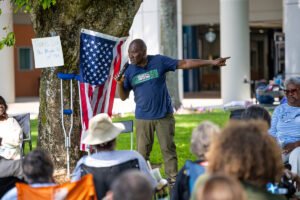
It is one of the hottest summers on record in Washington, DC, and there’s no reprieve from the sticky, stagnant air that greets us outside. Fans in hand, many of us in cultural attire, myself in an áo dài, we make our way into the Cannon House Office Building. In the month of our country’s 250 celebration, our group carried our love for our Southeast Asian American (SEAA) communities into meetings with lawmakers in congressional offices.
As executive director of the Southeast Asia Resource Action Center, or SEARAC, I have been a part of advocacy efforts for data disaggregation for many years. Part of that advocacy involves bringing people together on the Hill—a place that doesn’t regularly see groups like ours—and visibly demonstrating our community’s collective power.
This year, our advocacy around data disaggregation holds an added sense of urgency. Its significance has only grown amid a federal landscape that has become increasingly hostile to the communities it is meant to serve, dismantling policies and programs that for decades have supported our communities.
Disaggregating the racial and ethnic data collection and reporting of SEAA populations across all federal agencies has remained a cornerstone civil rights issue for our broader AANHPI communities for over 30 years.
Funding for bilingual education and interpretation services, for example, has been slashed, making it harder for families with limited English proficiency to navigate schools and advocate for their children. College access programs that helped first-generation students attain their degrees, now face ongoing attacks and deep funding cuts. Institutions that serve large numbers of Asian American Native Hawaiian and Pacific Islander (AANHPI) students have lost critical federal support, threatening services that many SEAAs rely on to overcome systemic barriers to educational success. And despite everything that is at stake, efforts to acknowledge racial and ethnic disparities have also come under attack.
Data Equity and Community Visibility
Our SEAA communities are incredibly diverse, encompassing more than 3 million people in the United States, which includes more than 15 distinct ethnic groups and dialects. Many fled war, violence, and persecution in the aftermath of the Secret War in Laos, the Khmer Rouge genocide in Cambodia, and the Vietnam War, and were resettled in underresourced neighborhoods in this country. As a result, SEAAs face challenges that are unique from other communities in the Asian American, Native Hawaiian, and Pacific Islander diaspora. When we are lumped under one checkbox labeled “Asian American,” our needs are often erased, our stories go untold.
The data paint a picture of a thriving Asian American monolith when in truth, SEAA communities have long endured systemic inequities across economic opportunity, education, health, immigration, and other critical aspects of well-being.
Data disaggregation has always been about something bigger: data equity and community visibility.
For example, while 9 percent of Asian Americans live below the poverty level, that percentage increases to 12 percent for Hmong communities, 12.1 percent for Cambodians, 10.4 percent for Laotians, and 11.5 percent for Vietnamese. Roughly 31.8 percent of Vietnamese workers and 30.2 percent of Hmong workers receive, on average, less than $17 per hour on wages, along with 28.2 percent of Laotian workers and 27 percent of Cambodians and Mien. This rate drops to 13.4 percent for Taiwanese workers and 15.7 percent for Asian Indians.
When data are reported by ethnicity rather than as one broad Asian category, policymakers and institutions can pinpoint, for example, where AANHPI students face barriers, compared to SEAA communities, which must navigate lower college enrollment and completion rates. When compared not just to the general population, but to the broader Asian category, 12 percent of Asian American adults ages 25 and older have not finished high school; however, that number jumps to 33 percent for Mien, 28 percent for Cambodians, 25 percent for Laotians, 24 percent for Vietnamese, and 19 percent for Hmong communities. This type of data disaggregation can help identify which families face higher rates of poverty and lower wages, disparities in chronic disease and mental health outcomes, and gaps in educational, economic, and investment support.
As such, disaggregating the racial and ethnic data collection and reporting of SEAA populations across all federal agencies has remained a cornerstone civil rights issue for our broader AANHPI communities for over 30 years.
For SEARAC, data disaggregation has always been about something bigger: data equity and community visibility. The data allow us to support policies based on community-specific needs rather than misleading statistics.
The 2020 Census, for example, was a pivotal moment for SEAA communities. Despite the US Census Bureau misclassifying Hmong in its coding as East Asian rather than Southeast Asian, the agency was able to, for the first time, collect and report population data for the Iu Mien, Lahu, and Tai Dam communities. Those populations have been living in the United States for over 50 years with no government data until the 2020 Census data was made available to the public. However, recent census collection still excluded many other SEAA populations, such as the Montagnard indigenous communities.
Sign up for our free newsletters
Subscribe to NPQ's newsletters to have our top stories delivered directly to your inbox.
By signing up, you agree to our privacy policy and terms of use, and to receive messages from NPQ and our partners.
Nevertheless, the Census Bureau’s collection and reporting is not reflected in our federal government as a whole; most federal data collection and reporting remain vastly insufficient. When they go beyond the Asian category, they often only focus on the six most populous Asian communities: Chinese, Asian Indian, Filipino, Vietnamese, Korean, and Japanese.
For example, the federal Integrated Postsecondary Education Data System (IPEDS) that collects and maintains data on postsecondary enrollment and program completion, does not collect or report disaggregated racial/ethnic data, and only reports out on aggregated “Asian” and “Native Hawaiian or Pacific Islander” student data.
In 2024, however, the US Office of Management and Budget updated its Statistical Policy Directive 15 (SPD 15), requiring the collection and reporting of the six most populous populations (Asian, Native Hawaiian, or Pacific Islander, etc.), as well as allowing for write-in options, with Hmong listed as an example. Because systems like IPEDS follow this standard, this means that we would finally see some granular racial/ethnic data about the postsecondary outcomes of our students.
This approach, including the usage of a write-in option with examples, has already proven effective in the Census Bureau’s data collection and reporting and has contributed to the more robust and detailed AANHPI census data we have today. SEARAC was one of the key voices that continuously met with the Census Bureau’s staff to include a write-in option and include both Hmong and Cambodian as examples.
Implementation of the updated SPD 15 across the federal government agencies has been delayed by one more year, however, which could slow progress toward data equity and community visibility for SEAA communities.
Most federal data collection and reporting remain vastly insufficient. When they go beyond the Asian category, they often only focus on the six most populous Asian communities: Chinese, Asian Indian, Filipino, Vietnamese, Korean, and Japanese.
Bringing Southeast Asian American Leaders to the Capital
SEARAC’s push for better data is not new. Rather, it builds on decades of advocacy to advance data equity for SEAA communities.
Since 2015, we have advocated for the All Students Count Act, a bill that would require more detailed reporting of AANHPI student data in K-12 schools. Although the standalone legislation did not become law in 2015, its introduction resulted in the addition of technical assistance language within the Every Student Succeeds Act (ESSA) enacted later that year and resulted in guidance from the Department of Education on collecting and reporting disaggregated racial data. The All Students Count Act was reintroduced in the Senate in May of 2026.
Our advocacy also helped advance the infrastructure needed to make the implementation of data disaggregation possible. In 2016, SEARAC worked with the Department of Education’s Office of English Language Acquisition on its launch of the Asian American and Pacific Islander Data Disaggregation Initiative (D2), a discretionary grant program designed to help states collect and evaluate data on AANHPI English learner students. The initiative awarded grants to three states—Hawaii, Minnesota, and Washington—to develop and strengthen AANHPI student data disaggregation efforts.
These policy gains are part of SEARAC’s mission to center SEAAs as leaders in shaping change. For example, I had the privilege of experiencing 14 advocacy days in the halls of Congress this July with participants of our annual Leadership and Advocacy Training (LAT) program, which brought a cohort of 23 leaders. Over 27 years, LAT has equipped more than 1,400 SEAAs, including myself, and allies with the skills to turn their lived experience into action for their communities.
Our efforts are part of a broader civil rights movement advocating for more granular federal data, including data disaggregated by race, disability, and gender—to better understand and address inequities across communities.
For a few hours this sweltering summer, our collective power was impossible to miss. We showed that the legacy of our SEAA communities’ 50-year history in the United States is not only part of the Southeast Asian American story but a part of the US story as well. Participants successfully urged their elected officials to support legislation like the All Students Count Act and helped increase co-sponsors of the bill following these visits.
The challenge before us now is to ensure that after we’ve left Washington, our communities are visible in the decisions that will define the country’s next 250 years.