
Truth to Power is a regular series of conversations with writers about the promises and pitfalls of movements for social justice. From the roots of racial capitalism to the psychic toll of poverty, from resource wars to popular uprisings, the interviews in this column focus on how to write about the myriad causes of oppression and the organized desire for a better world.
This interview has been edited for length and clarity.
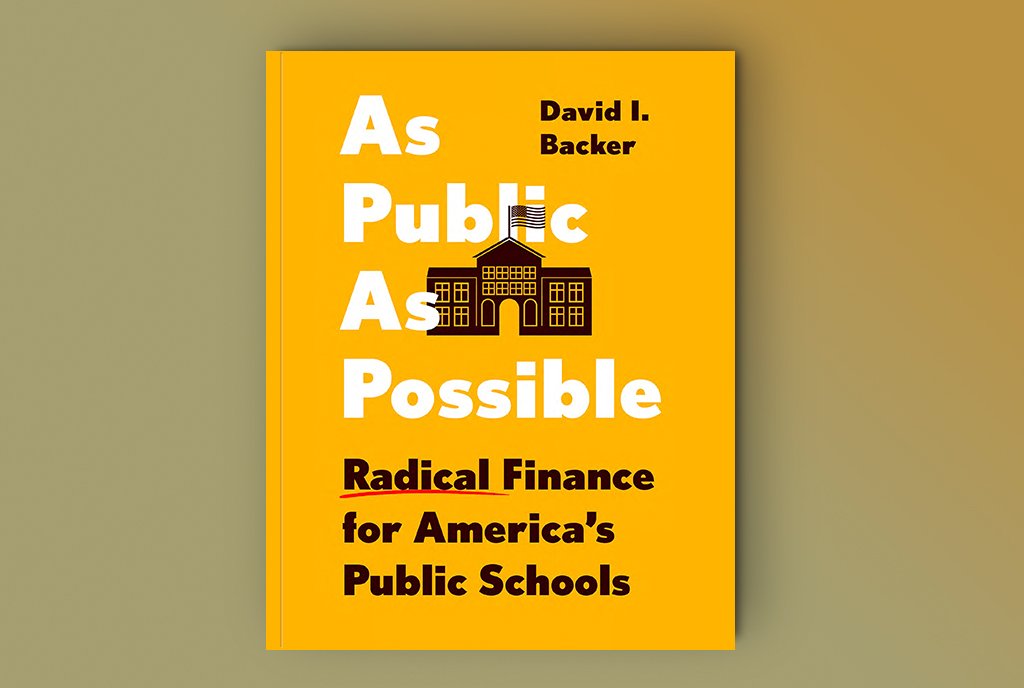
The beginnings of As Public as Possible: Radical Finance for America’s Public Schools took shape in 2020 when Backer launched his Substack newsletter, “Schooling in a Socialist America.” The quieting of the world gave Backer the opportunity to dive into the world of finance and economics where he realized that the language of finance was purposefully exclusive. Backer then committed to writing every week about the intersection of public education and finance, translating those systems into something more accessible.
After about three years of writing, a colleague connected Backer to an editor at The New Press. Pulling upon years of accumulated reporting and analysis, As Public as Possible gave Backer the chance to organize those ideas into a coherent framework, that would provide educators, parents, advocates and lawmakers an opportunity to understand how public school education and economics—seemingly disconnected issues—fit together.
ICM: Early in your book, you use West Contra Costa Unified School District, an area in Northern California, as a case study to illustrate how school finance is interwoven with other existing structures and mechanisms such as property values and the lasting impacts of segregation. Why was it important to begin there?
DB: It illustrates two very different ways of thinking about school finance.
The dominant, technocratic approach asks what the district did wrong. It assumes financial problems stem from poor management, so the solution becomes firing staff, cutting programs, closing schools, or weakening teachers’ unions.
I think that’s fundamentally backwards.
West Contra Costa exists within structures it didn’t create: racialized property markets, deindustrialization, segregation, and long-standing economic inequality. Those forces shape the district’s finances long before local administrators make a single budgeting decision.
Too often, policy discussions ignore those structural realities and instead blame districts for conditions beyond their control.
The district didn’t choose its property values any more than it chose to stand nearby wealthier community school districts like Orinda, Piedmont, or Pleasanton. Yet those differences profoundly shape educational opportunity.
One example is the state’s intervention during the early 1990s. California stepped in through the country’s first school district receivership, offering financial assistance while imposing steep interest rates on the loans used to stabilize the district.
The usual story focuses on whether district leaders managed the crisis well. What gets left out is that residents organized. Community members marched from West Contra Costa to Sacramento, staged a month-long hunger strike, and ultimately convinced state lawmakers to reduce the loan’s interest rate dramatically.
That’s the story I’m interested in.
The technocratic narrative assumes districts have complete control over their finances while ignoring the broader economic forces surrounding them. I argue almost the opposite. Districts have very little control over housing markets, state policy, or corporate decisions—but communities do have agency through organizing and political action. Those stories deserve to be at the center of how we understand school finance.
ICM: One idea that stood out was your argument that “inequity” is too passive a way to describe these systems.
DB: That’s exactly why I prefer the language of theft.
Pulling on Esther Cyna’s work on the kleptocracy of school finance, I discuss a 1970s debate in Halifax County, North Carolina, over how local tax revenues should be distributed among school districts.
The language of theft forces us to ask who made those decisions, who benefited, and who lost. Once you can answer those questions, you can also begin thinking about how the system might change.
Wealthier, predominantly White districts successfully pushed for an ad valorem system that directed more resources to communities with higher property values, while larger, more diverse working-class districts argued for a per-capita distribution that reflected equitable resource distribution based on population.
The wealthier districts organized, won the political fight, and claimed a larger share of public resources.
Calling that “inequity” makes it sound accidental—as though the system simply drifted out of balance. But people made deliberate choices that benefited some communities at the expense of others.
The language of theft forces us to ask who made those decisions, who benefited, and who lost. Once you can answer those questions, you can also begin thinking about how the system might change.
ICM: That reminds me of current debates around teachers. We often blame individual educators and schools for problems that seem rooted in underfunding—whether it’s paying for classroom supplies themselves or being penalized for taking leave after having a child.
DB: A few years ago, there was a viral promotion at a South Dakota hockey game where teachers raced across the ice to grab cash for their classrooms. It was intended as entertainment, but it became an unintentionally powerful image of chronic underfunding.
When schools lack adequate resources, we end up asking teachers to absorb the consequences personally. Then, when they struggle or leave the profession, we blame them instead of examining the conditions that produced the problem.
Experienced teachers become better educators over time and get to better understand the communities they serve. Policies that make it harder for them to remain in the classroom ultimately hurt students as much as teachers.
ICM: I deeply appreciated that you highlighted the Minnesota Miracle and the Fiscal Disparities Act as one of the most promising alternatives that got school districts and communities the resources they deserve. What makes it so significant?
DB: Whenever people ask what school finance could look like, this is one of the first examples I mention.
The basic idea is simple. It started with the Citizens League, whose advocacy pushed to solve the economic challenges that the state was facing. A school board member and municipal bond dealer brought a revolutionary idea to Paul Gilje, who led the Citizen’s League. The league worked with [Governor] Wendell Anderson, to deliver the Minnesota Miracle aka to the Fiscal Disparities Act. Instead of allowing every municipality to keep all the gains from rising commercial and industrial property values, the Twin Cities region pools 40 percent of that growth and redistributes it to communities whose tax bases have grown more slowly.
It’s still a locally governed system, but it recognizes that neighboring communities share the same regional economy and should be able to reap benefits too. That’s what makes it so innovative. Rather than treating municipalities as isolated competitors, it acknowledges that prosperity is interconnected.
The policy isn’t perfect, and I’d support even greater redistribution. But as a practical reform, it’s been remarkably successful. Since its adoption in 1971, it’s reduced disparities in local tax-base wealth by roughly 20 percent. It passed the Minnesota Senate by a single vote, which is why it became known as the “Minnesota Miracle.”
ICM: Why hasn’t the Minnesota miracle model spread elsewhere?
DB: Timing has a lot to do with it.
Some states explored similar ideas, but politically the country moved in the opposite direction. As neoliberalism became more influential, the emphasis shifted toward competition, local responsibility, and individualism grew rather than regional sharing.
Sign up for our free newsletters
Subscribe to NPQ's newsletters to have our top stories delivered directly to your inbox.
By signing up, you agree to our privacy policy and terms of use, and to receive messages from NPQ and our partners.
I recently revisited William Fischel’s The Homevoter Hypothesis, which argues that homeowners often vote based on how they believe decisions will affect their property values. This captures something important about how local politics often works.
On average, school districts spend between 8 and 10 percent of their annual budgets servicing debt. That’s a significant share of every education dollar going toward repaying loans rather than directly supporting students.
Interestingly, he dismisses tax-base sharing as an idea that shouldn’t be pursued. That, to me, says a great deal about the assumptions that have shaped school finance for the past several decades.
I also think school finance remains unnecessarily opaque. Many people assume it’s too technical to understand, which makes it difficult to imagine alternatives. Part of what I hope my book does is show that these systems aren’t inevitable. They were created through political choices, which means they can also be changed through political choices.
ICM: One thing your book helped me understand was the role of the municipal bond market. It’s not something most people think about when they think about public education. How does the bond market shape what happens in schools?
DB: On average, school districts spend between eight and 10 percent of their annual budgets servicing debt. That’s a significant share of every education dollar going toward repaying loans rather than directly supporting students.
Those loans exist because districts regularly face major capital expenses that can’t be covered through their operating budgets. Building a new school, repairing aging facilities, upgrading technology after a cyberattack, or responding to unexpected legal settlements all require large amounts of money upfront.
Like households taking out a mortgage, school districts have to borrow.
In the United States, they do that through the municipal bond market. Districts issue bonds, investors purchase them, and districts repay the principal with interest over many years.
This isn’t a recent development—school districts have been borrowing this way since the nineteenth century—but it has enormous consequences for how public education operates today.
Beyond the cost itself, borrowing changes the incentives for school leaders.
Districts depend on strong credit ratings to keep future borrowing affordable. If those ratings decline, financing becomes more expensive, which means administrators are under constant pressure to reassure financial markets that they’ll always repay their debts.
That creates a hierarchy of priorities. If budgets tighten, districts can lay off teachers, eliminate programs, or postpone services—but they can’t simply stop paying bondholders.
That’s where the financial system begins to shape educational decisions.
That means the same financial institutions helping school districts build schools and repair facilities are also helping finance the industry that produces many of the weapons used in school shootings today.
ICM: And that’s where you make the connection to the gun industry.
DB: The same major banks that underwrite municipal bonds for school districts—institutions like JPMorgan Chase, Wells Fargo, Citibank, and Morgan Stanley—also provide financing to many other industries, including firearms manufacturers.
After the 2018 shooting in Parkland, Florida, activists pressured banks to stop lending to gun companies. Some institutions publicly suggested they would limit those relationships.
But then Texas, which has one of the country’s largest municipal bond markets, required banks seeking state bond business to certify that they did not discriminate against the firearms industry.
Faced with the prospect of losing billions of dollars in municipal bond business, major banks reaffirmed their willingness to finance gun manufacturers.
That means the same financial institutions helping school districts build schools and repair facilities are also helping finance the industry that produces many of the weapons used in school shootings today.
After the Uvalde shooting, I argued that this creates a self-reinforcing cycle in which the same flows of capital finance both school infrastructure and the firearms industry.
This is a danger to your kids and society. If we want to rethink school safety, we also have to rethink the financial systems that connect these institutions in the first place.
ICM: Toward the end of the book, you point to green banks as one possible alternative. Given all the discussion around the Inflation Reduction Act and clean-energy investments, how do you see green banks fitting into the future of public education?
DB: Green banks are one of the ideas I’m most optimistic about. I sometimes describe them as the reverse of charter schools. Charter schools move public money into private management. Green banks move private capital toward public purposes for the common good.
Green banks create financing for projects that traditional lenders often overlook—particularly energy-efficient public infrastructure—and help public institutions access that capital on better terms. For schools, that opens up some exciting possibilities.
School buildings are among the largest sources of public-sector emissions, yet they’re also the places preparing students for the future. That’s the contradiction I describe in the book as the problem of educational power.
Green banks offer a way to finance cleaner school buildings while reducing dependence on the traditional municipal bond market.
One of the most promising examples is the Connecticut Green Bank, which estimates that every public dollar it receives can attract roughly six dollars in private investment. That kind of leverage makes public funding go much further.
Pension funds have an important role to play. Public pensions represent enormous pools of collectively owned retirement savings. Historically, pension funds invested heavily in public infrastructure through municipal bonds—a practice sometimes called fiscal mutualism.
I think we can build on that history by connecting pension capital with green banks to finance school modernization and decarbonization.
In the book, I call that idea “green fiscal mutualism.”
The Inflation Reduction Act moved in that direction by creating the Greenhouse Gas Reduction Fund, a $27 billion investment designed to capitalize green banks across the country.
Those funds are intended to attract even more private investment into public infrastructure.
Whether those programs ultimately fulfill their promise remains to be seen, but I think they point toward a different political economy—one where public institutions rely less on traditional financial markets and more on democratic investment in shared infrastructure.