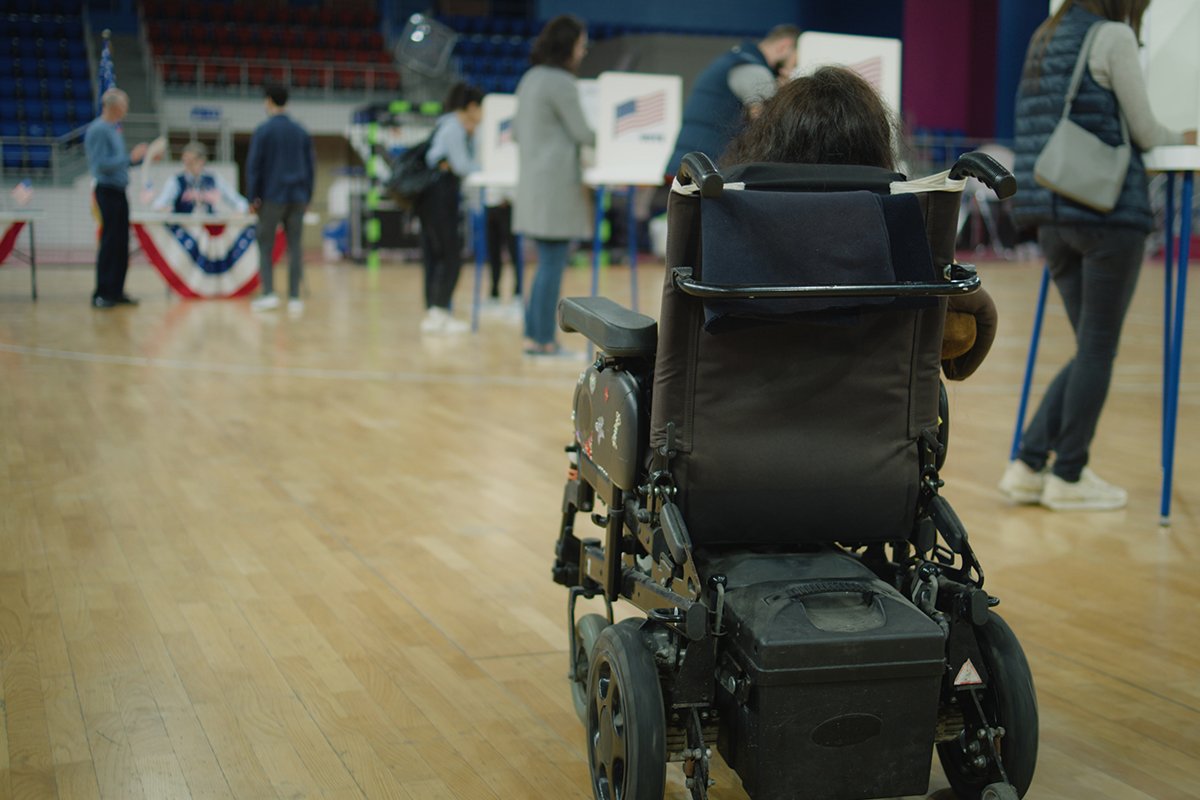
During Michigan’s 2025 elections, dozens of auditors fanned out across the state, visiting more than 400 polling locations to determine whether disabled voters could likely cast their ballots independently.
At first glance, the results seem grim: Only 10 percent of the Election Day polling locations assessed met basic accessibility standards. That means it could be difficult or impossible for the one in three adult Michiganders who are disabled to exercise their right to vote. Last year’s audit in Michigan likely reflects a nationwide trend. When the last nationwide audit was conducted almost a decade ago, it found that 83 percent of polling locations were inaccessible.
“We want to help [polling locations] do better on this so that our voters can show up and successfully cast their ballots,” said Eric Welsby, advocacy director at Detroit Disability Power (DDP), the organization behind Michigan’s audit, the largest poll accessibility audit in the nation.
The right to vote is meant to be guaranteed to the more than one in four adults in the United States who are disabled under the Voting Rights Act of 1965, the Americans with Disabilities Act (ADA) of 1990, the Help America Vote Act of 2002, and state laws. However, without training for poll workers or enforcement by election officials, these protections can go unheeded. Boards of Elections can be sued for discriminating against disabled voters because of inaccessible polling sites or restrictive voting policies, but legal fights often take years to bring about change.
Only 10 percent of the Election Day polling locations assessed met basic accessibility standards.
DDP trains auditors and helps them get credentialed as election challengers, which gives them more freedom to move around a polling place than uncredentialed poll watchers.
Once on site, auditors complete a 24-question survey that measures polling locations against four legally required criteria: accessible parking and a clear pathway, an accessible entrance, a fully functional accessible voting machine, and a properly set-up wheelchair-height voting booth for marking a paper ballot privately and independently. Sites are labeled inaccessible if they have access barriers in any of the four categories. Some of the issues can be tough to address, such as steps to get into a polling site in a historic building exempt from certain accessibility requirements under the law or a parking lot that has begun to crack after one too many Michigan winters.
‘You don’t need to do major construction’
However, many of the access barriers identified in DDP’s audit are easy to address.
Even something as simple as improving signage to ensure voters can find a building’s accessible entrance could help some sites that failed the audit earn a passing score during the next election, according to DDP’s 2025 elections poll accessibility audit report.
The most common barriers found in last year’s audit were issues with accessible voting machines. These machines offer multiple ways for blind and low-vision voters to mark their ballots without assistance, including ballots on-screen in a large font, an audio function, and a braille keyboard. Voters can also use the terminals with a sip-and-puff device if they cannot operate a touch screen or keyboard. Many sites failed their audits because their machine was not switched on, not oriented to ensure privacy, or without headphones.
“The [accessible voting machines] and the wheelchair height voting booth are something that really are fully in election workers’ power to fix,” Welsby said. “You don’t need a jackhammer. You don’t need to do major construction. It’s really about knowing how to have them set up, how to set them up properly, how to make sure a voter using those can cast their ballot independently and secretly.”
Even something as simple as improving signage to ensure voters can find a building’s accessible entrance could help some sites that failed the audit earn a passing score during the next election
To help polling sites make needed changes, DDP shares its audit results and works alongside local election officials. “We know that the audits and having real concrete issues to address makes it a lot easier for clerks to address those issues,” Welsby explained. “The real goal is to protect our people and make sure their rights are protected while also making sure clerks feel supported.”
Sign up for our free newsletters
Subscribe to NPQ's newsletters to have our top stories delivered directly to your inbox.
By signing up, you agree to our privacy policy and terms of use, and to receive messages from NPQ and our partners.
DDP began informally auditing polling place accessibility in 2018. Four years later, during the midterms, it formalized its audit program in partnership with The Carter Center. The organization audited 261 polling locations across Metro Detroit during that November election—then the largest poll audit in the nation’s history. In 2024 and 2025, it expanded its coverage to more polling locations, reaching a new record of 415 Election Day polling locations and 32 early voting sites statewide last year. The percentage of polling sites that passed the audit fell from 16 percent in 2022, to 13 percent in 2024, and 10 percent last year.
Welsby said that the declining number of accessible sites in DDP’s audits reflects the audit’s growing sample size and that many of the polling sites the organization visited in earlier audits have made improvements. This election cycle, he expects auditors to assess around 700 sites of the state’s roughly 5,000 polling locations. DDP will publish the results of the audit early next year.
“Voter education means little if a voter can’t actually get through the doors to use any of the voter resources that are available to them.”
Nonprofits in New York, Georgia, Pennsylvania, Indiana, and Nebraska pick up the task
The organization has also built its poll accessibility audit program into a national effort through the National Polling Access Audit Coalition, a partnership with other organizations focused on training voting rights advocates nationwide to evaluate and improve polling place accessibility in their own communities.
This year, with support from the Carter Center and the American Association of People with Disabilities, the coalition launched the Voting Access Audit Fellowship to train five nonprofits on how to establish their own audit programs. The fellowship includes mentorship and funding to get local programs off the ground.
One of those new local programs is in Cobb County, Georgia, in the Atlanta Metropolitan area. Jacob Rogers, program coordinator at Vote Your Voice, an initiative of Cobb Collaborative, the local fellowship recipient, said his organization jumped at the chance to get involved because it saw how voter suppression was affecting marginalized community members and wanted to learn more about how to support disabled Georgians.
“Georgia has a long history of voter suppression, being the home of the civil rights movement here over in Atlanta,” he said. “We’re very familiar when it comes to these sorts of attempts [to undermine the right to vote].”
Southern states have some of the most restrictive voting laws in the nation, and many hit disabled people particularly hard. Georgia overhauled its election laws in 2021. Among other changes, the new law restricts access to absentee ballots and limits the use of ballot drop boxes—both things that can help make voting more accessible to many disabled people.
Now, the Trump administration is ramping up attacks on mail-in voting nationwide. Mail-in voting is more accessible for many disabled voters, including those with mobility-limiting disabilities and blind or low-vision voters. It also presents a safer option for many with compromised immune systems or those who care for aging family members who would otherwise need to wait in line at a polling location during flu season.
Rogers said Cobb Collaborative has trained a team of more than a dozen interns and volunteers who will audit at least 30 polling sites across the county during Georgia’s early voting period from October 13-30 and on Election Day. He said he is looking forward to scaling up in the future: “I want to continue this for all elections going forward and keep Cobb County accessible for everyone.”
The other nonprofits in this year’s Voting Access Audit Fellowship are Count US IN in Indiana, Keystone Progress Education Fund in Pennsylvania, Civic Nebraska, and the Metropolitan Asian Deaf Association in New York. Each is working alongside a DDP staff member and other mentors to develop strategies for producing a poll access audit that meets local requirements for poll monitoring and accounts for state election laws.
Rogers said that even before his new poll auditors visit their first sites, the mentorship his organization has received has already influenced its perspective on voter advocacy. “Voter education means little if a voter can’t actually get through the doors to use any of the voter resources that are available to them.”