In this column with NPQ, LandBack for the People, NDN Collective builds on their podcast of the same name, sharing stories from Turtle Island and beyond about Indigenous people organizing in community, advocating for social justice, and fighting for the return of Indigenous lands.
Content warning: This article contains some stories about harms committed at Indian Boarding Schools.
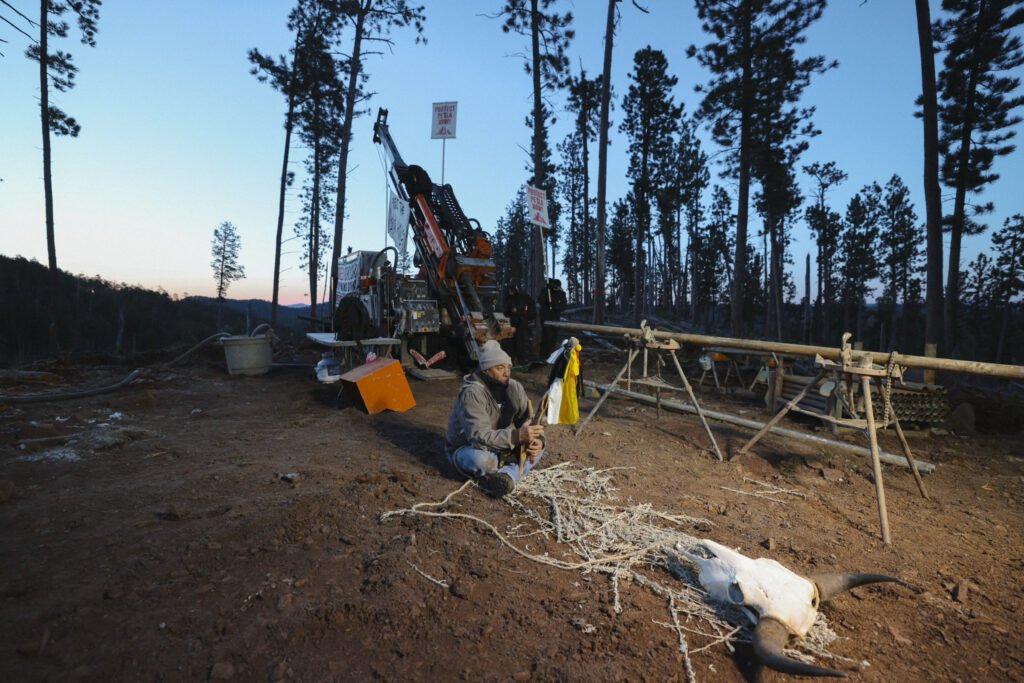
This spring season has brought about some hard-won victories for my Indigenous relatives in the Black Hills, from a successful action that resulted in a mining company withdrawing its permit at the sacred site Pe’Sla to the adjourning of a South Dakota Board of Minerals hearing, after they were served a lawsuit which left the approval of a uranium mine at the sacred site of Craven Canyon uncertain. These victories give me the hope necessary not only to move forward but also to heal from past harms inflicted upon our ancestors and our communities.
I was reminded of the episode of the NDN Collective’s LANDBACK for the People podcast, “Truth, Reconciliation, Healing & Boarding Schools.” It made me reflect on how much Indigenous people have endured, how much we have survived—and how we are still fighting for our land and people despite all the attempts to eradicate us.
On this show, Nick Tilsen, founder and CEO of NDN, and our guests got into the dark histories of the founding of the United States of America—the boarding school era. This was a period of time where the US government, systematically and strategically, using taxpayer dollars, established mandatory federal Indian boarding schools to operationalize their infamous policy of “Kill the Indian, save the man.”
“This was real, this happened, nobody is lying, this is the honest truth.”
Guests for the show included Charlee Brissette, Lacey Kinnart, and Jason Packineau from the National Native American Boarding School Healing Coalition (NABS). They spoke about how the coalition got started in 2011 with no budget and a single person, and how the need for healing and reckoning around boarding schools is so vast that they’ve grown to a staff of 25 since then.
Our guests shared that members of the coalition work on the boarding school issues from many angles—from working on the Truth and Healing Commission House Bill 7325 on boarding schools, to NABS’s Oral History Project, to archiving, to just providing space to witness survivors and have them tell their stories—some for the first time in their lives.
Packineau spoke about the Truth and Healing Commission bill, which is currently under consideration in the House, and seeks to investigate the government’s role in boarding school abuses and make recommendations toward accountability and healing. The vision the bill presents is deep truth-finding, recording and archiving, making stories and information readily available to tribal communities and the public at large. He shared that the recording and archiving is an important part of countering shame and stigma survivors might feel, and that it’s “a really big part of the healing process because it really just validates that this was real, this happened, nobody is lying, this is the honest truth.”
Sign up for our free newsletters
Subscribe to NPQ's newsletters to have our top stories delivered directly to your inbox.
By signing up, you agree to our privacy policy and terms of use, and to receive messages from NPQ and our partners.
“To be able to see him address the camera and address the audience directly was one of the most powerful things I think I’ve seen in my life.”
Kinnart recounted how NABS’s Oral History Project was born from former Secretary of Interior Deb Haaland’s creation of the Federal Indian Boarding School Initiative, shortly after the remains of 215 children were found buried in unmarked graves near the Kamloops Indian Residential School in Canada. Some of the children buried were as young as three years old. The school operated from the late 19th century to the late 1970s, first by the Catholic Church and later by the federal government. My own great-grandparents were forced to attend two of these schools in Alberta.
In many ways, the reckoning with US based boarding schools began all at once following the heartbreaking discovery at Kamloops. Kinnart said that “they make a joke that you can’t even buy a box of pens within 30 days, so the fact that [Secretary Haaland] created an initiative this big in 30 days was historic in and of itself.”
“It’s everybody’s history. It’s not just Indigenous history.”
After Secretary Haaland travelled to twelve places on her Road to Healing Tour, listening to survivors and descendants share their experiences with boarding schools in a public forum, her team realized they needed a more sustainable, more intimate container. They reached out to NABS and the Oral History Project was born with its goal to collect testimonies from survivors of US boarding schools.
Tilsen and Brissette recalled how the two of them collaborated to get an oral history interview with Native American activist Leonard Peltier after he was finally freed from federal prison. “To be able to be there for the interview and witness him sharing his stories—because he’s got so many stories—and to be able to see him address the camera and address the audience directly was one of the most powerful things I think I’ve seen in my life,” said Brissette, “He has such a strong message, and he has such a strong fire. And so to be able to be a part of that was just a huge honor.”
NABS’s team encouraged people to consider joining their coalition, emphasizing that this role is to not only be there as a survivor or a descendant, but also as an ally. As Brissette says, “It’s everybody’s history. It’s not just Indigenous history.” So the coalition is calling upon everyone to learn this history and pay attention to news about the Truth and Healing Commission bill, and be ready to stand alongside us and advocate for its passage.
To learn more about the work, donate, or sign up to share your story as a survivor or a descendant of a survivor, visit boardingschoolhealing.org.